Master of Science in Nursing – Adult-Gerontology Primary Care Nurse Practitioner class guide
The current Chamberlain path for Master of Science in Nursing – Adult-Gerontology Primary Care Nurse Practitioner: official sequence positions, class codes, credits, variant choices, and the complete program → class → verified week hierarchy.
Every numbered class in the selected official grid links to its Chamberlain course page. Compound identities such as UNIV-101A/B and the DNP practicum A/B/C variants stay on their real class pages rather than becoming phantom combined codes.
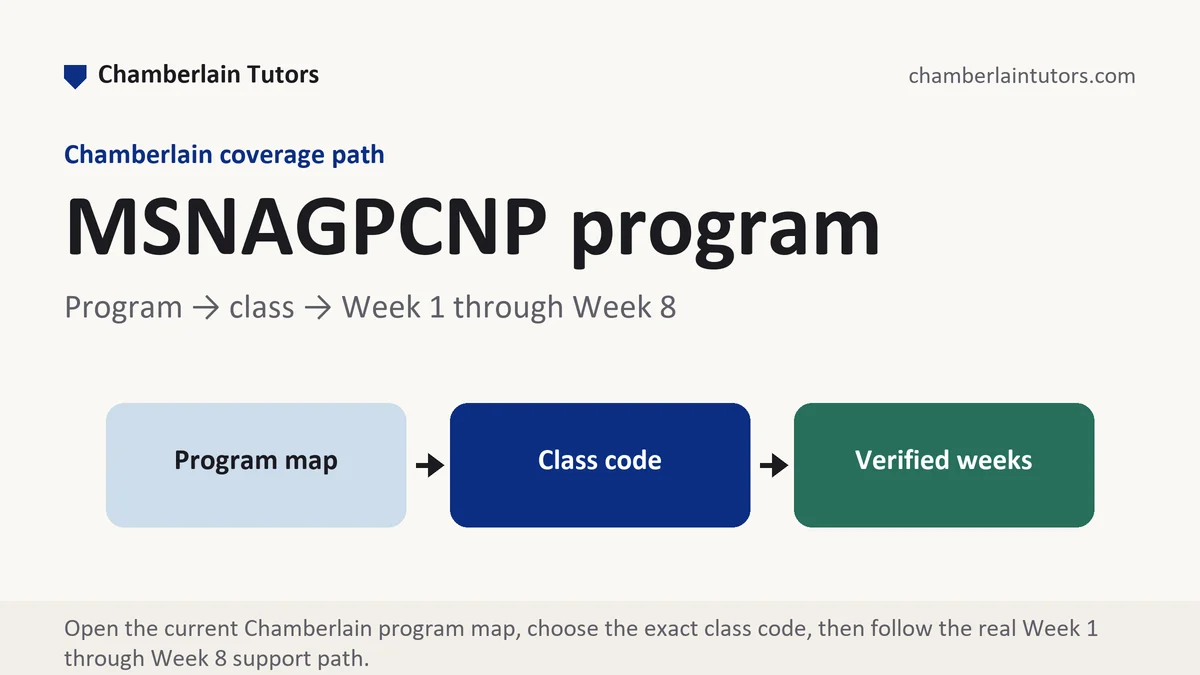
What this program map represents
The official curriculum publishes the shared MSN-NP core and specialty block separately; this page joins them without changing lab or clinical-hour requirements.
The map is a curriculum sequence, not a promise that every student will take every row in exactly the same order. Transfer evaluation, state rules, prerequisite clearance, elective choice, program availability, placement readiness, and approved plan changes can alter an individual schedule. The current student plan and catalog remain authoritative.
Chamberlain's calendar has 16-week semesters split into two 8-week sessions. That makes week the right deliverable unit inside a class, but it does not make each curriculum row an eight-week assignment list. Course pages publish Week 1, Week 2, and later manuals only when the real Canvas deliverable has been verified.
The classes, one by one
| Official sequence | Class code | Class title | Credits | Coverage |
|---|---|---|---|---|
| Year 1 – Semester 1 – Session I | NR-581NP | Foundational Concepts for Advanced Nursing Practice | 3 | Class guide linked |
| Year 1 – Semester 1 – Session II | NR-582NP | Leadership and Role Development for Advanced Nursing Practice | 3 | Class guide linked |
| Year 1 – Semester 2 – Session I | NR-583NP | Informatics for Advanced Nursing Practice | 3 | Class guide linked |
| Year 1 – Semester 2 – Session II | NR-584NP | Quality and Safety for Advanced Nursing Practice | 3 | Class guide linked |
| Year 1 – Semester 3 – Session I | NR-585NP | Research Methods and Evidence-Based Practice for Advanced Nursing Practice | 3 | Class guide linked |
| Year 1 – Semester 3 – Session II | NR-586NP | Population Health and Epidemiology for Advanced Nursing Practice | 3 | Class guide linked |
| Year 2 – Semester 1 – Session I | NR-507 | Advanced Pathophysiology | 3 | Class guide linked |
| Year 2 – Semester 1 – Session II | NR-565 | Advanced Pharmacology Fundamentals | 3 | Class guide linked |
| Year 2 – Semester 2 – Session I | NR-568 | Advanced Pharmacology for the Adult-Gerontology Primary Care Nurse Practitioner | 3 | Class guide linked |
| Year 2 – Semester 2 – Session II | NR-509 | Advanced Physical Assessment (25 Lab Hours) | 3 | Class guide linked |
| Year 2 – Semester 3 – Session I | NR-576 | Differential Diagnosis in Adult-Gerontology Primary Care (125 Clinical Hours) | 3 | Class guide linked |
| Year 2 – Semester 3 – Session II | NR-577 | Primary Care Management of Adolescents & Adults (125 Clinical Hours) | 3 | Class guide linked |
| Year 3 – Semester 1 – Session I | NR-578 | Primary Care Management of Older Adults (125 Clinical Hours) | 3 | Class guide linked |
| Year 3 – Semester 1 – Session II | NR-579 | Palliative Care in Adult-Gerontology Across the Spectrum (125 Clinical Hours) | 3 | Class guide linked |
| Year 3 – Semester 2 – Session I | NR-580 | Adult-Gerontology Primary Care Capstone & Intensive (125 Clinical Hours) | 3 | Class guide linked |
Turn the curriculum into a session plan
Start from the live registration record, then copy each active class code, session, current syllabus version, grading scale, core-versus-supplemental status, and known applied requirement into one board. A curriculum grid tells you where the class belongs; only Canvas tells you what Week 1 through Week 8 actually requires and when the Mountain Time deadline falls.
Build the session board in two lanes. The weekly coursework lane holds discussions, peer replies, papers, case work, simulations, presentations, quizzes, and other graded items. The applied lane holds clinical, practicum, field, clerkship, immersion, approval, logging, or project dependencies. Protect the second lane first because a missing clearance or real-world activity cannot be repaired by writing faster on Sunday.
For every graded deliverable, record its weight, rubric rows, due time, source needs, and next action. Keep the 76% core-assignment calculation separate where the syllabus uses it. A high supplemental score cannot rescue a core average that never clears the gate, and a passing written average cannot override an unsatisfactory required clinical or lab component.
The grading floor belongs to the class, not the program title
NP specialty and NP graduate-certificate courses use Chamberlain's no-C specialty scale: 0–83 is failing and the A band begins at 94. The current syllabus identifies which rows use that scale.
Use the current syllabus as the scale selector before making any grade forecast. Tag every item by grading bucket, enter earned and possible points, and calculate both the ordinary weighted grade and any gated core average. A useful forecast names the minimum remaining score by bucket; a single blended percentage can hide the exact rule that causes a course failure.
No curve, extra-credit assumption, or generic “C is passing” shortcut belongs in a Chamberlain plan. The correct target is the A band for the registered scale, with enough margin that one difficult week does not put progression rules in play. Where an NP specialty scale applies, below 84 is not a low passing grade—it is an F.
Program → class → week
This page is the program layer. Each linked code opens the class layer, where the course's evidence, writing, calculation, simulation, or professional reasoning is explained. When a real weekly deliverable has been verified, the class page opens a Week 1, Week 2, and onward manual with its own right rail. The manual is never inferred from an eight-week session calendar.
That separation keeps the network useful when curricula change. Program membership and sequence come from the official grid; class identity and description come from the catalog; weekly work comes from a verified deliverable source. If only the first two layers are public, the page says where verification stops.
Applied-work and student-responsibility boundary
This path includes applied, clinical, clerkship, practicum, field, or capstone work. The student completes the real activity, protects patient and client information, obtains every approval and signature, records truthful hours, makes professional decisions, and submits through the required system.
De-identify patients, clients, employers, sites, classmates, and organizations before sharing material. Tutoring may help interpret a rubric, organize evidence, check calculations, improve a de-identified paper, rehearse a presentation, or prepare honestly for an exam. It cannot provide patient care, attend a clerkship, complete a simulation, invent an encounter, log hours, obtain a signature, or enter Canvas.
Quality gates before the session closes
Run a rubric pass before a style pass. Every independently scored requirement needs a visible answer, every data claim needs a source and period, every recommendation needs an owner and measure, and every file must agree with the narrative. For discussions, preserve the initial-post and response obligations separately because a strong first post does not erase a missed reply.
After feedback, classify each comment as coverage, reasoning, evidence, calculation, format, or professional-boundary work. Revise the smallest complete unit that resolves it, then inspect every dependent paragraph, table, slide, or appendix. Keep the feedback in a private course ledger so later weeks inherit the lesson without copying old prose into a new task.
Before submission, open the exported file, reconcile citations and references, verify the requested filename and format, remove comments and identifying data, and confirm that the uploaded copy—not only the local draft—is complete.