In the MSN-NP core sequence, NR-582NP is MSN-NP core sequence. Students search the code mid-panic more than any title, so this page answers the code: here is the honest read and the service behind it.
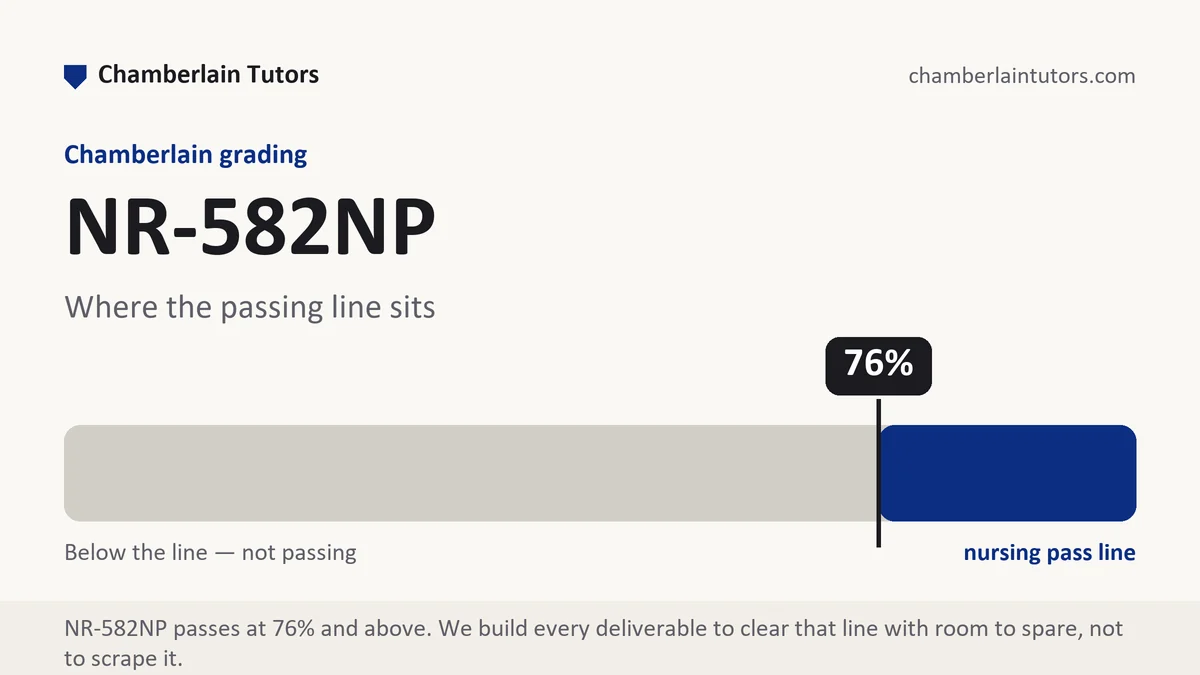
What NR-582NP actually grades
Second in the shared core, deepening the scholarly and role-development writing the sequence exists to build, still on the no-C scale, still weekly. The danger is momentum debt: students who limped through the first course meet compounding expectations here.
How we help in this course
Our 582 support pairs each week's draft with notes that consolidate the register, so the sequence starts teaching instead of taxing. Same pipeline, same floor check, same 24 to 48 hours.
The service terms match the whole site: 24 to 48 hour delivery, A-band targeting on your scale with the floor math shown, two independent QA passes, free revisions until the target is met.
How to write this course's deliverables
Write from the scoring guide, and use the prompt only for the subject. The second core course asks for sustained role writing, and role writing wanders more than any other kind, because the subject is partly you and there is always one more thought worth adding. The guide is what stops the wander. Before you draft anything this week, open your rubric in Canvas, put each criterion row at the top of its own blank page, and refuse to write a sentence that does not belong under one of them. Then measure what you owe against the weight each row carries. The sections below work that method through for the writing NR-582NP sets.
In NR-582NP right now?
Send the week and the rubric from Canvas. First premium sample free, floor-checked, back in 24 to 48 hours.
One NR-582NP week on the desk clock
A typical week in the second core course asks for an initial board post, replies that engage the thread, and written role-development work, all of it feeding an average where 84 is failure. The desk runs the week in a fixed order: the post is drafted in a document, rubric-checked, and handed back ready to paste once, because Chamberlain boards have no edit button; the written deliverable enters the pipeline and returns inside 24 to 48 hours; everything lands ahead of the 11:59 p.m. Mountain-Time cutoff rather than at it.
Why the scale makes this course heavier than it looks
Students who scraped through the first core course arrive here carrying momentum debt, and the specialty scale gives that debt nowhere to hide. There is no C to retreat to, no extra credit to patch with, and a failing outcome would spend one of the very few lives the two-failure dismissal rule allows. The floor check exists for exactly this stretch: each draft is pre-scored against the 94-plus A band before delivery, and your gradebook math is recomputed whenever a score posts so drift gets caught in week terms, not session terms.
Trying the desk on a single deliverable
The first premium sample is free, which turns NR-582NP into a low-risk audition: send one week's prompt and rubric, receive a floor-checked draft with a walkthrough, and judge the register for yourself before any money moves. Most clients pick the week that worries them most and let the sample answer the question.
Rows first, then a reverse outline
Role papers fail structurally more often than factually. The content is usually right and the order is wrong, so a grader hunting for a criterion has to go looking, and a criterion that has to be hunted for scores lower than one that is waiting. Two passes fix it. Before drafting, turn every row into a working heading. After drafting, run it backward: read your own paragraphs and mark in the margin which row each one answers. Paragraphs that answer no row come out. Rows with no paragraph get written.
Then price the rows in words. Say your scoring guide carries five rows worth 18, 15, 12, 9 and 6 points and the paper should run about 1,400 words. Set aside roughly 200 for an introduction and conclusion no row scores directly. The remaining 1,200 splits by weight into about 360 words for the 18-point row, 300 for the 15, 240 for the 12, 180 for the 9 and 120 for the 6. Most students find their reflective section has quietly eaten twice its budget while the heaviest row holds one thin paragraph. Your weights will differ, so run the division on your own guide.
A role paper, section by section
Role papers reward a fixed shape. Unless your rubric hands you headings of its own, run these six in order; the sequence keeps personal material where it earns points instead of where it leaks them.
| Section | What the grader needs to see | The version that scores low |
|---|---|---|
| Introduction with a stated position | That the paper argues something about the role rather than announcing its own contents. | A roadmap paragraph. Graders are holding the rubric; they do not need a table of contents. |
| Scope of the role | That you can say what this role is authorized to do, where, and under what conditions, with the document that says so. | A description general enough to fit any advanced practice nurse anywhere. It answers the row without earning it. |
| The evidence base | That your claims about the role rest on literature rather than on what your unit happens to do. | Personal experience offered as proof. It is fine as illustration and worth nothing as evidence. |
| Self-assessment | That you can name one specific gap without apologizing for it or performing modesty around it. | Generic strengths and weaknesses. "I need to improve my time management" is not graduate self-assessment. |
| Development plan | That the plan is measurable: what you will do, by when, and how you will know it worked. | Verbs like continue, strive, focus on. Nothing built from those can be checked by anyone, including you. |
| Conclusion | That the position stated at the top survived the paper, with the strongest counter-consideration acknowledged. | New material. A claim that first appears in the conclusion was never supported anywhere. |
Which sources can carry which claims
Role writing mixes two families of source, and graders notice immediately when a student cannot tell them apart.
Authority documents. Position statements, scope documents and certification requirements establish what is expected or permitted. Cite the edition or year and the jurisdiction, because both change and a stale scope claim is simply wrong. What these documents cannot do is establish that an intervention works.
Research. Put the design and the sample ahead of the finding. "A two-year cohort study following 1,180 new graduate nurses found" lets a reader weigh the claim; "research indicates" asks them to take your word for it.
Verbs that match the design. Where the study observed rather than assigned, the honest verbs are associated with, more likely among, accompanied by. Reserve improved, reduced and caused for designs that controlled who got what. Role literature is heavily observational, so this is where the sequence catches most students.
Denominator and window before any number. Workforce and turnover figures are the usual offenders. Not "turnover is high among new providers" but "one in four new providers in that sample left the role within the first two years." Give the count, the base and the period.
What separates a passing role paper from a strong one
The role paper that passes describes the role accurately, reflects honestly, cites correctly and arrives on time. It reads as a competent report about a job. On a scale with no C band, competent reporting sits uncomfortably close to the line.
A strong paper takes a position that could be argued against, and then argues it. It treats the self-assessment as evidence rather than confession, drawing on something documented instead of something felt. And its development plan reads like a plan a manager could hold you to, with a date and a measure attached. Graders in the second core course are watching for whether the sequence is starting to change how you think, and those three moves are what that looks like on paper.
Where NR-582NP papers leak points
- Reusing your own earlier work without asking. Ask your faculty member first and in writing. The permission question is cheap; the integrity conversation is not.
- Reflection with no literature under it. Every reflective claim in a graduate paper needs a source sitting beside it, even when the claim is about you.
- Diary register. A paragraph that opens with a story and never gets to an argument reads as filler no matter how true the story is.
- An authority document quoted as proof of effect. A professional body saying something should happen is not evidence that it works.
- Scope claims with no date and no jurisdiction. Both change. A claim missing either is marked wrong rather than incomplete.
- Carrying first-course habits forward. The second course does not restate the register expectations, it assumes them, and the scoring guide assumes them too.
What second-course students ask
Can I write in first person in this course?
Can I reuse a paper I wrote in the first core course?
My development plan feels invented. How do I make it real?
The weeks, one by one
Week 1
NR-582NP Week 1 opens the second core course on its first catalog strand: leadership theory for advanced nursing practice, the frameworks that describe how leaders actually move people, and the question of which one fits the provider role you are building. Read the full Week 1 manual.
Week 2
NR-582NP Week 2 usually turns from leading others to becoming someone new: the transition from RN to advanced practice, read through role theory, role strain, role ambiguity, the documented shock of the first NP year, and the frameworks that map the passage. Read the full Week 2 manual.
Week 3
NR-582NP Week 3 usually takes the leadership strand into the room where it gets tested: interprofessional teams, how collaboration works, why it breaks, which conflict behaviors repair it, and what an NP's arrival changes in a team's chemistry. Read the full Week 3 manual.
Week 4
NR-582NP Week 4 usually asks the leadership strand to produce something: a change proposal, one clinical problem, one change model, a phase-by-phase plan with resistance handled and results measured, sitting at the session's midpoint where papers take over from posts. Read the full Week 4 manual.
Week 5
NR-582NP Week 5 usually opens the course's third catalog strand: health policy, how rules that govern practice actually get made, at the organizational, state, and federal levels, and where nurses enter the machinery. Read the full Week 5 manual.
Week 6
NR-582NP Week 6 typically moves from how policy is made to making a case within it: practice authority, the state rules deciding what NPs may do independently, and the advocacy argument for changing them, built on evidence rather than indignation. Read the full Week 6 manual.
Week 7
NR-582NP Week 7 is where the policy strand usually turns into a deliverable with a real-world shape: the policy brief, a compressed document written for a decision-maker with two minutes, not a professor with an evening. Read the full Week 7 manual.
Week 8
NR-582NP Week 8 usually closes the course by turning its four strands on their author: a leadership development plan, your honest position now, goals with dates and measures, and the resources that will move you, submitted while you run the final gradebook arithmetic of the second core course. Read the full Week 8 manual.
Where NR-582NP sits in Chamberlain's programs
Open the exact program map for sequence, credit, and option context. The current student schedule and syllabus remain authoritative after transfer evaluation, electives, state rules, and approved plan changes.