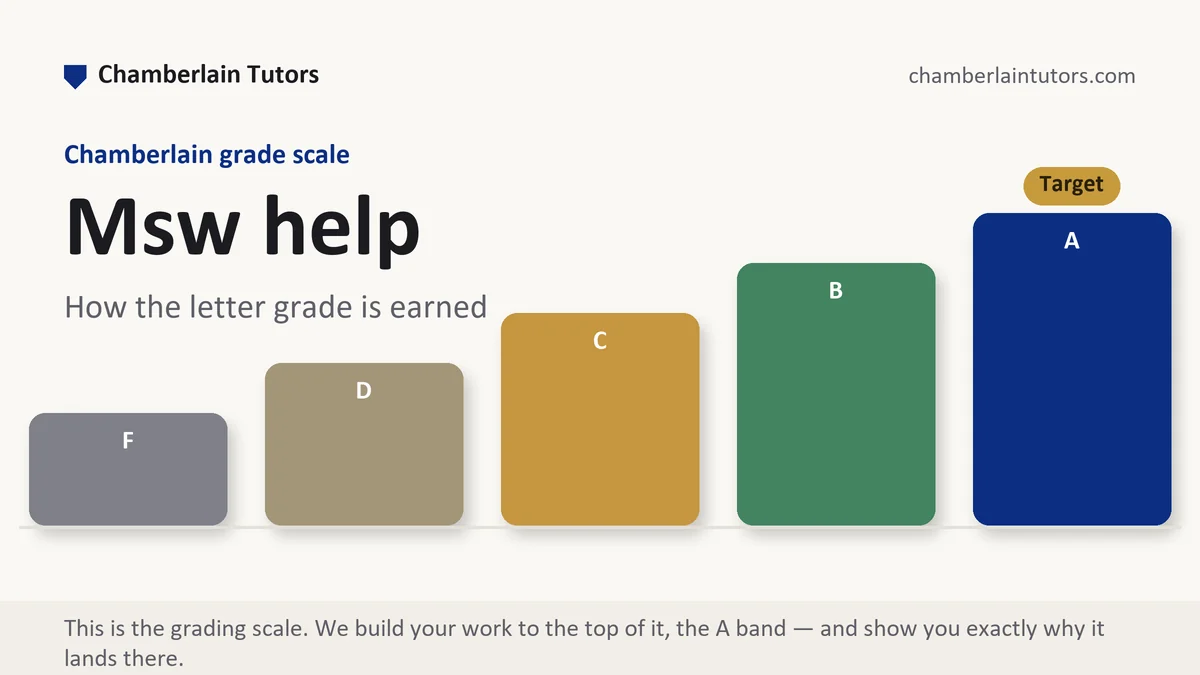
Chamberlain's CSWE-accredited MSW runs 48 credits over two years, or 30 credits in one year for Advanced Standing BSW holders, through the MSW-501 to MSW-555 sequence, with a 400.8-hour generalist practicum and a 504-hour specialized practicum, and a Medical Social Work track that fits the university's clinical DNA. The grading runs the MPH and MSW scale where an A starts at 93 and 69 fails. We draft the program's case writing, reflections, and the MSW-555 integrative capstone in person-first clinical register, 24 to 48 hours per deliverable.
The program, briefly
The sequence moves from foundations through the MSW-541 to 549 range into specialized practice and the capstone seminar, on Chamberlain's standard weekly machinery: uneditable discussions, Turnitin-screened papers, Mountain-Time cutoffs. The graduate-withdrawal rule is gentler here than in nursing, practicum withdrawal records as a W rather than a WF, but the scale still starts its F at 69 and the two-failure health-professions dismissal rule still applies, so consistency remains the whole game.
What MSW writing rewards
Two crafts dominate the rubrics. Case conceptualization with theory visible: assessment through intervention reasoned in order, the framework named and actually used on this client rather than recited. And structured reflection: honest examination of your reactions and biases that stays analytic instead of dissolving into diary. The Medical Social Work track adds hospital systems fluency, discharge realities, interdisciplinary friction, benefits navigation, written specifically. Our social work writers draft all three in the strengths-based, person-first register the discipline grades for.
Practicum-linked writing and the capstone
Nine hundred practicum hours across the two placements generate a steady written shadow: learning agreements, process recordings, integrative papers, and finally the MSW-555 capstone and integrative seminar that binds the program together. Process recordings are a craft of their own, the dialogue, the analysis column, the supervision questions, and the first drafted sample teaches the format faster than any handbook. Placement logistics belong to their own specialists; every written deliverable around the hours belongs to us, confidential without exception.
Send this week's case work
Course code, assignment, rubric. Clinician-register drafts, first premium sample free.
What happens after you send an MSW assignment
The desk runs the same sequence on every MSW deliverable, and it is worth knowing before you send anything, because the quality of what comes back is set mostly by the completeness of what goes out.
What you send
The course code, the assignment page copied out of Canvas, the rubric, the due date in your own time zone, and any instructor feedback from earlier in the term. That last item matters more in social work than in most disciplines, because faculty tend to grade for a particular theoretical stance and their earlier comments are usually the only place it is written down.
The read, before the writing
Someone works the rubric criterion by criterion and separates what is being graded from what is merely being requested. In MSW prompts the two differ constantly: the prompt asks for a description of the client, the rubric awards its points for the assessment reasoning underneath the description.
The draft, in register
Person-first and strengths-based, with the required framework named and then actually applied to this client rather than defined and abandoned by the second paragraph. Applying it is what separates a 96 from an 86 on most conceptualization rubrics.
Two QA passes, run separately
One against the rubric, one for APA and originality. They stay separate on purpose, because whoever is checking that the framework got applied stops noticing reference formatting after twenty minutes of reading for something else.
Back to you inside 24 to 48 hours
With the projected score against your scale, where an A begins at 93. You read it, you learn from it, you submit it. Revisions are included until a supported piece reaches target.
What we take, and what only you can supply
Social work is the program on this site where the boundary of the service is a professional-conduct question rather than a policy preference. Some of what an MSW course asks for is writing, and writing is what we do. Some of it is a record of something that happened between you and a client, and nobody else can produce that honestly. We decline the second category every time, including the parts students most want handed off. We do not attend your practicum, contact your field instructor, sign a learning agreement, or record hours you did not sit. The 400.8 generalist hours and the 504 specialized hours are yours, and the licensure track waiting past graduation assumes they were.
| Deliverable | What you send | What only you can supply |
|---|---|---|
| Discussion post and replies | The prompt, the rubric, the week's readings | Your own practice observations, where the prompt asks for them |
| Case conceptualization paper | The case, the required framework, the rubric, prior feedback | Nothing further; this one is fully ours to draft |
| Structured reflection | The prompt plus your notes on the reaction you actually had | The reaction. We shape and sharpen it, we do not invent it |
| Process recording | Your session notes and your seminar's required format | The dialogue, because it happened to you and to a client |
| Learning agreement, hour logs, field paperwork | Nothing. We decline these outright | All of it, signatures and the field instructor conversation included |
| MSW-555 capstone | The seminar syllabus, the section calendar, your placement contexts anonymized | The placements themselves |
Why the 93 scale changes the math
Nursing students at this university learn to watch a 76 floor. The MSW scale is a different shape and needs a different habit. An A begins at 93, the C band runs 73 to 76, and the F starts at 69. That leaves four points between passing with a C and failing outright, and it puts the A out of reach of any term that does not start strong.
Work it out. Model a course as six equally weighted graded pieces. An A at 93 needs 558 points across the six. Suppose the first half posts an 88, a 90 and a 91, respectable work by any reading. You are holding 269, so the last three pieces have to total 289 between them, an average of 96.3. Three near-perfect papers to convert a good start into an A. Nobody plans for that. People arrive at it.
The other side is worse. A single 62 in that bucket, one week where a case paper went in half-built, leaves the remaining five needing 75.2 apiece just to hold the C and 87.2 to reach the B band that starts at 83. That is why we ask for the session's whole calendar at intake rather than one assignment at a time, and why the first two graded pieces of an MSW course are the ones worth over-preparing.
The whole term, or only the hard pieces
Two arrangements make sense here, and they fail in opposite directions.
Take the whole term and the argument is consistency. The map gets drawn once at the start of the session, the register holds identical from the first discussion to the final paper, and the week your placement runs long does not become the week a deliverable disappears. What it costs is your own practice in the exact skill the field seminar will keep grading for another two years, and it is the larger commitment to make before you have seen much of the work.
Take single pieces and the argument is control. You spend where it hurts, you keep your hand in, you decide each time. What it costs is timing. The decision to ask for help almost always arrives on the day the panic does, which is the worst possible day to brief anyone on a case you have carried for six weeks. Register drifts between pieces too, and graders notice when week three sounds like a different clinician from week six.
Most students settle in between. Conceptualization papers and capstone sections come to the desk, where theory-to-practice reasoning is a craft worth borrowing. Reflections stay closer to home, because a reflection earns its points by being honestly yours, and honestly yours is something we can sharpen but should never manufacture.