NR-579 is the palliative care practicum, 125 precepted hours in hospice, palliative care or rehabilitation settings with the written work carried by a small theory component. Two things get graded that appear nowhere else in the track: symptom management written with the precision of a prescribing plan, and conversations documented as clinical events, with what was asked, what was said, what was understood and what was decided.
What NR-579 actually grades
Whether every element of your plan serves a goal the patient stated. In curative care the goal is assumed, so students are used to writing plans that never mention it. Here the goal is the organising fact, and a symptom plan that is pharmacologically correct but disconnected from what the patient said they wanted will lose the rows that carry the most weight. The clearest sign of a strong paper is that each intervention is followed by the burden it is meant to relieve.
The second thread is documentation of communication. Family meetings, goals of care discussions and prognosis conversations are graded content, and vagueness is where students lose marks: recording that goals were discussed says nothing, while recording the question asked, the words the patient used in reply, what they appeared to understand and the decision reached is a clinical record. Ethics belongs to the same section, applied to the specific tension in the case rather than surveyed in the abstract.
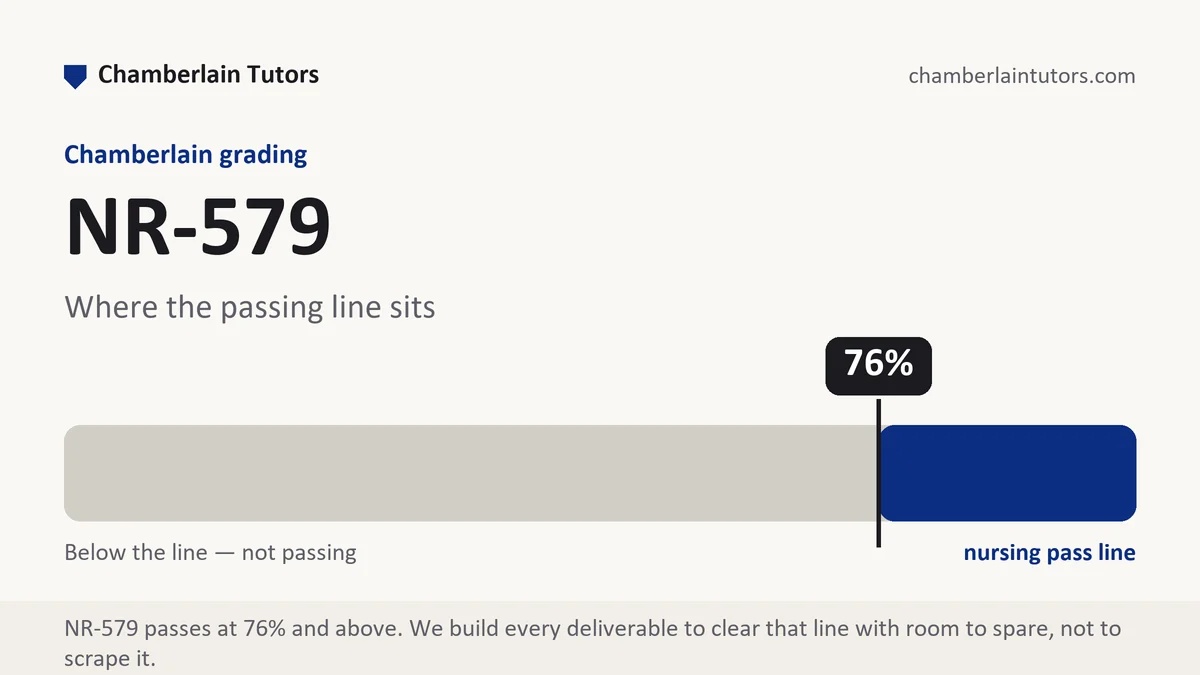
The NP specialty scale has no C, so 84 is the pass line, and supplementary work does not lift an average that has already drifted. This is often the most emotionally demanding practicum in the track, and emotionally demanding weeks produce late, thin documents unless the writing is planned around them.
How we help in this course
We draft the symptom management write-ups, goals of care case analyses, communication and family meeting documentation, ethical analyses, hospice eligibility and transition papers, caregiver support plans, discussion posts and reflective pieces. What our drafts hold to is the link between goal and intervention, and precision in the symptom plan: agent, route, starting dose, titration, breakthrough provision, the anticipated adverse effect and the plan that pre-empts it.
The clinical part stays with you. We do not work clinical hours, contact preceptors, hospices, facilities or faculty, complete or sign placement paperwork or logs, or sit assessments. These 125 hours count toward the 625 clinical hours the MSN NP tracks require. Our work is the documents, drafted from de-identified material you provide.
In NR-579 right now?
Send the week and the rubric from Canvas. First premium sample free, floor-checked, back in 24 to 48 hours.
Let the guide set the proportions
Palliative assignments invite reflective writing, and reflective writing expands to fill whatever space it is given. The scoring guide is the corrective. Copy the rows out, cut each to its verb, assess, manage, communicate, justify, evaluate, and use them as headings in the guide's order so each row has a section addressed to it.
Then weigh them in words. A 1,500 word palliative case with rows weighted 30, 30, 25 and 15 percent gives roughly 450 words to symptom assessment, 450 to the management plan, 375 to communication and goals, and 225 to evaluation and family support. The submissions that disappoint are usually the ones where the writer, moved by the encounter, spends 700 words on the narrative and then writes the symptom plan in a paragraph. The rubric priced pharmacological precision and communication equally, and both need their share.
Hold the budget next to each heading as you draft. If the evaluation section will not fill, the plan has no reassessment interval and no threshold for changing course, and those two sentences are the repair.
The shape of a palliative care write-up
Whatever your assignment is called, the graded document tends to carry these parts.
| Part | What it has to carry | The version that scores low |
|---|---|---|
| Illness trajectory | Where the patient is in the course of the illness, and what the recent pattern suggests. | A diagnosis with no sense of movement or stage. |
| Symptom inventory, scored | Each symptom with an intensity measure, its effect on function, and what makes it better or worse. | Pain noted, without severity, timing or impact. |
| Goals in the patient's words | What matters most to them, recorded as they expressed it, including what they want to avoid. | Comfort care, used as though it were a plan. |
| Symptom management plan | Agent, route, starting dose, titration, breakthrough provision, and the anticipated adverse effect pre-empted. | An opioid started with no breakthrough plan and no bowel regimen. |
| Non-pharmacological and psychosocial | Positioning, environment, spiritual and psychological support, named and assigned to someone. | Holistic support will be provided. |
| Communication record | The question asked, the response, what was understood, and the decision reached. | Goals of care were discussed with the family. |
| Surrogate and directives | Who decides if the patient cannot, what documents exist, and where they are recorded. | Advance directive mentioned with no content and no location. |
| Caregiver and after | Practical caregiver support, what to expect, and what happens when the patient dies. | Family will be supported. |
Evidence and citation craft in palliative writing
This literature carries more uncertainty than most, and the writing is graded on whether you represent that uncertainty honestly.
Currency where practice moves. Where your guide sets no rule, treat symptom management recommendations older than five years as needing a stated reason. Equianalgesic and conversion guidance in particular has been revised over time, and repeating an old ratio as current is a safety-relevant error in a paper about medication.
Survival figures are distributions, not numbers. Report a median with its range or interquartile spread rather than an average, and name the population the estimate came from. Prognostic tools carry the same requirement: say what patients they were derived in and over what horizon they estimate. This is the paragraph that shows a grader you understand what a prognosis is and what it is not.
Verbs the design can pay for. Much palliative evidence is observational or comes from small trials in specific diagnoses, so write was associated with lower symptom scores rather than relieved. Where a randomized trial supports a stronger verb, use it and name the trial. Overstated causal language about interventions near the end of life is both an evidence error and an ethical one, since it can imply promises to families.
Denominator and window on every rate. Of the 320 patients enrolled in the program, 214 died at their preferred location within the six-month follow-up is a usable figure. A 67 percent rate is not, and in this literature the denominator is often where a striking claim quietly falls apart.
Where a palliative write-up earns the top band
A passing palliative write-up is kind and vague. The symptoms are named, the medications are reasonable, the tone is compassionate, and the document could describe almost any patient at the end of life.
Strong write-ups do three things. They tie each intervention to a stated goal, so the reader can see why this symptom is being treated this aggressively and that one is being left alone. They record the conversation with specificity, including the words the patient used, because a quoted phrase carries more clinical information than a paragraph of summary and is the strongest evidence a communication row can be given. And they name what would change the plan, including the possibility of stopping something that is no longer serving the goal, since the willingness to withdraw an intervention is the clearest sign that the writer understands the field. Goal-linked, specifically recorded, revisable.
Mistakes that cost points here
- Euphemism instead of documentation. Phrases like passed away peacefully belong in a card. A clinical record says what was observed, what was given and what was decided.
- A prognosis stated as one number. Give a range and its source, or write about trajectory instead. A single figure will be quoted back to a family and it will be wrong.
- Opioid plans without their companions. Breakthrough provision, bowel management and a plan for the expected adverse effects are part of the prescription, not extras.
- Comfort care as a plan. The phrase describes an orientation. The plan is the list of what continues, what stops, and what is added for each symptom.
- Ethics recited rather than applied. Name the actual tension in this case, whose values are in conflict, and how the plan resolves it. Principles listed without a case attached score as filler.
- Identifiable detail in an emotive case. These are the write-ups where names and dates slip in. Use age band, setting type and clinical picture only, and keep the discussion post out of the browser until it has been checked.
Questions NR-579 students ask
How do I document a goals of care conversation so it scores well?
How much pharmacological detail belongs in a palliative case?
This placement is emotionally heavy and my writing is suffering. What actually helps?
Where NR-579 sits in Chamberlain's programs
Open the exact program map for sequence, credit, and option context. The current student schedule and syllabus remain authoritative after transfer evaluation, electives, state rules, and approved plan changes.
The weeks, one by one
Week 1
NR-579 opens with the written frame that will hold 125 precepted hours together: objectives you can be measured against, a stated plan for how the hours will be used, and an early reflective piece that shows you can analyze practice rather than narrate it. Read the full Week 1 manual.
Week 2
By the second stage of a palliative practicum the written work usually turns toward symptom reasoning: how you assess a symptom in writing, what you considered and ruled out, and why one management pathway earned your recommendation over another. Read the full Week 2 manual.
Week 3
Around the third stage the written work in a palliative practicum usually asks for a full case, not a single symptom: an adult or older adult you assessed, presented in a scholarly write-up that carries history, trajectory, needs across domains, and a defended plan. Read the full Week 3 manual.
Week 4
Midway through a palliative practicum the written work usually turns to communication: a goals-of-care or serious-illness conversation you took part in, analyzed against a named communication framework rather than retold. Read the full Week 4 manual.
Week 5
Past the midpoint, a palliative practicum's written work tends to move from the encounter in front of you to the course of the illness around it: where a patient sits on a recognized trajectory, what functional decline is telling you, how prognostic information is estimated and communicated, and. Read the full Week 5 manual.
Week 6
The sixth stage of a palliative practicum usually turns the written work toward ethics: a decision where two defensible positions were in conflict, a surrogate acting on behalf of someone who can no longer speak, and your written analysis of how the conflict was worked rather than how it felt. Read the full Week 6 manual.
Week 7
Late in a palliative practicum the written work usually widens past the patient to the people and systems holding the care together: the family caregiver whose capacity is the real determinant of whether a plan works, the transition between settings where plans most often break, and the bereavement. Read the full Week 7 manual.
Week 8
The closing stage of a palliative practicum asks you to argue, in writing, what 125 precepted hours actually produced. Read the full Week 8 manual.