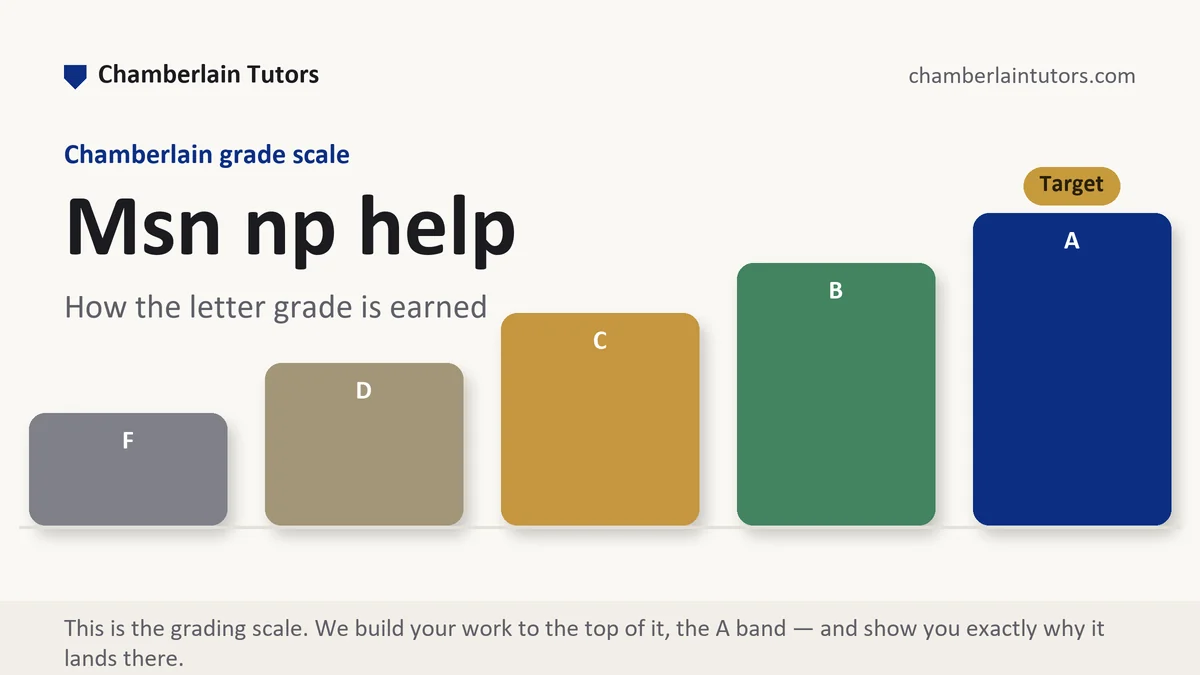
Every Chamberlain NP student, FNP, AGACNP, AGPCNP, PMHNP alike, passes through the shared core: NR-581NP through NR-586NP, plus the advanced sciences trio of NR-507 pathophysiology, NR-509 advanced assessment with its pass-or-fail video check-off, and NR-565 pharmacology territory. All of it grades on the specialty scale where below 84 is an F, and bridge students need a B or higher in NR-581 just to progress. We draft every written deliverable in the sequence to the A band, floor-checked against that scale before delivery, in 24 to 48 hours.
The core sequence, honestly described
The NR-58xNP series is where new NP students meet graduate expectations for the first time: scholarly writing, evidence work, role development, and the weekly discussion cadence, all under the no-C scale from day one. Its danger is not any single assignment; it is the combination of a new register and an unforgiving floor while confidence is still forming. Our core-sequence support front-loads exactly that: models that teach the graduate register fast, with the scale math visible on every draft.
The NR-581 gate
For bridge and accelerated students the catalog is explicit: a B or higher in NR-581 is required to progress. That converts the very first course into a checkpoint, and it is the single most common panic point in our Chamberlain inbox. The play is unheroic and effective: treat week one like week four, bank the early discussions and papers at the A band, and never let the first unfamiliar rubric teach its lesson at gate prices.
The sciences trio: NR-507, NR-509, NR-565
NR-507 wants disease mechanism argued in writing; our drafts keep the causal chain explicit because that is what its rubric rows score. NR-509 pairs written work with a video-recorded physical-exam check-off and immersion lab where failing either reverts the entire course grade to an F; the writing is ours to draft, and the check-off gets prep support, documentation frameworks, sequence drills, practice scripts, never a stand-in. NR-565's pharmacology writing gets the same treatment as every drug-heavy course we serve: mechanism, interaction, monitoring, and rationale carried in prose that reads clinical.
The service, tuned to the scale
Everything here runs the standard pipeline with the Chamberlain floor check tuned to the specialty scale: drafts targeted at 94-plus, margins built in, revisions free below target. Discussions arrive final-quality for the uneditable boards, assignments Turnitin-safe by construction, and your session map tags every core assignment the moment the syllabus posts. When the didactics hand off to track courses, the same team follows you into the FNP or PMHNP sequence.
In the core right now?
Send the course, the week, and the rubric. First premium sample free, scored on the NP scale before you see it.
What one session actually asks of you
Chamberlain runs six start dates a year and cuts the calendar into eight-week sessions, so a session is not a semester with slack in it. Week one already carries graded work, the weeks between carry a discussion thread with replies plus written deliverables, and everything lands on Mountain Time cutoffs inside Canvas. The boards do not allow editing once a post is submitted, which means the version you paste at 11:40 p.m. is the version that gets scored.
Two things follow. There is no recovery week: on a sixteen-week calendar a bad fortnight is survivable, and on eight weeks it is a quarter of the course. Sessions also abut each other, so the week you close one course is usually the week the next one opens. Students who plan a session rather than a week reach the track courses without a repeat on the transcript.
Two floors, and knowing which one you are standing on
Chamberlain does not grade every course the same way. Core nursing coursework runs against a 76 percent passing floor. The NP specialty scale has no C at all, so anything below 84 is an F. The same raw number means two different things depending on which course returned it, and the gap is eight points wide.
| Returned score | Core nursing course, 76 floor | NP specialty scale, no C |
|---|---|---|
| 95 | Comfortable pass | A band, margin intact |
| 90 | Comfortable pass | Passing, four points under the A band |
| 86 | Ten points of cushion | Two points above failure |
| 84 | Eight points of cushion | The line itself |
| 83 | Still a pass | F |
| 75 | Below the floor, fail | F |
Read the row for 83 twice. A habit carried forward from pre-licensure work, aim for the high 70s and stay clear of trouble, arrives in the NP core as a standard that now fails. Nobody announces this in week one. The gradebook simply starts returning numbers that used to be fine.
The arithmetic that decides your grade in week two
Weighted averages are not intuitive, so here is a course built from ordinary weights. Check your own syllabus for your actual weights, then run the same three lines.
| Category | Weight | Your average | Contribution |
|---|---|---|---|
| Discussions | 25 percent | 92 | 23.0 |
| Weekly assignments | 40 percent | 83 | 33.2 |
| Final paper | 35 percent | 80 | 28.0 |
| Course grade | 100 percent | Weighted | 84.2, a pass by two tenths |
Now change one number. Drop the paper from 80 to 76 and its contribution falls to 26.6, the course lands at 82.8, and on a scale with no C that is an F despite an A band discussion record all session. Four points on one deliverable moved the whole course across the line.
The more useful calculation runs the other way. Suppose you want a 94 out of this course. Discussions and assignments have already contributed 56.2 of their possible 65, so the paper would have to supply 37.8 out of a possible 35. That works out to a 108, which does not exist. The A was lost in weeks one through five, not in week eight, and no heroic final draft retrieves it. Keeping the A reachable means the first two categories have to average about 93 before the paper is even assigned, because a 96 paper contributes 33.6 and leaves 60.4 to be earned out of 65.
Two decisions worth making deliberately
One course per session, or two
Doubling up shortens the calendar and reaches the track courses sooner, which matters when a clinical timeline is counting sessions. It also doubles the weekly deliverable count in a format with no repair mechanism: two uneditable threads, two sets of replies, two rubrics, and two deadlines that will eventually collide with a night shift. One course per session protects the average, at the cost of more sessions on the calendar. Neither answer is wrong. The wrong move is doubling up by default in the session holding your hardest science course.
Post the discussion early, or polish it
Because the boards cannot be edited after submission, timing is a tradeoff rather than a preference. Posting early gives classmates something to reply to and removes deadline risk, and it freezes any error you have not caught: the misread prompt, the citation you meant to verify, the sentence you would have rewritten. Polishing until the cutoff produces a cleaner post, a thinner reply window, and one internet outage between you and a zero. Draft early, leave it a day, read it cold, then post.
The mistakes that actually cost grades here
- Carrying the pre-licensure standard forward. An 82 passed a year ago. In the NP core it is a failing number, and the habit that produced it is what has to change.
- Submitting a discussion post before reading it cold. The board is uneditable. Every typo and every unsupported claim is permanent the moment you click submit.
- Treating week one as orientation. On an eight-week session, week one is 12.5 percent of the course, and the scores it produces set the average everything else has to pull against.
- Leaving the NR-509 check-off until the end. The video-recorded physical exam and the immersion component are pass or fail against the whole course. Failing either reverts the course grade to F no matter what the written work scored.
- Mistaking graduate writing for longer writing. Rubric rows reward sourced claims, explicit reasoning, and a defensible conclusion. Adding paragraphs to a thin argument raises the word count and nothing else.