NR-507 sits in Chamberlain's MSN-NP advanced sciences, on the MSN-NP core path. This is its help page: what the course really grades and how our team carries it, floor check included.
What NR-507 actually grades
The advanced sciences course every NP track shares, where disease-process reasoning becomes weekly written work under the specialty scale. The rubric rows reward the causal chain spelled out, mechanism to finding to implication, and grade summary-style writing as Basic no matter how accurate it is.
How we help in this course
Our drafts keep the reasoning chain explicit in every paragraph, sourced current, in clinician register. The walkthroughs double as the sciences review a working nurse rarely has time to schedule.
Deliverables run the standard promise: a premium original draft in 24 to 48 hours, targeted at the A band of your course's actual scale, through the eight-person pipeline with both QA passes and the floor check, revised free until it lands.
Writing this course's deliverables from the rubric
Open the rubric before the prompt. In an advanced sciences course the heaviest scoring row asks you to explain a process rather than report a fact, and a process has an order: what changed at the cellular or organ level, what that change set in motion, what the patient therefore shows, what a clinician does about it. Write that order across a blank page and you have the skeleton before reading a single article. Everything below is a way of turning that scoring guide into an outline, a word budget and a checklist you can run tonight.
In NR-507 right now?
Send the week and the rubric from Canvas. First premium sample free, floor-checked, back in 24 to 48 hours.
Grading the causal chain under the 84 line
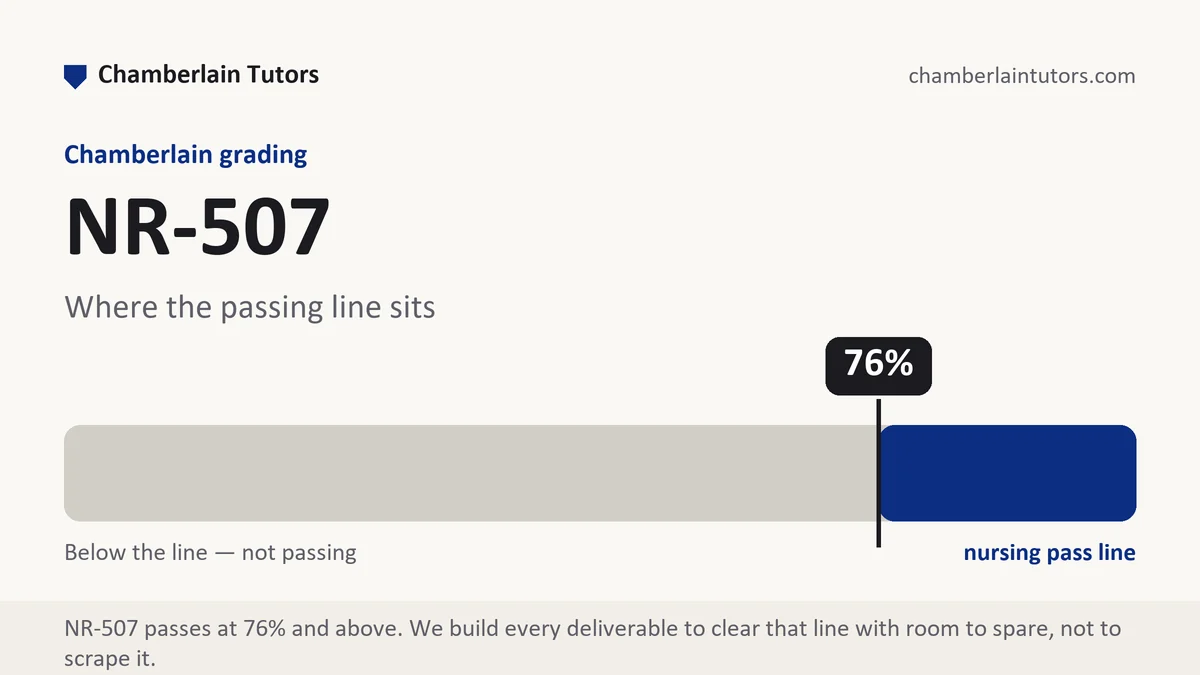
NR-507's rubric rows pay for mechanism-to-finding-to-implication reasoning and mark accurate summary as Basic, and the specialty scale converts that stylistic judgment into structural risk: a summary-voiced week scores in territory where no C exists to catch it. The floor check therefore reads every draft the way the rubric does, chain explicit in each paragraph, before it ships. Two failed nursing courses trigger dismissal review, which is why the sciences courses get treated as career infrastructure here rather than hurdles.
The weekly rhythm, mapped to a 24 to 48 hour desk
Each week of the advanced sciences turns disease-process reasoning into graded writing, and the desk's clock is built to sit ahead of the course's. Send the prompt when the week opens and the draft returns within 24 to 48 hours, leaving days of margin before the 11:59 p.m. Mountain-Time cutoff instead of minutes. Boards come back final-quality for the single permanent paste; papers carry the walkthrough that doubles as the sciences review a working nurse rarely gets to schedule.
Can you work from just the prompt if I forget the rubric?
We can start, but the rubric is the grading instrument, so send it when you can; the draft is scored against its actual rows before delivery. A rubric-blind draft is a guess, and this scale is a poor place for guessing.
Which week should the free sample cover?
Whichever one frightens you. The sample is a full premium draft with the reasoning-chain walkthrough, free, and it converts skeptics better than any promise on this page.
Turn the rubric into a section plan
A rubric is the assignment written twice, once loosely as a prompt and once precisely as criterion rows, and the precise version is the one that pays. Copy the rows out of Canvas into a blank document, one per line, then strip each to its verb: explain, differentiate, analyze, apply, support. Those verbs become your headings, left in the rubric's own order, so that a grader working down the rows keeps meeting the section they were about to look for.
Then price them. Weight is a depth instruction wearing a percentage sign. Say your week's paper is capped at 1,500 words and the guide carries four rows weighted 40, 25, 20 and 15 percent. Multiply straight through: the 40 percent row earns roughly 600 words, the 25 percent row 375, the 20 percent row 300, the 15 percent row 225. That arithmetic feels wrong the first time, because the row worth 600 words is usually the mechanism row, and mechanism is exactly what students compress into one paragraph so they can reach the clinical material they already know. Title page and reference list sit outside the count unless your guide says otherwise.
Leave those numbers visible for the whole draft. Write each target beside its heading and clear it once the section arrives there. Any section finishing well short of its share is reporting thin reasoning, not admirable economy.
The shape of a disease process paper
Most graded writing here is a disease process analysis in one costume or another: a paper, a case response, a board post. Each part below carries one job, and a grader either finds it or does not.
| Part | What it has to prove | How a thin version looks |
|---|---|---|
| Opening frame | Which population and which process you are explaining, said in one or two sentences with no runway. | A paragraph of importance claims before the topic appears. |
| Normal function baseline | The physiology about to break, carried only to the depth the disruption requires. | A textbook summary never referred to again. |
| The disruption | The step where normal function fails, named at the level this course teaches: receptor, mediator, pathway, organ. | Naming the disease a second time instead of the failing step. |
| Manifestations mapped back | Each sign traced to the disruption above it, so the list reads as consequences rather than inventory. | Bulleted symptoms with no line back to the mechanism. |
| Diagnostics as evidence | Why a study or value confirms the process you described, not merely that clinicians order it. | Tests any patient with the condition might receive. |
| Implications for practice | What the mechanism changes about assessment priority, monitoring or teaching at your level. | Advice general enough to fit any diagnosis. |
Evidence craft in the sciences
Four habits carry most of the difference in how you handle other people's findings.
Sources current enough to defend. Where your guide sets no rule, a source past five years old should come with its justification written into the sentence. A foundational account of a mechanism survives that test. A prevalence figure from fifteen years ago does not.
Design and sample first, result second. No finding should reach the reader before its provenance does. Nine words of setup, "in a prospective cohort of 3,180 adults followed four years", convert an assertion into evidence, and the sentence that skips them stays an assertion.
Verbs the design can pay for. Where the data is observational, the honest verbs are "tracked with", "was more frequent among" and "predicted". Where it is experimental and controlled, "caused" and "led to" become available. Borrowing a causal verb for correlational evidence is the sciences equivalent of a documentation error.
Every rate carries a denominator and a period. Strip either away and the number is ornament. "Roughly one in nine of the 2,400 patients enrolled developed the complication within 12 months" earns its place; "11 percent developed the complication" does not.
Accurate is not the same as strong
A passing answer here is accurate. It names the right pathway, cites real sources, and offends nobody. On the specialty scale that has no C, accurate and unremarkable is a dangerous place to sit: 84 is the last passing number, and a run of merely correct submissions averages under it faster than students expect. Supplementary work cannot rescue a weak weighted average, so the margin has to come from the graded pieces themselves.
A strong answer differs three ways. It commits to one process and explains it deeply instead of touching four politely. It keeps the chain unbroken, so every clinical statement in the second half traces back to a mechanism sentence in the first. And it says what follows for practice specifically enough to act on: which finding you would recheck first, what would change your thinking, what the patient should watch for.
Six habits that quietly lose marks
- Summarizing instead of explaining. A correct account of a disease that never shows a step-by-step failure reads as undergraduate work however polished the prose.
- Front-loading a general introduction. An opening that spends 150 words on why the topic matters has burned a tenth of a short paper before saying anything gradeable.
- Treating a board post as a rough draft. Discussion posts do not reopen once submitted at Chamberlain. Draft elsewhere, read it aloud once, then paste.
- Citing a review for a number. Cite the study that produced the figure. Reviews are for framing; primary sources are for values.
- Letting the reference list drift. Every entry has to appear in text and every citation in the list. Graders check that mechanically.
- Writing to the word count instead of the weights. Reaching 1,500 words in the wrong proportion scores worse than 1,300 in the right ones.
Questions NR-507 students ask
My paper is accurate but keeps landing in the low 80s. What is missing?
How many sources does a weekly deliverable actually need?
The prompt and the rubric seem to ask for different things. Which one wins?
The weeks, one by one
Week 1
NR-507 Week 1 opens advanced pathophysiology at the cell, because every organ chapter later in the session is this same chemistry at a larger scale. Read the full Week 1 manual.
Week 2
NR-507 Week 2 moves from a single injured cell to the body's answer to injury: the vascular and cellular events of acute inflammation, the mediators that drive them, the way tissue rebuilds afterwards, and the hypothalamic set point that produces fever. Read the full Week 2 manual.
Week 3
NR-507 Week 3 takes the defense system past its innate layer into acquired immunity, then studies the four ways that system misfires: allergy, cytotoxic attack on the body's own cells, immune complex deposition and delayed cell-mediated damage. Read the full Week 3 manual.
Week 4
NR-507 Week 4 turns from responses that any cell can mount to the instructions the cell was issued: inheritance patterns, mutation, epigenetic regulation, and what happens when the genes governing division stop governing it. Read the full Week 4 manual.
Week 5
NR-507 Week 5 is where the session turns from mechanism in general to a system in particular, and the system is delivery: the pump, the vessels, the volume moving through them and the blood that carries oxygen. Read the full Week 5 manual.
Week 6
NR-507 Week 6 asks a question with only three possible answers: is air failing to reach the alveolus, is blood failing to reach it, or is the barrier between them too thick to cross. Read the full Week 6 manual.
Week 7
NR-507 Week 7 is the regulation stage: the kidney holding volume, sodium, potassium and pH inside narrow limits, and the endocrine axes doing the same job with hormones and feedback loops. Read the full Week 7 manual.
Week 8
NR-507 Week 8 closes the session in the tissue with the least tolerance for error, the central nervous system, and then asks you to put the eight weeks together in one patient who has more than one thing wrong. Read the full Week 8 manual.
Where NR-507 sits in Chamberlain's programs
Open the exact program map for sequence, credit, and option context. The current student schedule and syllabus remain authoritative after transfer evaluation, electives, state rules, and approved plan changes.