NR-565, MSN-NP advanced sciences in the MSN-NP core path, gets the same promise as every course we cover, with the Chamberlain-specific machinery this school's rules demand.
What NR-565 actually grades
The pharmacology-territory course of the shared sciences, where drug reasoning becomes graded prose: choices defended through mechanism, interactions anticipated, monitoring assigned, all under the no-C scale and the weekly clock.
How we help in this course
Drug-dense drafting is a specialty of our nursing bench: the rationale carried in clean clinical prose, references current, the floor check run before delivery. Clients keep the walkthroughs as study sheets long after the course ends.
Orders run the full machinery: rubric decoded, core-versus-supplemental tagged, a program-matched writer, rubric QA then a separate APA and originality pass, the scale check, delivery inside 24 to 48 hours.
Where to start on a prescribing deliverable
Read the scoring guide first, then read the case. A pharmacology deliverable is graded as a defended decision, not as a description of a drug, and the guide tells you which parts of the decision carry weight: why this agent, why not the obvious alternative, what could go wrong, how you would know. Write those four questions down the margin of a blank page and you have an outline before you open a reference. Below is the method: rows into an outline, weights into lengths, then a short self-check before you submit.
In NR-565 right now?
Send the week and the rubric from Canvas. First premium sample free, floor-checked, back in 24 to 48 hours.
Drug reasoning, priced on the specialty ladder
NR-565 asks for pharmacology argued in prose, mechanism defended, interactions anticipated, monitoring assigned, and grades it on the scale where 84 is the final passing number. The failure mode we see most is accurate-but-listy writing: correct facts arranged as inventory rather than argument, which rubric rows read as Basic. Our drafts carry the rationale in clean clinical sentences with current references, and the floor check scores each one against the 94-plus band before it leaves, because on this ladder the difference between arguing and listing is the difference between progressing and repeating.
Proof before payment, in this course specifically
Drug-dense writing is where students are most skeptical that outside drafting can sound like them, so the free first sample exists to settle it with evidence: one week's prompt and rubric in, one premium draft out, walkthrough attached, no charge. Clients routinely keep those walkthroughs as study sheets long after the course closes, which is its own quiet endorsement. If the register convinces you, the same team simply keeps going with the next week's prompt.
Do the walkthroughs cover why each agent choice was made?
Yes. Every draft explains its prescribing logic step by step, so you can defend the reasoning in a board reply or a faculty question without hesitation.
What happens if a graded piece lands under target?
Revisions are free until it lands. The guarantee is the A band, A- at worst, and the floor math is shown with every delivery so target never means vague.
Price the rubric rows before you choose the agent
Rubric rows are the assignment; the prompt is only the invitation. Pull the rows into a blank document and read each one for how many separate things it grades. Rows in a prescribing course routinely bundle two: select an agent and justify the selection, or determine dosing and describe monitoring. A bundled row answered as one thing is a half-answered row, so split it and give each half its own paragraph.
Then convert weight into length. Suppose the week's paper is capped at 1,800 words and the guide carries four rows weighted 35, 30, 20 and 15 percent. That is 630 words for the first row, 540 for the second, 360 for the third, 270 for the last. Most students discover at this point that they had planned 800 words describing the drug and 200 defending the choice, when the weights ask for the reverse.
One habit saves more points than any other here. Wherever a row says "for this patient" or "in the scenario", every general statement in that section has to be re-anchored to the person in front of you. A true sentence about a drug class earns nothing until the next sentence says what it means for someone with this renal function, this age, this medication list. General pharmacology is background. The graded object is the decision.
The shape of a drug therapy rationale
Whether the week asks for a paper, a case analysis or a board response, the reasoning underneath runs the same eight moves. Each is a claim a grader looks to see made and supported.
| Move | What it has to prove | Common shortfall |
|---|---|---|
| Patient and problem in one frame | The clinical picture and the treatment goal, stated precisely enough that the goal can later be measured. | Background prose with no goal anyone could measure. |
| Agent and class | The choice named exactly, with route, dose, frequency and intended duration. | A drug name with no regimen attached to it. |
| Pharmacokinetics that matter here | Only the absorption, distribution, metabolism or elimination facts that changed the decision for this patient. | A full recital of properties, none of them used. |
| Pharmacodynamic rationale | Why the mechanism addresses this problem in this body, at the level of receptor, enzyme or pathway. | Mechanism restated from a reference and left unconnected. |
| Alternatives rejected | At least one credible alternative named and set aside for a stated reason. | Silence, which reads as a choice made without comparison. |
| Interaction and contraindication screen | That the medication list, comorbidities and any genetic considerations were checked rather than assumed. | A generic warning list lifted from a monograph. |
| Monitoring plan | What you will measure, the value at which it becomes a problem, and how soon you will look. | "Monitor for side effects." |
| Patient teaching | What the patient must do, watch for and report, in words they would actually use. | Clinical instructions written for a clinician audience. |
Evidence craft for a prescribing claim
Currency, and the right kind of source. Prescribing evidence ages faster than physiology. Anything past five years needs a stated reason, and a drug database is a fine place to confirm a dose but a poor place to source a claim about outcomes. For outcomes, cite the trial.
Design, sample and comparator before the result. Say what the study did, in how many people, and against what. "In a randomized trial of 2,214 adults compared with placebo over 12 months" tells a grader you read the study. "Studies show" tells them you read an abstract.
Verb choice follows study design. Randomized comparisons license "reduced" and "produced". Registry and cohort work licenses "was associated with" and "occurred less often among". Slipping into causal language on observational data is one of the few errors a grader can mark without knowing your topic at all.
Absolute effect, with its denominator and follow-up. Lead with how many patients and over how long, then give the number, and choose the absolute form. "Six of every 100 patients treated for a year avoided the outcome" is a sentence a patient could act on. "A 40 percent reduction" conceals the base and the time at once.
Correct, and then convincing
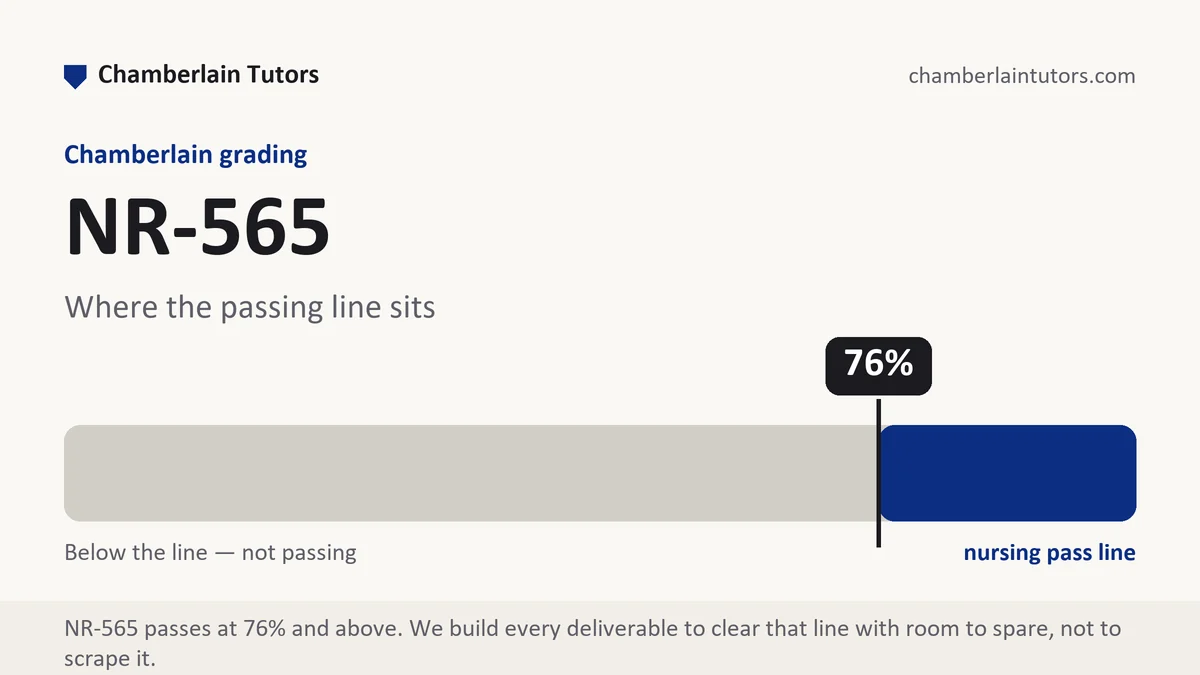
A passing pharmacology answer is correct. The drug is appropriate, the mechanism is accurately described, the references are real. On a specialty scale with no C, correctness alone sits close to the edge, because 84 is the last passing number and no amount of supplementary work repairs an average the graded pieces already set low.
A strong answer is a decision someone could act on. It names the regimen completely, defends it against a named alternative, states the two or three parameters it will be judged by, and gives the values and intervals at which it would change. The test is simple: hand the draft to a colleague and ask whether they could start the therapy and know when to stop it. Whatever they would have to ask you first is the row you underwrote.
Six write-up errors that cost marks
- A drug without a regimen. Naming the agent is a quarter of the answer. Route, dose, frequency and duration finish it.
- Monitoring written as a feeling. "Watch for adverse effects" scores as nothing. Name the parameter, the threshold and the interval.
- Skipping renal or hepatic adjustment. If the scenario hands you a value, the rubric expects you to use it, and silence reads as a missed check.
- Relative numbers with no absolute. A percentage reduction sounds decisive and says nothing about how many people benefit.
- Treating pharmacogenomic considerations as decoration. One honest sentence about what you would and would not test beats a paragraph of hedging.
- Answering a board in draft voice. Posts do not reopen after submission at Chamberlain, so the first version is the graded one. Compose elsewhere, paste once.
Questions NR-565 students ask
How much pharmacokinetics is too much?
Do I really have to name an alternative I rejected?
My reference list is mostly drug databases. Is that a problem?
The weeks, one by one
Week 1
NR-565 Week 1 opens advanced pharmacology with what the body does to a drug: how much of a dose reaches the circulation, where it travels once it arrives, how the liver changes it, and how the kidney removes it. Read the full Week 1 manual.
Week 2
NR-565 Week 2 turns the question around: not what the body does to the drug but what the drug does to the body, which means receptors, the signals they carry, and the curve that connects a dose to an effect. Read the full Week 2 manual.
Week 3
NR-565 Week 3 answers the question the first two stages raise: two patients receive the same dose of the same drug and one has no effect while the other has toxicity, so what explains the gap. Read the full Week 3 manual.
Week 4
NR-565 Week 4 is where the first three stages meet a real medication list. Read the full Week 4 manual.
Week 5
NR-565 Week 5 is the first stage where the drug has a second audience. Read the full Week 5 manual.
Week 6
NR-565 Week 6 covers the agents prescribed most often and monitored by numbers: the drugs that lower pressure, unload the failing heart, change lipids, manage clotting risk and control glucose. Read the full Week 6 manual.
Week 7
NR-565 Week 7 handles the agents whose target is an experience rather than a laboratory value: analgesics and the drugs used for mood, anxiety, psychosis and sleep. Read the full Week 7 manual.
Week 8
NR-565 Week 8 closes the session by asking the same prescribing question at four different ages, then asking you to write the answer as one plan a colleague could execute. Read the full Week 8 manual.
Where NR-565 sits in Chamberlain's programs
Open the exact program map for sequence, credit, and option context. The current student schedule and syllabus remain authoritative after transfer evaluation, electives, state rules, and approved plan changes.