In the MSN-NP core sequence, NR-509 is Advanced assessment with the pass/fail check-off. Students search the code mid-panic more than any title, so this page answers the code: here is the honest read and the service behind it.
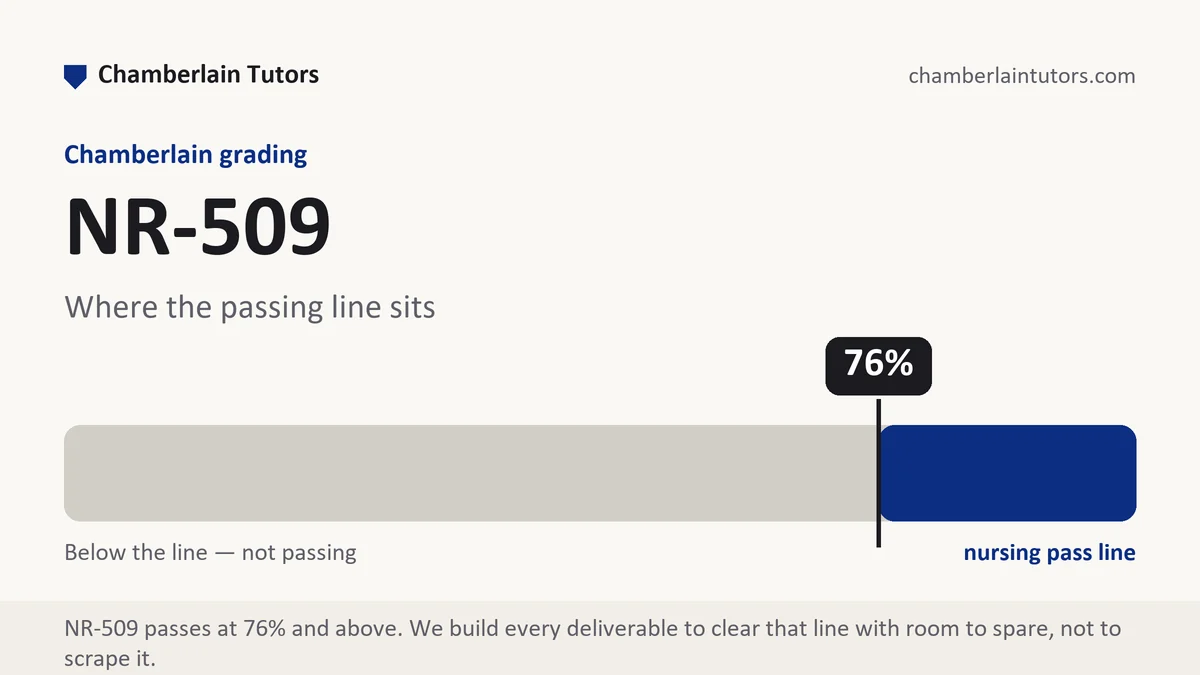
What NR-509 actually grades
The course students fear correctly: alongside its written work sits a video-recorded physical-exam check-off and immersion component, and failing either reverts the entire course grade to an F. The written deliverables are documentation-heavy; the check-off is performance under a camera.
How we help in this course
Two services in one here. The written work runs the standard pipeline to the A band. The check-off gets structured prep, documentation frameworks, sequence drills, practice scripts read aloud until the exam lives in your hands, never a stand-in, because that line does not move.
The service terms match the whole site: 24 to 48 hour delivery, A-band targeting on your scale with the floor math shown, two independent QA passes, free revisions until the target is met.
How to build the documentation this course grades
Open the scoring guide before the prompt, because in an assessment course the guide is applied to a document that already has a fixed clinical order. Your rubric rows will not arrive in the order your write-up must follow: rows are graded criteria, the write-up is a clinical record. Read the rows first, mark which part of the record each one lands in, then write in record order. The rest of this page builds that into an outline, a length for each part, and a documentation check for tonight's submission.
In NR-509 right now?
Send the week and the rubric from Canvas. First premium sample free, floor-checked, back in 24 to 48 hours.
Two graded surfaces, one course grade
NR-509 is really two examinations wearing one course code: documentation-heavy written work, and a video-recorded physical-exam check-off with an immersion component where failure reverts the entire course grade to an F. That reversion rule rewrites the strategy. The written side cannot bank enough points to survive a failed check-off, so both surfaces have to be treated as pass-critical from week one, and the desk splits them into two distinct services accordingly.
What the desk does and what stays in your hands
Written deliverables run the full pipeline: drafted to the A band, rubric QA, the separate APA and originality pass, floor check, back inside 24 to 48 hours. The check-off gets structured preparation, documentation frameworks, exam-sequence drills, and practice scripts rehearsed until the flow is automatic, but the camera records you and only you. No stand-in, ever; that boundary does not bend, and any service claiming otherwise is selling you a dismissal case. What the drills change is the arrival: the sequence rehearsed until the camera meets a clinician who has done this many times rather than a student meeting it cold.
How early should check-off prep begin?
Earlier than feels necessary. The drills work by repetition across weeks, not cramming across nights, and the written workload of this course does not pause while you rehearse.
Does the free sample apply to a documentation write-up?
Yes. A full assessment-documentation draft, free, floor-checked, is the fastest way to see whether our register matches what your section rewards. Turnaround holds at 24 to 48 hours even in documentation-dense weeks.
Map the rubric onto the record
The rubric is the grading instrument; the prompt is only its summary. Copy the rows out of Canvas and give each one a home in the record before you write a sentence: this row is graded in the history, this one in the objective findings, this one in the assessment, this one in the plan. Rows with no obvious home are the ones students lose, because nothing in a familiar template prompts them.
Then price the rows. Say your week's write-up is capped at 1,000 words and the guide carries five rows weighted 30, 26, 20, 14 and 10 percent. Multiply through and you get 300 words, then 260, 200, 140 and 100. A 30 percent row answered in four lines is a scored section you chose to skip, and in a documentation course the four-line version usually looks complete, which is exactly what makes it expensive.
One adjustment belongs to this course specifically. Word budgets sit awkwardly on documentation, where a normal system can honestly take eight words. So budget by evidence rather than by prose: the 300-word row should carry the most findings, the most reasoning and the most citations, even when it is written in clipped clinical phrasing. Count what you documented, not only what you typed.
What a documentation write-up has to prove
Whatever the week calls it, the graded artifact is a record of thinking. Each part below is where a grader looks for a specific proof.
| Part of the record | What it has to prove | Where the points leak |
|---|---|---|
| Reason for visit and history | That hypotheses drove the questions. Each one recorded should be a question asked because of the previous answer. | A complete but undirected history that could belong to any patient. |
| Review of systems | That reported information stayed separate from observed information, and that the systems reviewed match the concern. | Objective findings smuggled into the subjective section. |
| Objective examination | That the maneuvers documented were justified by the concern, recorded in standard order and standard terms. | Whole systems recorded as normal when nothing shows they were examined. |
| Pertinent negatives | That the absences you name actually move the differential up or down. | Negatives listed because a template lists them. |
| Assessment and differential | That the list is ranked, and that each entry is tied to a documented finding raising or lowering it. | Three plausible diagnoses with nothing separating them. |
| Plan | That every diagnostic and teaching step follows from the ranked differential, with the result that would change it stated. | A plan that would read identically without the examination above it. |
Evidence craft when the evidence is an exam finding
Currency you can defend. Assessment technique changes slowly, but recommendations about it do not. Anything older than five years needs a stated reason to be in the reference list, and "the textbook says so" is not one.
Design and sample before any test characteristic. Before quoting a sensitivity or specificity, say what the maneuver was compared against and in how many patients. A sensitivity drawn from 96 patients in a specialty clinic does not transfer to a primary care room, and naming that limit reads as strength.
Verbs sized to what an examination can do. A finding supports, raises, lowers, or is consistent with. Very little on examination confirms or excludes on its own. Write "raises the likelihood of" instead of "confirms", and reserve causal language for evidence designed to establish cause.
Denominator and time frame before a prevalence. Citing how often a condition presents a certain way means leading with "among 1,140 adults presenting to primary care over two years" and only then giving the figure. A prevalence lifted from an inpatient sample and applied to a clinic patient is a scored error, not a rounding one.
Complete, then traceable
A passing write-up is complete. Every heading filled, terminology right, nothing missing. On a specialty scale with no C that is a thin place to stand, because 84 is the last passing number and completeness is what every submission already has.
A strong write-up is traceable. Read yours backwards: the plan should be predictable from the differential, the differential from the findings, the findings from the questions you asked. When a grader can reconstruct your reasoning in reverse without guessing, you are in the top column. Keep the course's other surface in view while you do it. The recorded physical examination check-off carries a failure that reverts the entire course grade to an F, so documentation practice and examination practice are one practice. Write the record in the order you perform the exam, and the sequence you rehearse becomes the sequence you document.
Six documentation errors that cost points
- Letting subjective and objective bleed. "Patient appears anxious" is an observation, not a report. One line in the wrong section is a scored error.
- Documenting an examination you did not perform. Template normals are an integrity problem before a grading one. Leave a system out rather than filling it in.
- Using "unremarkable" for a whole system. It tells a grader nothing about what you looked for.
- A differential with no discriminators. Naming three conditions is a list. Saying which documented finding argues for and against each one is an assessment.
- Rehearsing the check-off silently. Say the sequence aloud as you perform it. The recording captures narration as well as technique, and the flow you practice is the flow you write.
- Leaving the recorded exam until late. It is not the written work's neighbor, it is the course's other half, and waiting never makes it easier.
Questions NR-509 students ask
Can someone else record or perform the physical examination check-off for me?
How do I write a differential when several diagnoses genuinely fit?
The write-up template feels like it fights the rubric. What do I do?
The weeks, one by one
Week 1
NR-509 Week 1 almost always belongs to the health history: the interview that gathers it and the write-up that records it. Read the full Week 1 manual.
Week 2
NR-509 Week 2 is where the objective record usually begins: the general survey, vital signs taken with technique worth defending, and the skin, hair and nails as the first system inspected. Read the full Week 2 manual.
Week 3
NR-509 Week 3 typically brings the head, eyes, ears, nose, throat and neck: the most instrument-dense stop on the exam, where the otoscope and ophthalmoscope enter the record and dozens of small structures each expect a line. Read the full Week 3 manual.
Week 4
NR-509 Week 4 usually opens the chest: the respiratory and cardiac exams, performed in the inspect, palpate, percuss, auscultate sequence and documented in a vocabulary that locates every sound. Read the full Week 4 manual.
Week 5
NR-509 Week 5 tends to descend to the abdomen, the one region where the exam's order changes: auscultation comes before percussion and palpation, because touching the belly first changes what you will hear. Read the full Week 5 manual.
Week 6
NR-509 Week 6 usually pairs the musculoskeletal and neurological exams, the two systems documented in numbers: strength on a zero-to-five scale, reflexes on a zero-to-four-plus scale, range of motion in degrees, and cranial nerves accounted for one by one. Read the full Week 6 manual.
Week 7
NR-509 Week 7 is, by the arc's logic, integration: the regional exams assembled into one continuous head-to-toe sequence, performed smoothly, narrated aloud, and documented in the order it ran. Read the full Week 7 manual.
Week 8
NR-509 Week 8 closes the arc with synthesis: the complete note, subjective through plan, where the history you learned in week one and the exams you built since finally argue for a ranked differential and a defensible plan. Read the full Week 8 manual.
Where NR-509 sits in Chamberlain's programs
Open the exact program map for sequence, credit, and option context. The current student schedule and syllabus remain authoritative after transfer evaluation, electives, state rules, and approved plan changes.