Chamberlain runs the largest FNP student population in the country through a 45-credit, eight-semester track at $760 per credit, pairing written didactics with 625 clinical hours, all graded on the specialty scale where below 84 fails. The writing spine runs from NR-511 and NR-566 through the primary-care sequence of NR-601, NR-602, and NR-603 to the NR-667 capstone. We draft every written deliverable in that spine to the A band in 24 to 48 hours, floor-checked on the no-C scale, with the clinical-adjacent writing handled alongside.
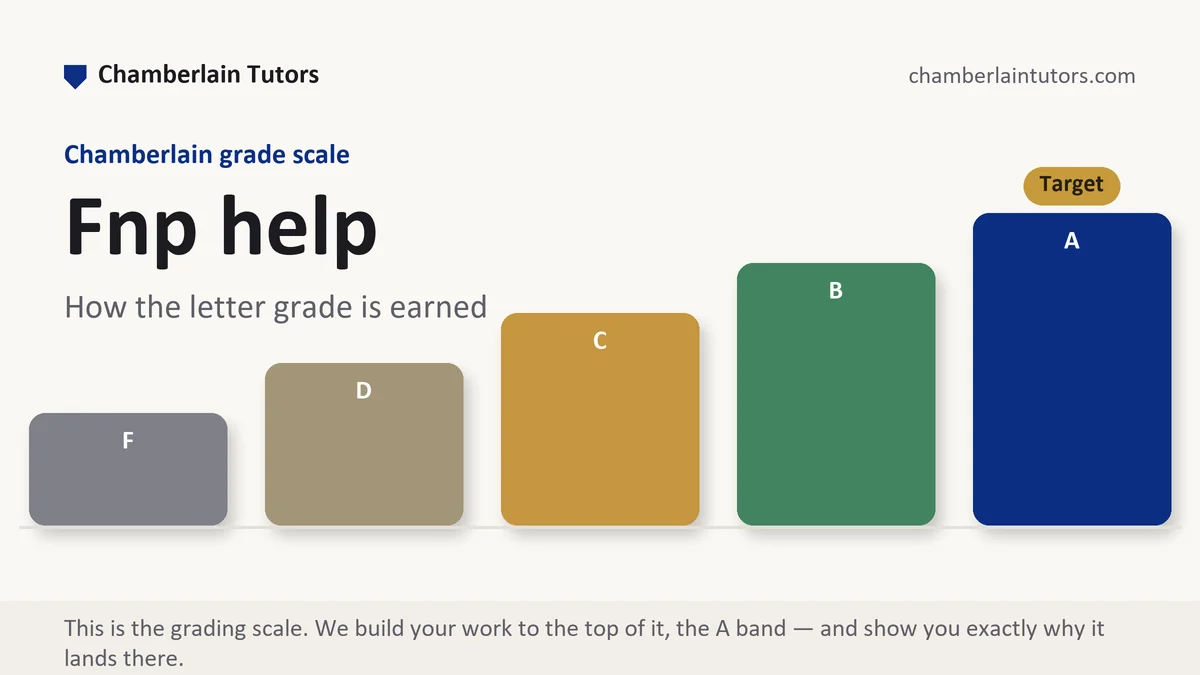
The track, and where the pressure concentrates
FNP didactics are case-driven: management write-ups across the lifespan, pharmacology applied to primary care in NR-566, differential reasoning in NR-511, every week carrying discussions on uneditable boards plus substantial written work. The pressure concentrates where the scale meets the calendar: a 47-week stretch of clinical placements layered over didactic courses whose F line sits at 84. Chamberlain itself cites a 90.43 percent three-year board pass rate for this track, which tells you the program teaches well and grades hard, both true, and only one of them your problem this week.
The primary-care sequence: NR-601, 602, 603, and the capstone
The 601 series is where the writing turns fully clinical: adult and geriatric management in NR-601, women's and family care through the sequence, each course expecting documentation-quality case work with guidelines cited and choices defended. NR-667 closes the track with capstone work and board-review intensity. Our FNP drafts are written by MSN-credentialed clinicians in exactly that register, the workup visible, the plan defensible, the evidence current, and the notes on every draft show which rubric row each section satisfies.
Didactics next to clinicals, without the collision
The track's real enemy is the Tuesday when a clinical day, a discussion deadline, and a case paper land together. The session map fixes the calendar half: every written deliverable planned around your placement days, drafts arriving ahead of the Mountain-Time cutoffs. The clinical half, hours, sites, logs, belongs to its own machinery, and the writing that surrounds it, reflections and practicum-linked assignments, folds into the same weekly rhythm. You bring the patients; we keep the paper moving.
In the FNP track right now?
Send your course, week, and rubric. A-band drafts on the no-C scale, first premium sample free.
What a week with us looks like in this track
-
You send the course, the week, and the rubric
NR-511 week four, NR-566 week six, or the capstone stage you are standing on. Canvas screenshots are fine. For FNP work, add your clinical days for that week, because the calendar we plan against is the one with patients in it.
-
Scope and price are quoted before anything begins
Discussions and standard written assignments run 24 to 48 hours. Capstone-scale work gets a dated plan rather than a single turnaround, because staged deliverables fail on planning, not on writing.
-
The draft returns floor-checked and rubric-mapped
Each draft is scored against the scale your course actually uses, the 84 line on the specialty scale, before it leaves. The notes name which rubric row every section answers, so you can see the reasoning and not only the prose.
-
You personalize it and post it once
You submit from your own account, in your own voice, exactly once, because the boards cannot be edited after posting. Anything below target comes back for free revision.
Working backward from the cutoff
Most FNP requests arrive about a day late, and the arithmetic is simple enough to do on a phone between patients. Take a Sunday 11:59 p.m. Mountain Time deadline. Standard deliverables run 24 to 48 hours, so plan against 48 rather than 24 and delivery lands Friday night at the latest. Then subtract your own time: reading the draft, making it sound like you, checking the sources you want to check, and asking for the revision if a rubric row looks thin. Call that a day. The request should be in by Thursday night.
Send the same request Saturday morning and the entire window sits on top of the deadline with nothing left over. That does not mean it cannot be done. It means it has to be flagged as a short-runway job when you ask rather than assumed, and sometimes the honest answer is that the piece belongs a week later. If your rotation runs Tuesday and Thursday, the practical rule is to send the week's work on the Monday before it, while both evenings are still yours.
Three ways FNP students use this, and what each one costs
| Arrangement | What you send | Best when | The tradeoff |
|---|---|---|---|
| One deliverable | A single paper, case write-up, or discussion with its rubric | You are steady, and one week collided with a rotation | Smallest commitment, and it does nothing for the weeks you did not flag. You remain the planner. |
| Heavy weeks only | The two or three highest-weight pieces per course, chosen in week one | You write well and the calendar is the actual problem | Protects the categories that decide the grade, and leaves low-weight drift to you, which is where the slow bleed happens. |
| The whole session | Both syllabi in week one plus your clinical days | Two didactic courses stacked on a rotation | Nothing is forgotten and every deadline is planned, at the price of the largest commitment and the strongest habit of leaning on a schedule someone else built. |
The honest version of that last row: students on full-session coverage finish sessions cleanly and can finish them less independent than they started. The counterweight is the rubric-mapped notes. Read them, and by the second session most people draft their own work at the A band and send only the weeks that detonate. Ignore them and you have bought a calendar rather than a skill.
What we decline, without exception
- Clinical hours. We do not complete them, stand in for them, or produce anything stating you were somewhere you were not. The 625 hours are yours.
- Preceptors and sites. We do not contact your preceptor, your clinical coordinator, or a site on your behalf, and we do not complete or sign placement paperwork.
- Hour logs and evaluations. Time logs, preceptor evaluations, and attendance records are records of what you personally did. Nobody else can fill them in.
- Your logins. We never ask for and will not accept Canvas or My Chamberlain credentials. You submit your own work from your own account.
- False hope on a dead course. If the weighted math says a course cannot reach 84 with the weight that remains, we say so and help plan the retake instead of selling you eight more weeks of drafts.
The line underneath all of it is simple. The writing around clinical practice can be coached. The practice itself has to be yours, because a certification exam, and eventually a patient, will assume that it was.
Where the handoff goes wrong
- Sending the prompt without the rubric. The prompt says what to write about. The rubric says where the points live and how they are weighted. Only one of those decides the grade.
- Naming the week but not the course. Week four means three different things across three FNP courses. The course code costs you four characters and prevents the wrong draft.
- Posting a returned draft without reading it. It has to sound like you, and on an uneditable board there is no second attempt at making it sound like you.
- Leaving out the clinical days. A plan built without your rotation schedule will cheerfully put a deadline on the evening you get home at nine.
- Asking after the deadline instead of before it. A missed submission is a fixed zero. Everything upstream of the cutoff is negotiable, and nothing downstream of it is.