Chamberlain runs 16-week semesters split into two 8-week sessions, and inside every session the week is the unit: threaded discussions that cannot be edited once posted, Turnitin-screened written assignments, journals, and projects, all rubric-scored in Canvas on a Mountain-Time clock. Our weekly service is built for exactly that machine: discussion posts drafted right the first time, assignments back in 24 to 48 hours to an A target, every week of the session mapped in advance so the 76 percent core floor never gets close.
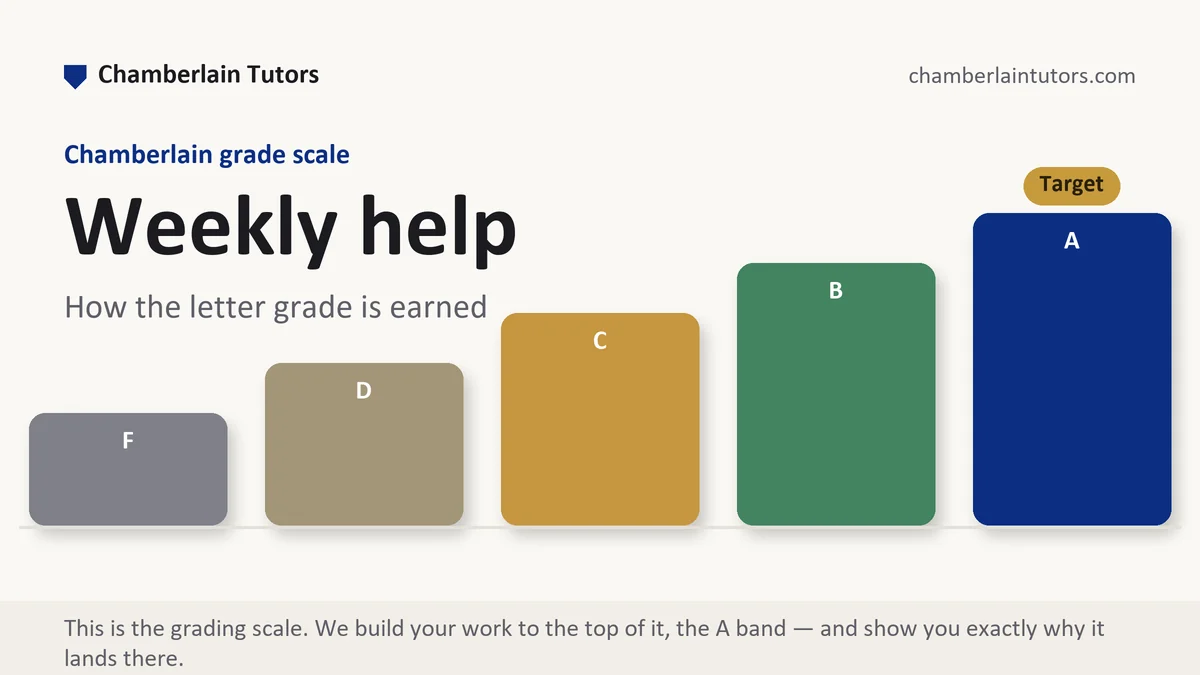
The session shape, and why weeks feel relentless
Six start dates a year feed the two-sessions-per-semester calendar, and online students typically carry one course per 8-week session, which sounds light until the deliverable list lands: a discussion with reply obligations plus written work, weekly, with no draft-saving on the boards and deadlines striking on Mountain Time, a real trap for students in Eastern and Central zones who file at what feels like the last hour. Eight weeks also means the gradebook math hardens fast; by week four, a weak start is a containment problem, not a recoverable one.
Every weekly deliverable, handled
| Deliverable | What you get | Timing |
|---|---|---|
| Discussion posts | Final-quality drafts written for boards where editing is impossible, sourced and rubric-aware. | ahead of the post day |
| Peer and faculty replies | Substantive responses that meet the engagement rubric, never filler. | before the weekly cutoff |
| Written assignments | Premium original drafts, Turnitin-safe by construction, criterion-mapped. | 24-48 hours |
| Journals and reflections | Personal register with structure, built from the details you share. | 24-48 hours |
| Care plans, EBP and QI projects | Clinical documents in working-nurse register with current evidence. | 24-48 hours |
| iHuman and simulation write-ups | The written layer around simulations, documentation and debrief work. | 24-48 hours |
The stakes, which are the whole story here
Chamberlain's rules are engineered without slack: a 76 percent weighted core-assignment floor in pre-licensure nursing courses where falling below fails the course outright, an NP specialty scale where anything under 84 is an F, no extra credit, no curving, and dismissal triggered by two failed nursing courses. That is why our Chamberlain service leads with QA rather than speed: every draft passes a grade-floor check against the actual scale your course uses before it ever reaches you. The full rulebook, decoded, lives in the grading-rules manual.
Quick answers
Can you keep my whole session covered?
What does the guarantee promise?
I am mid-session and sinking. Too late?
Hand off this week
Course code, week number, rubric. First premium sample free.
What one covered week actually contains
Most weeks run a three-beat pattern: an initial discussion post due mid-week, peer and faculty replies later in the week, and a written deliverable at the close. As a workload that looks modest. As a schedule it is the whole problem, because the beats do not sit next to each other. The post must be finished days before the assignment is due, and replies cannot be written until classmates have posted. Three separate moments, none collapsing into one evening.
Students rarely lose a week to difficulty. They lose it to the second beat, because replies depend on other people's timing. The structural fix beats the heroic one: write the initial post to final quality early, then treat replies as a scheduled appointment. A covered week works the same way, with the written deliverable already moving while the thread is still filling.
The Mountain-Time conversion, done once
Canvas closes on Mountain Time wherever you live, and the students who get burned file at what feels like a safe hour. Convert once, put it on your own calendar, and stop doing arithmetic at midnight. For an 11:59 p.m. Mountain cutoff during daylight saving:
| Where you are | 11:59 p.m. Mountain lands at | What it does to your evening |
|---|---|---|
| Hawaii | 7:59 p.m., same day | The tightest zone. Your deadline is dinnertime. |
| Alaska | 9:59 p.m., same day | Two hours gone before you start. |
| Pacific and Arizona in summer | 10:59 p.m., same day | One hour gone, and it is the hour people use. |
| Central | 12:59 a.m., next day | An hour of grace, but the date has flipped. |
| Eastern | 1:59 a.m., next day | Two hours that read like a free evening. |
Mainland gaps hold year round, so the table survives the November clock change; only Arizona and Hawaii never move their clocks. Confirm your own cutoff hour in Canvas, since not every item closes at the same minute. And if you hand work to anyone, ask the plain question first: what happens when a draft arrives after my Mountain cutoff? Get that answer before you hand over a week.
Doubling up in one session, argued both ways
One course per 8-week session is the standard shape, and every student eventually does the math on taking two. Both answers are defensible, so here is each side.
For it: six start dates a year already make this calendar dense, and two courses in one session finishes a term of credit in half the wall-clock time. Any charge billed per session rather than per course then covers both, worth checking against your own statement. If your work schedule gets worse later in the year, spending the good months at double load is a real strategy.
Against it: the week does not double, it compounds. Two boards with different post days, two reply obligations tied to two sets of classmates, and two deliverables on one Mountain-Time clock is six scheduled moments a week instead of three. The 76 percent floor applies per course, so one bad week threatens two grades at once. And since dismissal math runs on failed nursing courses, a doubled session is the only route to two failures inside eight weeks.
The honest test is your worst week: put two full course weeks inside the ugliest week of your last three months and see whether it holds. A repeat costs the same money twice plus a session of delay.
Running your own core-average arithmetic
The 76 percent floor is not your overall grade. In core nursing courses the assignments tagged core are averaged as their own group, and that group must reach 76 before the rest of the gradebook matters. Supplementary work cannot rescue a weak weighted average. Here is the arithmetic.
Suppose your course tags four graded pieces as core, weighted equally. The first two post at 68 and 74, so you hold 142 points of a possible 200. Finishing at 76 needs 304 across all four, leaving 162 across the two remaining pieces: an 81 average, no misses. A comfortable 80 needs 320 total, so 178 across two, an 89 average. Two mediocre scores in a four-piece group have already turned everything left into an A requirement.
Run the same two scores on the NP specialty scale, which has no C at all, so anything under 84 fails. You need 336 points, leaving 194 across two pieces: a 97 average. Do this with your real numbers in week three. If the required average is higher than anything you have scored in that course, you have found a problem while it is still a problem, not yet a transcript.
The mistakes that actually cost grades
- Typing a discussion post straight into the box. Boards cannot be edited once posted, so a half-formed thought becomes the graded thought. Draft elsewhere, paste once.
- Replies that agree. Engagement rows score substance: a source, a counterpoint, a case from your own floor. Agreement plus a compliment reads as nothing submitted.
- Waiting on week two feedback before starting week three. Comments often arrive after the next deadline, and the session does not pause for them.
- Reading the prompt and skipping the rubric. The prompt is the topic; your week's rubric rows are the score, and points leak from rows nobody consciously read.
- Assuming a strong quiz average protects a weak core group. It does not, and by week six there is not enough weight left to prove otherwise.
Practicum weeks, and the line that does not move
RN-to-BSN students reach NR-436 as the practicum course, with NR-435 as the state-specific alternative where a state's rules require it. Those weeks still carry written deliverables: journals, reflections, and project documents built on what you did in the field. That writing is where a coursework studio belongs, and we draft it from the details you supply.
The field half is not ours and never will be. We do not complete clinical hours, contact a preceptor or a site, sign placement paperwork, or fill in an hour log. Those are the parts a license is made of. Send us the shift you worked and we will help you write it. Nobody here works the shift.