NR-578 is the AGPCNP practicum for older adults, 125 precepted hours across primary care and long-term care settings with the written work carried by a small theory component. The organising idea is that a problem list is not a plan for an older adult. Function, prognosis and what the patient wants come first, and every disease decision in the write-up has to be arguable against those three.
What NR-578 actually grades
Whether you can put function at the centre and keep it there. A geriatric write-up that opens with a list of diagnoses and manages each in turn is the standard middle-band submission, and it is missing the thing this course exists to teach: that mobility, cognition, continence, nutrition and the ability to manage a household predict outcomes better than the disease labels do, and that they change what treating any of those diseases is worth.
The second graded thread is subtraction and timing. Older adults accumulate medications, screening tests and referrals, and the graded skill is deciding what to stop, what to defer and what to keep, using the patient's likely trajectory rather than the guideline's default. That reasoning has a name in the assignments: whether an intervention has time to help. A preventive measure that takes years to produce benefit is a different proposition for a patient with a limited horizon, and writing that comparison explicitly is what separates strong papers here.
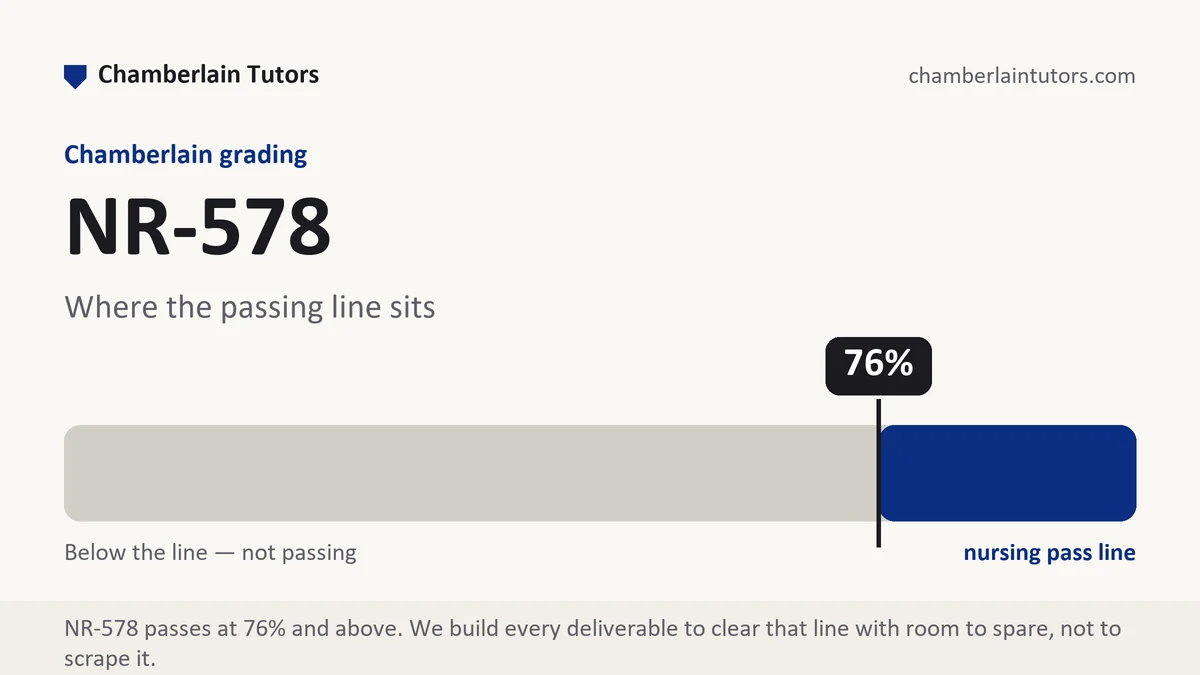
The specialty scale has no C, which sets the pass line at 84, and no supplementary work repairs a weighted average that has already drifted. Geriatric case documents are long, and they get compressed at the end of clinical weeks, which is where the marks go.
How we help in this course
We draft the comprehensive geriatric assessment write-ups, chronic care plans for older adults, medication review and deprescribing documents, falls and cognition case work, long-term care and transition papers, discussion posts and reflective assignments. Our drafts open with function, keep the medication list as a live object rather than an appendix, and force every recommendation to answer the question of whether this patient has time to benefit from it.
Your placement remains yours. We do not work clinical hours, contact preceptors, clinics, facilities or faculty, complete or sign placement documents or hour logs, or sit any assessment. The 125 hours here count toward the 625 clinical hours the MSN NP tracks carry. We write the documents that surround them.
In NR-578 right now?
Send the week and the rubric from Canvas. First premium sample free, floor-checked, back in 24 to 48 hours.
Read the rows before the chart
Comprehensive assessments are long documents, and length without a plan is how strong students end up with average scores. Take the rows into a blank file, cut each to its verb, assess, prioritize, manage, justify, coordinate, and write those as headings in the guide's order so a grader working down the rows never has to search backwards.
Then turn the percentages into a word plan. A 2,000 word geriatric case with rows weighted 35, 25, 25 and 15 percent gives roughly 700 words to the functional and clinical assessment, 500 to the prioritised management plan, 500 to the evidence and rationale, and 300 to coordination, caregiver support and follow-up. In practice, the assessment section swells to 1,200 words because there is so much data to record, and coordination, the part that decides whether anything actually happens for the patient, gets a closing sentence. The budget is what stops that, and it is worth writing down before you open the notes.
Keep the numbers beside each heading while drafting. If the coordination section will not fill, the plan has no named services, no caregiver instruction and no handover, and adding those three is both the writing fix and the clinical one.
The shape of a geriatric assessment and plan
Whatever the assignment is titled, the graded document usually contains these parts.
| Domain | What it has to record | The version that misses the point |
|---|---|---|
| Function and trajectory | What the patient can do now for daily and household activities, and what changed over recent months. | Independent, offered with no detail and no comparison. |
| Cognition and mood | The instrument used, the score, its limits, and what the result changes about the plan. | A judgment about memory with nothing behind it. |
| Medication review | Every agent with its indication, plus the sedative and anticholinergic burden read as a total. | A list transcribed from the chart with no analysis. |
| Mobility and falls | Gait, balance, footwear, home hazards, previous falls with injury, and a specific intervention. | Fall risk noted, precautions in place. |
| Nutrition, continence, sleep | The everyday domains that drive admissions, each with a finding and an action. | Omitted because the visit was about a disease. |
| Goals and horizon | What the patient wants from care, and how that shapes screening and treatment choices. | Full treatment assumed and never discussed. |
| Caregiver and setting | Who provides support, what strain they are under, and what the setting can deliver. | Family supportive, recorded once. |
| Prioritised plan | Three or four actions in order, with what was deliberately stopped or deferred. | A plan addressing every problem equally. |
Evidence and citation craft for older patients
Most clinical evidence was produced in patients younger and healthier than the ones in this course, so the craft rules bend around that fact.
Currency, and a second question about age. Where the guide sets no rule, hold recommendations to five years and justify anything older in the sentence. Then ask the question this course adds: what age range was enrolled. A recent guideline built on trials of adults under 75 is still weak evidence for a frail 90 year old, and saying so is analysis rather than evasion.
Time to benefit against remaining horizon. This is the geriatric evidence skill. Where a preventive intervention took several years in the trial to separate from control, write that interval, then place it beside a realistic statement of this patient's trajectory and priorities. It is the single most persuasive paragraph available in these papers, and it converts a screening or treatment decision from a default into a judgment.
Verbs that match designs, and harms reported as carefully as benefits. Observational geriatric research supports was associated with; trials support reduced. Older adults are also the group in whom harms are most often under-reported, so where you cite a benefit, cite the adverse effect data with the same precision rather than in a sentence of reassurance.
Denominator, window, and age band. Any rate needs its base and its period, and in this literature it needs the age of the people it came from. Among the 1,150 adults aged 75 and over followed for three years, 96 sustained a fracture is usable. An 8 percent fracture rate is not, because you cannot tell whose risk it describes.
What a strong geriatric case does first
A passing geriatric case is thorough and disease-shaped. Every problem is addressed, the medications are listed, the guidelines are followed, and the plan would exhaust the patient if anyone tried to carry it out.
Strong cases do three things. They lead with function and let it drive priority, so the plan starts with what the patient is losing rather than with the highest laboratory value. They set the horizon explicitly, saying which interventions have time to help and which do not, which is the reasoning that justifies both stopping and continuing. And they write the stop list, naming what comes off and how, since in this population subtraction is usually the intervention with the largest immediate effect. Function first, horizon stated, something removed.
Mistakes that cost points here
- A disease list with no function in it. If nothing in the write-up says what the patient can do, the assessment row is scoring a chart summary.
- Screening on autopilot. Recommending a test without any statement about horizon or preference is the classic error this course is built to correct.
- Cognition asserted rather than assessed. Name the instrument, report the score, note what could confound it, and say what it changes.
- A medication list left unanalysed. Indication, burden and a proposed subtraction are the three things the review row wants.
- The caregiver invisible. A plan that depends on a family member without ever assessing their capacity is a plan that will fail in the first fortnight.
- Posting before rereading. Chamberlain discussion posts do not reopen after submission, so draft it, check the medication reasoning, then paste.
Questions NR-578 students ask
How do I write about prognosis without sounding like I am predicting a death date?
My patient lives in long-term care. Does that change how I write the plan?
How do I keep a comprehensive assessment from becoming twelve pages of data?
Where NR-578 sits in Chamberlain's programs
Open the exact program map for sequence, credit, and option context. The current student schedule and syllabus remain authoritative after transfer evaluation, electives, state rules, and approved plan changes.
The weeks, one by one
Week 1
Anyone who has worked a med-surg floor has watched an eighty-six year old arrive walking for a straightforward pneumonia and leave five days later unable to reach the bathroom without two people, with a discharge summary that records the antibiotic and says nothing about the walking. Read the full Week 1 manual.
Week 2
A telephone medication review, with a spouse reading bottle labels aloud one at a time and pausing over the two that look identical, produces a list no reconciliation screen in a chart has ever matched. Read the full Week 2 manual.
Week 3
A video visit is a difficult place to discover that the answers you are hearing have been quietly prompted from just off camera for months, and the discovery itself is a finding worth writing down. Read the full Week 3 manual.
Week 4
Post-fall paperwork on an inpatient unit trains a nurse to record an event: time, witnessed or not, injury, notification, neuro checks. Read the full Week 4 manual.
Week 5
A discharge summary listing nine active diagnoses and eleven follow-up recommendations is a familiar object to anyone who has worked a med-surg unit, and it is also an impossible instruction: the recommendations were written by nine different services, none of which knew what the other eight were. Read the full Week 5 manual.
Week 6
The transfer packet that leaves a med-surg unit at five o'clock on a Friday is the least reliable document in American health care, and every nurse who has received one on the other end at seven that evening knows exactly which fields were copied forward without being read. Read the full Week 6 manual.
Week 7
A family meeting held over video, with one son in a car park on his lunch break and a daughter on a laptop three states away, is now an ordinary way for a goals-of-care conversation to happen, and the written record of it is graded on the same things a bedside conversation would be. Read the full Week 7 manual.
Week 8
A nurse finishing a long stretch on a med-surg unit can usually name the three patients she still thinks about and cannot name a single competency she demonstrated, and a closing practicum document is the exercise that converts the first list into the second. Read the full Week 8 manual.