Chamberlain's CEPH-accredited MPH runs 43 to 44 credits across six semesters, 14 months on the accelerated path, at a verified $590 per credit, fully asynchronous online except the fieldwork that matters most: a 144-hour Applied Practice Experience and the Integrative Learning Experience that closes the degree. Provisional admits add MPH-599 Professional Writing, which announces what the program actually grades. We draft the population-health writing end to end, 24 to 48 hours per deliverable, on the MPH scale where an A starts at 93.
The program, briefly
The MPH runs Chamberlain's weekly machinery at public-health altitude: epidemiology and biostatistics interpreted in prose, policy briefs, program-planning documents, and community assessment work, discussion boards included and uneditable as everywhere. The asynchronous design makes it a working professional's degree, and the accelerated calendar makes it a dense one; six semesters of weekly deliverables reward the same session-map discipline as the nursing programs, with gentler grading edges but the same two-failure dismissal backstop.
What MPH writing rewards
Public-health rubrics prize data carried honestly into argument: rates and confidence intervals read correctly, disparities described with precision rather than sentiment, interventions matched to the evidence base and budgeted like they might actually run. The common failure is advocacy-register writing where analysis was asked for. Our public-health drafts keep the quantitative spine visible, cite current surveillance and literature, and land recommendations an actual health department could implement, which is the exact bar the CEPH competencies set.
The APE and the Integrative Learning Experience
The 144-hour Applied Practice Experience pairs fieldwork with a two-part written product, and the ILE closes the degree with an integrative deliverable that must braid the competencies together. Both are staged documents, not sprints: we scope them with dated plans, draft the written products through the two-QA pipeline, and keep the portfolio layer consistent with the fieldwork as you report it. The practice-experience hours run virtually through our desk, coordinated with your program; every page the gradebook sees is ours to draft and yours to own.
Six semesters, and what each term actually asks
Run the arithmetic before the first start date and the program stops surprising you. Credits of 43 to 44 spread across six semesters average a little over seven credits a term, and each semester splits into two 8-week sessions, so the load usually arrives as courses back to back rather than side by side. At the verified $590 per credit, the degree prices out between $25,370 and $25,960, which is roughly $4,200 to $4,350 a semester before books and fees. The figure that catches working students is not the money. A 3-credit graduate course planned at nine hours a week over a 15-week term becomes about 17 hours a week when the same content is compressed into eight, and the accelerated 14-month route runs that compression repeatedly with six start dates a year feeding it.
The pace decision, named in both directions
The accelerated route and a longer arrangement are not a serious option and a soft one. They are two different risk profiles, and the right answer depends on what your next two years look like outside Canvas.
| Pace | What it buys | What it costs | Who it fits |
|---|---|---|---|
| Accelerated, 14 months | The credential sooner, fewer terms for life to interrupt, one continuous stretch of momentum | No absorbent weeks. A bad month has nowhere to go, and the applied practice term lands while coursework is still running | Stable job, stable home, and a protected block of weekly hours that genuinely exists |
| Spread across more terms | Room to absorb a bad month, easier scheduling for the applied hours, lighter weekly reading | Longer total exposure, more re-entry points, and momentum rebuilt from scratch each term | Shift work, caregiving, or a job that spikes seasonally |
| A deliberate sit-out session | A real reset when the alternative is a failing stretch on the transcript | Sequence risk. One skipped course can move the term that holds the practice experience | Anyone whose alternative is submitting work they already know is under the line |
Your enrollment plan and your advisor are the authority on which courses run in which term, and that plan deserves to be read like a contract before you commit to a pace. Ask which courses have to be finished before the practice experience term opens, and get the answer in writing. The pace decision is cheap to make in month one and expensive to make in month ten.
The four points that decide a letter
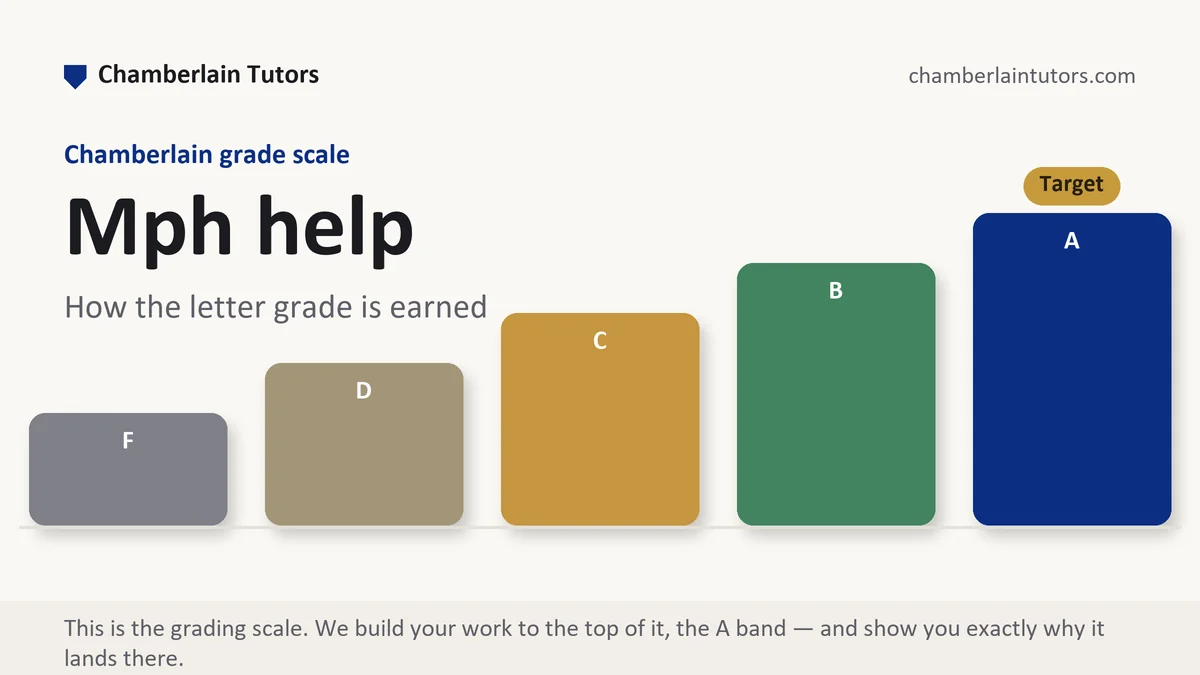
On the MPH scale an A opens at 93, the C band is only four points wide at 73 to 76, and F begins at 69. That geometry punishes a specific student: the consistently good one. Here is the arithmetic, using a weighting shape your own syllabus will replace with its real numbers.
Say a course puts 75 percent of the grade in weekly work and 25 percent in one final written piece. Weekly work averaging 91.5 contributes 68.6 points (91.5 at three quarters weight). A strong 95 on the final piece adds 23.8 (95 at one quarter weight). Total: 92.4. That is a good semester and it is not an A. To clear 93, the final piece has to score 97.5, because 93 minus 68.6 leaves 24.4 points that must come out of a quarter of the grade. Almost nobody writes a 97.5 under deadline pressure.
The lesson is not to write harder in week eight. It is that the A band is won in the weeks that carry no tension, when two points are still cheap to buy. A 91.5 average is a decision made early, not a verdict delivered late.
The mistakes that cost MPH students real points
Graders in this program mark the same handful of failures term after term, and none of them are about effort.
- A rate quoted with no denominator and no period. "Cases rose 40 percent" tells a reader nothing until it says out of what population, across which months, measured against what baseline.
- A confidence interval reported and then ignored. An interval that crosses the null, written up as a positive finding, is the fastest way to lose the analysis row of a rubric.
- Crude rates compared across populations with different age structures and then called a disparity. Age-adjust, or say plainly in the text that you did not and what that limits.
- Recommendations with no owner, no cost, and no timeline. A rubric asking for a program plan reads that as an opinion with paragraph breaks.
- A framework named in the introduction and never used again. Naming it is free. Applying it to your own data is the graded part.
- A news write-up cited where the surveillance table or the original study was available. Public health rubrics check the citation trail harder than most.
- Figures and tables that restate the paragraph beside them instead of carrying what the prose cannot.
Planning the 144 hours before the term that holds them
The hour count is the piece students plan last and should plan first. Spread the 144-hour requirement across a 16-week semester and it is nine hours a week. Compress the same total into one 8-week session and it is 18, which for a full-time employee is a second job stacked on the coursework that term still owes. Choose the weekly rate first and the calendar follows: six hours a week needs 24 weeks, twelve hours a week needs twelve, and the site you approach has to be able to agree to whichever number you bring. Bringing a number is also what makes that conversation short.
Be exact about the division of labor here, with us and with anyone else you consider. The site, the hours, the supervision, and the log are yours, and they are the part of this degree that is supposed to be your own experience. The writing around them is the work that can be handed off: the scoping document, the two-part written product, and the integrative deliverable that closes the degree. Before you pay anyone for help at this stage, ask three questions and listen closely to the answers. Which documents exactly do you draft? What happens if a coordinator asks for changes after review? Whose name goes on the deliverable? Anyone offering to arrange hours or sign paperwork is offering you a problem rather than a service.
Three questions MPH students send us
I already work in public health. Can my job count toward the applied hours?
My statistics are ten years old. Will the biostatistics writing sink me?
I sat out a session. What did that actually cost me?
Send this week's brief
Course code, assignment, rubric. Public-health register drafts, first premium sample free.