NR-584NP sits in Chamberlain's MSN-NP core sequence, on the MSN-NP core path. This is its help page: what the course really grades and how our team carries it, floor check included.
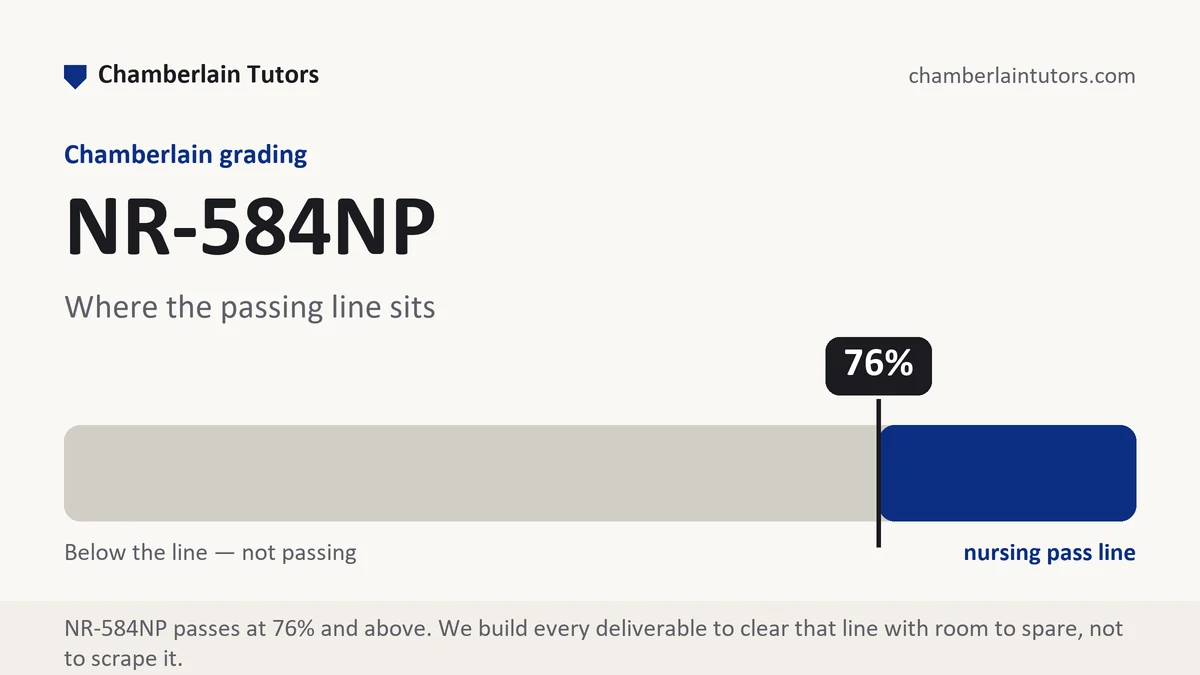
What NR-584NP actually grades
The core's later stretch, integrating the sequence's threads into more sustained written work while the weekly cadence never relents. By now the scale has taught its lesson to everyone; the question is whose gradebook paid the tuition for it.
How we help in this course
For clients arriving mid-core we start with the gradebook screenshot, compute the honest position on the specialty scale, and draft what the remaining weeks need. For clients who started with us, 584 is usually the quiet course.
Deliverables run the standard promise: a premium original draft in 24 to 48 hours, targeted at the A band of your course's actual scale, through the eight-person pipeline with both QA passes and the floor check, revised free until it lands.
How to write this course's deliverables
Open every deliverable in this course by asking what the scoring guide wants proved, not what the prompt wants covered. Later-core writing is longer, and length is where unscored prose accumulates unnoticed. The discipline that keeps a long paper scoring is narrow: each criterion row from your Canvas rubric becomes a heading in the draft, each heading gets either a number or a source underneath it, and anything with neither gets cut before it eats the space a scored row needed. The sections below apply that to the deliverable this stretch of the core keeps asking for, the sustained paper that takes a real problem and argues a change.
In NR-584NP right now?
Send the week and the rubric from Canvas. First premium sample free, floor-checked, back in 24 to 48 hours.
Arriving mid-core with a gradebook in hand
Most NR-584NP orders open with a screenshot, because by the core's later stretch the question is rarely abstract: it is a number. The desk computes your standing on the no-C scale, states plainly what the remaining graded work must average, and builds the week plan backward from that figure. Since nothing at Chamberlain curves and no excused graded work exists, the honest math is the only planning tool there is, and we run it before any order is priced.
What the desk returns each week here
The later core weeks mix sustained written deliverables with boards that stay permanent the moment they post. Written work moves through the eight-person pipeline, rubric QA first, then the separate APA and originality pass, then the floor check against the 94-plus A band, delivered inside 24 to 48 hours and ahead of the Mountain-Time clock. Board posts arrive composed, sourced, and checked, ready to paste once, final. Replies follow the same rule because they are graded and uneditable too.
Is it too late to start help in the fourth core course?
Almost never. The scale punishes drift, but the arithmetic usually shows more room than the dread suggests, and a strong finish on A-band drafts moves an average fast in an eight-week format.
Does the free sample still apply this deep in?
Yes. First premium draft free, floor-checked, regardless of which week of the sequence you arrive in. Many mid-core clients decide from that single draft whether the desk carries them the rest of the way.
Turning rows into questions you can answer
Rewrite each criterion row as a question a stranger could ask you, then answer it in one line before you draft anything. A row about a practice problem becomes: how big is it, in what population, over what period. A row about evidence becomes: which three sources say the change works, and how good are they. A row about evaluation becomes: what number would move, and when would you look. Rows that produce a confident one-line answer are already written. Rows that produce a shrug are where the paper is going to lose points, and you have found them on day one rather than on day six.
Then buy length with weight. Suppose four rows carry 48, 30, 24 and 18 points against an 1,800-word target. Deduct 200 for framing that belongs to no single row, leaving 1,600 to divide: roughly 640 words for the 48-point row, 400 for the 30, 320 for the 24 and 240 for the 18. Four rows means four substantial sections, and 640 words is three or four paragraphs, not a heading with two sentences under it. Divide using the weights printed on your own guide before you write a line.
How a practice-problem paper is built
Absent headings supplied by the prompt, these six pieces cover what a later-core guide asks for, and together they stop a paper about a problem drifting into an essay about a topic.
| Piece | What a grader is checking for | The failure mode |
|---|---|---|
| The problem, with a number | That the problem is real and sized: how often, in whom, measured how, over what period. | A problem stated as a concern. Nothing later in the paper can be evaluated against a concern. |
| Setting and the people in it | That you know who is affected and who would have to act differently for anything to change. | Naming a unit and stopping. Rows about stakeholders want the people whose work the change lands on. |
| The evidence for the change | That someone has tested something like this, in a population near enough to yours for the result to travel. | Evidence that a problem exists, offered as evidence that a solution works. Two different claims. |
| The change itself | That the change is specific enough for a reader to picture Monday morning: who does what, when, instead of what. | "Implement education." It is the most common intervention in graduate writing and the least scoreable. |
| Measurement | That you named the number, the base it sits over, the collection method and the point at which you look. | Measuring satisfaction with the change instead of the outcome the change was meant to move. |
| Barriers | That you anticipated the two or three genuine obstacles and have a response to each. | An apology in disguise. Barriers rows want problem-solving, not a list of reasons it might fail. |
Numbers, sources and the verbs between them
This is the course where students start quoting figures, and figures are where careful papers break.
A count on its own proves nothing. Not "falls dropped from 12 to 7" but "7 falls per 1,000 patient-days across the 90 days after the change, against 12 per 1,000 patient-days across the 90 days before." Counts without a denominator move with census and prove nothing.
Compare like with like. A before period and an after period should share the same base and the same length. Six months of baseline against six weeks of follow-up is not a comparison, and graders in this stretch of the core catch it.
Lead with the study, not the conclusion. "A cluster trial across 14 primary care sites, following 2,300 patients, reported" is appraisal. "The literature supports" is a placeholder.
Practice improvement is rarely randomized. Almost nothing in this kind of work assigns anyone to anything, so the defensible verbs are followed by, coincided with, observed together with. Reduced and caused require a design that assigned people to groups. Overclaiming here damages a paper faster than a missing source.
Guidelines and studies do different jobs. A guideline tells you what is recommended and when it was last revised. It does not supply the effect size, and citing it for one is a marked error rather than a stylistic preference.
The gap between complete and convincing
Work that passes identifies a real problem, cites current evidence, proposes something reasonable and stays inside the format. It is complete. With no C band underneath it, complete and unremarkable is a narrower margin than it feels like at the time.
A strong paper is recognizable by two features. Its numbers connect: the figure in the problem statement is the same figure the measurement section proposes to move, in the same units, over a stated period. And its change is specific enough to argue with, which means a grader can imagine it happening and can also imagine why it might not. Papers that stay general cannot be disagreed with, and work that cannot be disagreed with reads as work that took no position.
What quietly costs points in NR-584NP
- A problem with no size. If nothing was counted, nothing can be evaluated, and every later row inherits the weakness.
- Education as the whole intervention. Teaching people something is a component, not a change. Say what happens differently after the teaching.
- A borrowed baseline. A rate from a published study in another setting is context, not your unit's starting point. Label it as what it is.
- A measurement plan with no window. A number with no when is a hope. Name the point at which you look and what you expect to see.
- Causal verbs on observational evidence. Nothing else undoes an otherwise solid paper this quickly.
- Sprawl. Later-core papers run long, and long papers hide unscored paragraphs. Map paragraphs to rows before submitting, and delete what maps to nothing.
Questions from later-core intakes
My site will not give me real data. What do I use?
How specific does the proposed change have to be?
The rubric says analysis and my writing keeps coming out as description. How do I tell them apart?
The weeks, one by one
Week 1
NR-584NP Week 1 opens Chamberlain's Quality and Safety for Advanced Nursing Practice course, and quality courses almost universally open the same way: with the story of how patient harm became a measurable discipline, and with the vocabulary that the next seven weeks will assume you own. Read the full Week 1 manual.
Week 2
NR-584NP Week 2 usually descends from the field's history into its engine room: safety science, the study of why competent people working in imperfect systems produce harm, and just culture, the framework for responding without either scapegoats or shrugs. Read the full Week 2 manual.
Week 3
NR-584NP Week 3 typically teaches the discipline's ruler: how quality is measured, and why a well-built measure is harder than it looks. Read the full Week 3 manual.
Week 4
NR-584NP Week 4 usually arrives at the doing of improvement: the models that structure change, small-cycle testing chief among them, and the working tools, cause-and-effect diagrams, process maps, run charts, that make problems visible before anyone tries to fix them. Read the full Week 4 manual.
Week 5
NR-584NP Week 5 typically pairs the two formal investigation methods of the safety toolkit: root cause analysis, which works backward from an event that happened, and failure mode and effects analysis, which works forward through a process that has not failed yet. Read the full Week 5 manual.
Week 6
NR-584NP Week 6 usually widens the lens from the unit to the forces above it: the regulators who require, the accreditors who survey, the payers who tie dollars to performance, and the public reporting that puts a facility's numbers where patients can read them. Read the full Week 6 manual.
Week 7
NR-584NP Week 7 is where the course's pieces usually assemble into its heaviest single deliverable: a quality improvement proposal that takes one sized problem from evidence through intervention to a measurement plan. Read the full Week 7 manual.
Week 8
NR-584NP Week 8 typically asks the question improvement work most often fails: not whether a change can be made, but whether it holds after the attention moves on. Read the full Week 8 manual.
Where NR-584NP sits in Chamberlain's programs
Open the exact program map for sequence, credit, and option context. The current student schedule and syllabus remain authoritative after transfer evaluation, electives, state rules, and approved plan changes.