NR-577 is the AGPCNP management practicum for adolescents, adults, women and marginalized populations, 125 precepted hours with the written work carried by a small theory component. Where the diagnostic course asks what is wrong, this one asks what happens over the next year: the target you and the patient agree on, the point at which you intensify treatment, and what you do when the plan meets a life that does not accommodate it.
What NR-577 actually grades
Management across time, not management at a moment. Chronic disease plans are scored on whether they have a trajectory: a starting point, a target, a review date, a threshold that triggers the next step, and a statement of what the next visit will decide. A plan that names a drug and a lifestyle recommendation has described a visit. The rubric rows are looking for the twelve months after it.
The second thread is the patient in the plan. This course names marginalized populations explicitly, and that shows up in scoring as a demand for realism: a plan built around three daily doses for someone working two jobs, or a referral to a service the patient cannot reach, is clinically correct and practically useless, and the guide will reward the version that says so and adapts. Adolescent care adds its own requirement, since confidentiality and consent work differently and a write-up that ignores them is missing content rather than nuance.
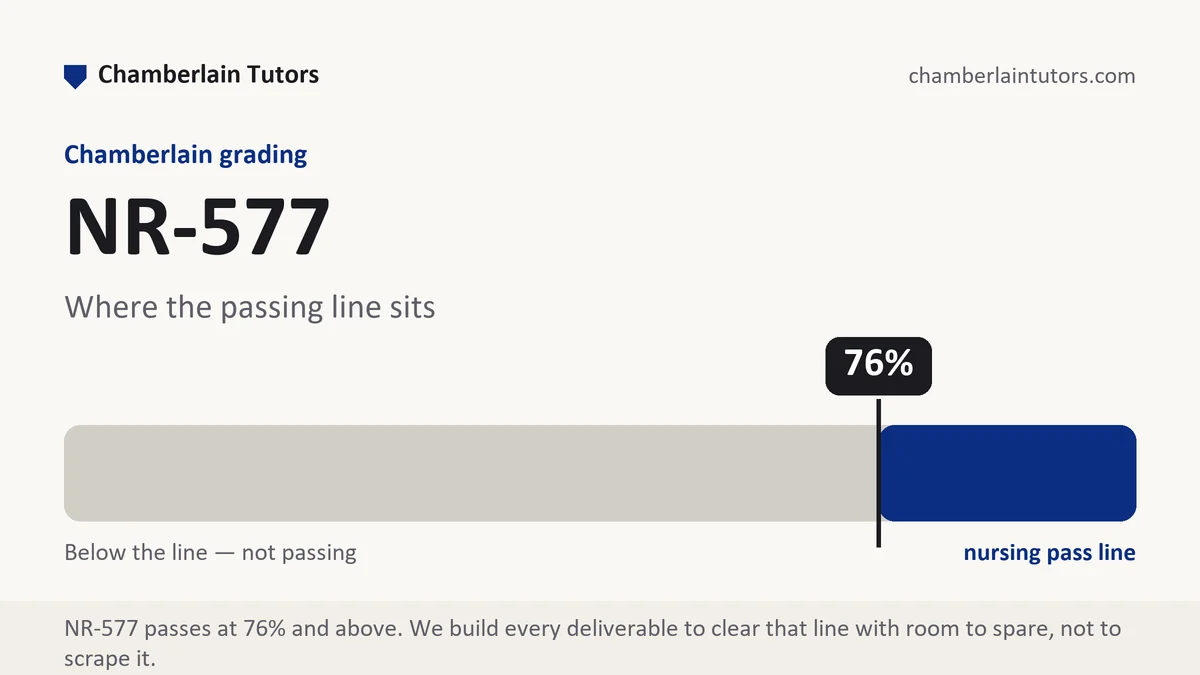
The specialty scale has no C, putting the pass line at 84, and supplementary work cannot lift an average that has already slipped. In a practicum, the written work is produced around clinic days, which is exactly why plans get written thin and score in the middle.
How we help in this course
We draft the chronic disease management plans, acute presentation write-ups, health promotion and screening pieces, case analyses, patient education documents, discussion posts and reflections. The habit our drafts hold is putting a date on everything: targets with review points, intensification with thresholds, follow-up with a decision attached, which is what turns a correct plan into a plan that scores.
The clinical component is entirely yours. We do not complete hours, contact your preceptor, clinic or faculty, sign or complete placement paperwork or logs, or sit assessments. Those 125 hours count toward the 625 clinical hours the MSN NP tracks require. The writing is where we work.
In NR-577 right now?
Send the week and the rubric from Canvas. First premium sample free, floor-checked, back in 24 to 48 hours.
Turn the guide into a plan with dates
Management prompts hand you a patient and ask for a plan, and the guide quietly asks for five separate things inside it. Copy the rows out, reduce each to its verb, assess, plan, justify, educate, evaluate, and use those as headings in the guide's order so the grader scores in the sequence they read.
Then convert each weight into a word count. An 1,800 word management case with rows weighted 30, 25, 25 and 20 percent gives roughly 540 words to the treatment plan, 450 to the evidence and rationale behind it, 450 to education and self-management support, and 360 to monitoring and follow-up. The way these usually arrive is 700 words of background about the disease, 600 on the drug choice, and a closing paragraph covering education, monitoring and follow-up together. Two rows worth 810 words end up sharing 200, and the score reflects it precisely.
Keep the budget bracketed beside each heading. When the follow-up section will not fill, the plan has no thresholds in it, and writing three of them, the value that triggers intensification, the value that triggers referral and the date of the next review, fixes both the section and the plan.
The shape of a chronic disease management plan
Whatever the assignment is called, the graded document usually assembles from these parts.
| Part | What it has to show | The version that scores as ordinary |
|---|---|---|
| Where the patient is now | Current control stated in numbers, with the trajectory over recent months. | A diagnosis with no current measurement attached. |
| Target, negotiated | The goal, whether it matches the guideline target, and why it differs if it does. | The guideline number applied without reference to this patient. |
| Treatment plan | What starts, what changes, at what dose, and what is deliberately left alone. | A drug named with no relationship to the current regimen. |
| Intensification rule | The value and the date at which you escalate, and what the next step would be. | Adjust as needed based on response. |
| Barriers and workaround | Cost, transport, work pattern, literacy, insurance status, and the specific adaptation you made. | Encourage adherence. |
| Prevention folded in | The screening, immunisation or counselling this visit could also deliver. | Preventive care deferred indefinitely to another appointment. |
| Follow-up with a decision | The interval, what will be measured, and what that measurement will decide. | Return in three months, purpose unstated. |
Evidence and citation craft in chronic care writing
Chronic disease evidence is abundant and easy to misuse, and these rubrics reward students who use it carefully.
Targets have vintages. Where your guide sets no rule, treat recommended targets, intervals and first-line choices older than five years as needing a stated reason. Disease mechanism from an older text is fine to cite; a threshold value is a moving number, and quoting a superseded one is a content error that a grader can check in a minute.
Ask what outcome was measured. Many chronic disease trials report a surrogate: a laboratory value, an imaging measure, a score. Whether that surrogate has been shown to track something the patient would care about is the analytic question this course rewards. Write it plainly, that the agent improved the measured value and that the evidence for a change in events is stronger or weaker, and the evidence row moves up a band.
Design and sample before the finding, with age called out. Adolescent management is frequently extrapolated from adult trials, and where you are doing that, say so and give the pharmacological or developmental reason it is reasonable. Reporting the enrolled age range in the sentence is a small habit with a large payoff in this course.
Verbs and denominators. Observational adherence and outcome work supports was associated with; randomized work supports reduced. Any rate carries its base and window, so write that 62 of the 940 patients treated over four years reached the target rather than quoting a percentage with no period attached, because in chronic disease the period is usually what the argument turns on.
Where a management plan earns the top band
A passing management plan in NR-577 is guideline-concordant and static. It picks the recommended agent, sets the recommended target, advises the recommended lifestyle changes, and would be identical for any patient with that diagnosis.
Strong plans differ three ways. The target is negotiated and the negotiation is visible, so the document records what the patient said they could do and what you agreed as a first step. The barrier is named and answered, which means the plan mentions a real obstacle, cost, hours, transport, caregiving, and adapts around it rather than exhorting past it. And the intensification is scheduled, with a value and a date rather than a promise to reassess. Negotiated target, named barrier, scheduled next step.
Mistakes that cost points here
- Lifestyle modification as a line item. Two words with no content score nothing. Name the change, the frequency, the starting point and how it is followed up.
- A target set without the patient. Where the guide asks for shared decision making, the plan has to record a preference that was actually expressed.
- Adolescent confidentiality mishandled. Consent, confidentiality and the presence of a parent in the room are graded content in adolescent cases, not background detail.
- No intensification threshold. A plan that never says when to escalate is a plan that cannot be evaluated at the next visit.
- Structural barriers acknowledged and then ignored. Naming a barrier and proceeding unchanged is worse than not naming it, because the guide is scoring the adaptation.
- Posting an unchecked draft. Discussion posts at Chamberlain cannot be edited once submitted, so build the plan in a document, check the doses and dates, then paste.
Questions NR-577 students ask
How do I write about social barriers without making assumptions about the patient?
How much detail does patient education need in the write-up?
My plans are correct but keep scoring in the low eighties. What is missing?
Where NR-577 sits in Chamberlain's programs
Open the exact program map for sequence, credit, and option context. The current student schedule and syllabus remain authoritative after transfer evaluation, electives, state rules, and approved plan changes.
The weeks, one by one
Week 1
A nurse who has spent nine years on a med-surg floor already knows how to titrate a plan against a patient who is not improving; what this course adds is the obligation to write that reasoning down as the person who made the decision rather than the person who carried it out. Read the full Week 1 manual.
Week 2
A video visit for four days of cough is the cleanest test of acute management writing there is, because the camera strips away almost everything except your history and your reasoning, and what is left on the page is the decision itself. Read the full Week 2 manual.
Week 3
Every nurse who has passed medications on a busy surgical floor has watched a drug get given for a reason nobody at the bedside could articulate, and the whole point of a prescribing stage is that the articulation is now your job. Read the full Week 3 manual.
Week 4
Chronic disease looks entirely different from a hospital bed than it does from a clinic chair: on the unit you meet it at its worst hour, and in primary care you meet it as a slow line on a graph that nobody has looked at in eighteen months. Read the full Week 4 manual.
Week 5
Nothing in an adult clinic prepares a writer for the moment a parent is asked to step out of a video call, because the confidentiality architecture that follows has no equivalent anywhere else in primary care. Read the full Week 5 manual.
Week 6
On a med-surg unit a contraceptive is a line on a home medication list, transcribed once and never questioned; in an ambulatory management practicum it becomes a decision you have to defend against a person's clotting risk, her migraine history, her plans and her ability to get a refill. Read the full Week 6 manual.
Week 7
A patient who joins a video visit from a parked car on a fifteen minute break, with the phone propped on the steering wheel, has already told you more about why the last plan failed than any social history question will. Read the full Week 7 manual.
Week 8
Anyone who has written a med-surg shift handoff knows the difference between telling the next nurse everything that happened and telling them the four things that will decide the night, and a closing practicum synthesis is graded on exactly that distinction. Read the full Week 8 manual.