In the MSN-NP core sequence, NR-585NP is MSN-NP core sequence. Students search the code mid-panic more than any title, so this page answers the code: here is the honest read and the service behind it.
What NR-585NP actually grades
Late core, where role synthesis and heavier written deliverables meet the calendar's first real fatigue. The uneditable boards stay unforgiving, and supplementary work still cannot rescue a weak core average in courses that weight it.
How we help in this course
Our 585 drafts hold the A band while the walkthroughs stay honest about what each rubric row wants, because tired weeks are when self-scoring drifts. The session map keeps the finish line visible.
The service terms match the whole site: 24 to 48 hour delivery, A-band targeting on your scale with the floor math shown, two independent QA passes, free revisions until the target is met.
How to write this course's deliverables
The habit worth building in this course is scoring your own draft before Chamberlain scores it. Late-core deliverables run long enough that a tired writer stops seeing them, and a scale with no C band leaves generous self-assessment nowhere to land. So give the last hour before submission to the scoring guide rather than to a spell check: open your rubric in Canvas beside the draft, take one criterion row at a time, and highlight the sentences that answer it. Rows with nothing highlighted are where your grade is sitting right now. The sections below build that pass out into a working method for the synthesis writing NR-585NP asks for.
In NR-585NP right now?
Send the week and the rubric from Canvas. First premium sample free, floor-checked, back in 24 to 48 hours.
Late-core weeks and the fatigue problem
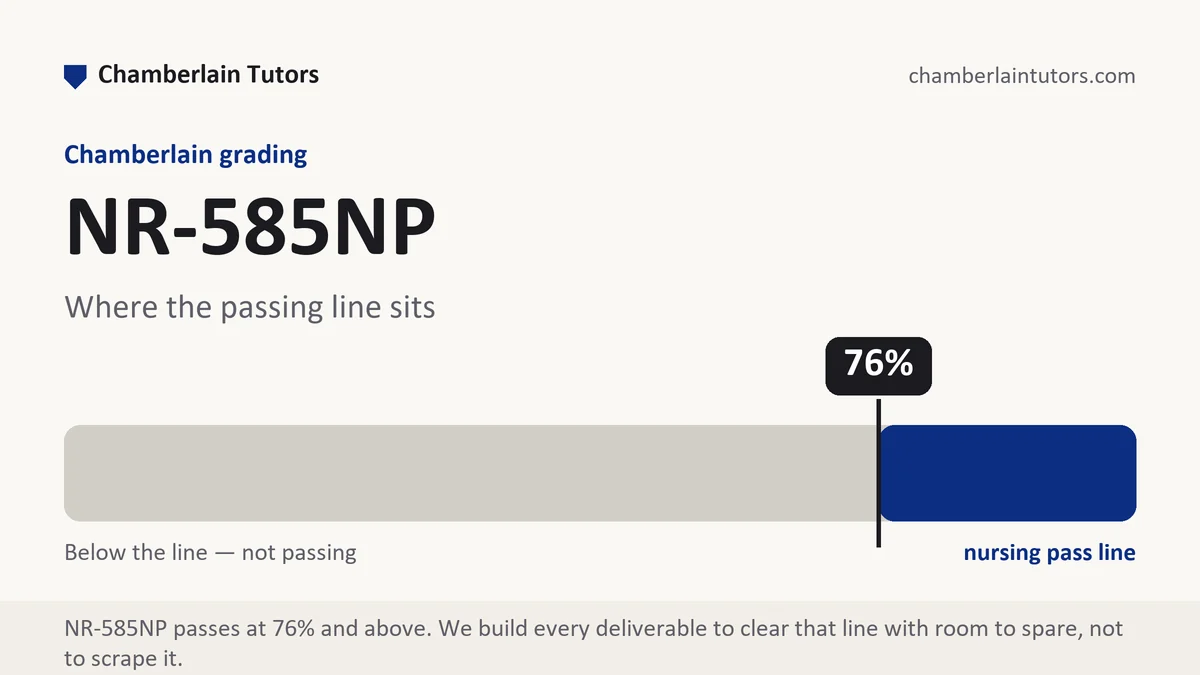
NR-585NP lands where the calendar starts collecting its toll: heavier synthesis writing, the same relentless weekly cadence, and a scale that still treats 83 as failure. Tired students self-score generously, which is precisely the drift the floor check is built to catch. Every draft leaving the desk is pre-scored against the course's real ladder before delivery, and the session map keeps the remaining weeks visible so the finish line stays a plan rather than a hope. Weeks that would have been all-nighters become hand-offs instead, and the energy saved goes where the scale actually pays for it, into the graded work still ahead.
What one week of this course produces
A representative week generates an uneditable board post with replies and a substantial written deliverable, all graded, all feeding an average with no C beneath it. The desk's rhythm maps onto that shape cleanly: post drafted final and pasted once, written work back within 24 to 48 hours through both QA passes, everything cleared ahead of 11:59 p.m. Mountain Time. Supplementary effort cannot rescue a weak core average in courses that weight it, so the drafts aim where the weight is.
Getting this week scoped today
Chat with the week number, the rubric, and your current standing does it. The reply covers what the week is worth, what the draft will argue, and the delivery time, and if you want proof before commitment, the first premium sample costs nothing and arrives floor-checked like everything else. No card, no commitment, just the evidence.
Budget the rows forward, score them backward
Plan a long paper by weight and check it by highlighter. The forward half takes five minutes. Suppose the guide splits 210 points across six rows: 55, 45, 40, 30, 25 and 15, with the deliverable landing near 2,700 words. Keep 200 back for the first and last paragraphs, which sit outside the rows, then divide the remaining 2,500 by weight: roughly 655 words for the 55-point row, 535 for the 45, 475 for the 40, 355 for the 30, 300 for the 25 and 180 for the 15. Write those six numbers at the top of the document and treat them as ceilings as well as floors. Your own guide will carry different weights; the division is what carries over.
The backward half happens the night before. Highlight every sentence that answers a given row in one colour, then move to the next row. Three things show up fast. Unhighlighted paragraphs are unscored, and in a paper this long there are usually several hundred words of them. A row running far under its budget is a section you skimmed because you were tired of the topic. A row running far over is usually the one you found interesting, which is not the same as the one that pays. Fix the shortfalls with the words you take out of the overruns and the paper gets better without getting longer.
The spine of a synthesis paper
If the prompt leaves the layout to you, these six stages hold a long argument together and keep it from turning into several shorter papers printed in a row.
| Stage | What it has to settle | Where it slips |
|---|---|---|
| The question the paper settles | That there is one argument here, stated early, that every later section serves. | An announcement of scope. If the opening lists topics rather than taking a position, the synthesis rows have nothing to attach to. |
| The threads you are joining | That you can say in a paragraph what each strand of the sequence contributes to this question. | Recapping courses. A grader wants the ideas, not a tour of where you met them. |
| Synthesis | That you can group sources by what they claim, name where they conflict, and say which you weight more and why. | Source-by-source paragraphs. This is the row most often left empty in an otherwise full paper. |
| Your position, defended | That you took a side and then met the strongest argument against it directly. | Meeting a weak objection instead. Graders at this level notice the substitution immediately. |
| What it takes in practice | That the position survives contact with staffing, cost, workflow and the people who would have to change. | Optimism. A plan with no friction in it reads as one that has never been near a clinic. |
| Evaluation and next step | That you named what you would watch, over what period, and what result would make you revise the position. | A summary in place of an evaluation. Repeating the argument is not the same as testing it. |
Weighing evidence when the sources disagree
Synthesis is a weighting exercise, and the weighting is where the citation rows are won.
Rank before you write. For every claim, decide which source carries it and which merely supports. A sentence trailing four citations tells a grader you could not choose, and choosing is the skill being graded.
Weight by design, not by count. "A three-arm trial in 640 primary care patients" earns weight. "Several authors agree" earns none, and it hides how thin the evidence underneath might be.
Currency, and why the exception has to be visible. Follow the window your guide names. An older source is defensible when it is the origin of a framework, and only if your sentence says so.
Verb strength travels upward. Observational evidence supports associated with, more common among, tracked alongside. Reduced, improved and caused belong to controlled designs. In a synthesis paper this matters twice, because your own position inherits the verb strength of the sources under it.
No rate without its base and its period. Not "follow-up improved" but "61 of the 94 patients who screened positive had documented follow-up inside 30 days, against 38 of 89 the previous quarter." Count, base, period, then meaning.
Setting transfer, said out loud. Evidence from a large academic centre does not automatically hold in a two-provider clinic. One sentence naming the gap is worth more than a paragraph pretending it is not there.
Deciding something, and why it scores
The paper that merely passes covers the ground. It is current, cited, organized and finished, and it says sensible things about every part of the question. What it never does is decide anything, and on a scale that turns 83 into a retake, a paper deciding nothing has spent 2,700 words being safe.
A strong paper commits. It names the position in the first paragraph, weights the evidence openly, takes on the best counterargument rather than a convenient one, and closes by naming the finding that would change its mind. Two smaller habits separate it further: it says how confident it is and why, and it stays the same length while doing more, because the space came out of the paragraphs that were only there to show reading. Late-core graders are reading for a clinician who can hold a position and still be moved by evidence, and that shows in the shape of the argument long before it shows in the sources.
Six point-leaks in NR-585NP writing
- Five short papers stapled together. Sections that never reference each other leave the synthesis rows empty no matter how good each section is.
- Citation stacking. Four sources behind one sentence is not thoroughness, it is an unmade decision, and it costs on the rows that reward judgement.
- A conclusion carrying new claims. Anything showing up for the first time at the end arrives unsupported by definition.
- Recycling your own earlier sections. Ask your faculty member before reusing prior work, in writing, and expect the answer to shape the plan.
- Meeting the weakest objection. Answering an easy counterargument reads worse than answering none, because it shows you saw the hard one and stepped around it.
- Meeting the rubric for the first time on the last night. Late-core writing sits on top of the 625 clinical hours an MSN NP track carries, and a tired first read of a scoring guide is the most expensive hour in the session.
What late-core students ask the desk
My paper is long enough but it reads like several short papers stapled together. How do I fix it?
Two of my sources flatly disagree. Which one do I use?
Can I build this on the same topic I used earlier in the core?
The weeks, one by one
Week 1
NR-585NP Week 1 is where a research and evidence-based practice course decides what you will spend the session arguing about, so the opening week almost always carries two jobs: separating research from evidence-based practice from process improvement, and turning something you have watched go. Read the full Week 1 manual.
Week 2
NR-585NP Week 2 usually turns the question you wrote into a search a stranger could run again, then asks you to rank what came back. Read the full Week 2 manual.
Week 3
NR-585NP Week 3 is where reading turns into judgement. Read the full Week 3 manual.
Week 4
NR-585NP Week 4 changes the instrument you appraise with. Read the full Week 4 manual.
Week 5
NR-585NP Week 5 is the week students dread and the week that pays the longest. Read the full Week 5 manual.
Week 6
NR-585NP Week 6 moves from whether a study is sound to whether it should have been done at all. Read the full Week 6 manual.
Week 7
NR-585NP Week 7 asks the question the whole session has been building toward: how does appraised evidence actually reach a patient. Read the full Week 7 manual.
Week 8
NR-585NP Week 8 closes the session where evidence work either lands or evaporates: deciding how anyone would know the change worked, and telling the people who need to hear it. Read the full Week 8 manual.
Where NR-585NP sits in Chamberlain's programs
Open the exact program map for sequence, credit, and option context. The current student schedule and syllabus remain authoritative after transfer evaluation, electives, state rules, and approved plan changes.