NR-568 is the three-credit pharmacology course for the adult-gerontology primary care track, covering drug therapy for acute and chronic disease in adolescents, adults and older adults, with polypharmacy as a running theme. The written work is not a drug list. It is a decision defended over time: why this agent, why not the obvious alternative, what benefit the patient can expect in numbers they would recognise, and what comes off the list to make room.
What NR-568 actually grades
Choosing under constraints. Acute prescribing is mostly about physiology; ambulatory prescribing is about physiology plus cost, adherence, follow-up intervals, patient goals and a medication list that already has nine things on it. The rubric rows in this course reward the student who writes the constraint into the reasoning rather than pretending the pharmacy is free and the patient takes everything as written.
The second graded thread is subtraction. Polypharmacy sections are not satisfied by counting drugs. They want a review that names a specific agent, states why it no longer earns its place, and gives a plan for removing it, including whether it can stop outright or needs a taper and what would signal that the removal went badly. Students find addition easy and subtraction uncomfortable, and the guide notices.
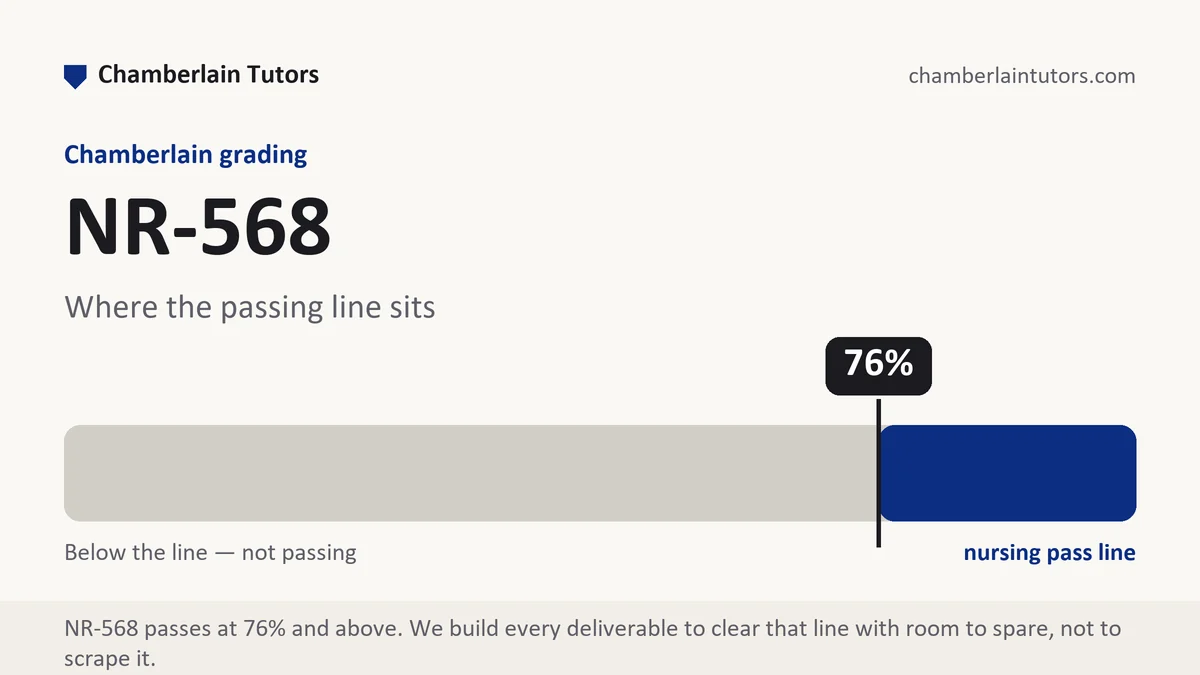
Because this sits in an NP specialty track, the grading scale carries no C, so below 84 fails, and no supplementary submission repairs a weighted average that has already drifted. In a course with weekly graded pieces, that arithmetic gets decided early.
How we help in this course
We draft the ambulatory prescribing cases, chronic disease management write-ups, drug class comparisons, polypharmacy and deprescribing reviews, patient teaching pieces and weekly posts. What our drafts add is the shape a grader is hunting for: goal first, choice defended against a named alternative, dosing adjusted for age and renal function, monitoring written as tests with dates, and teaching written in words a patient would actually use.
The limits are firm. We do not complete clinical hours, contact preceptors or sites, sign or fill placement paperwork, or sit assessments. Coursework is model writing built to a scoring guide, and it is not a prescription for anybody in your care.
In NR-568 right now?
Send the week and the rubric from Canvas. First premium sample free, floor-checked, back in 24 to 48 hours.
Read the rubric before the prompt
The prompt in a prescribing case usually reads like a clinical vignette with a question at the end, which encourages students to answer the question and stop. The scoring guide almost always asks for more than the question does. Pull the rows into a blank document, reduce each to its verb, assess, select, justify, monitor, educate, and let those verbs become headings in the guide's order.
Then read the percentages as word counts. A 1,500 word case with rows at 35, 25, 25 and 15 percent gives roughly 525 words to drug selection and rationale, 375 to dosing and adjustment, 375 to monitoring and follow-up, and 225 to patient education. The typical submission spends 800 words on selection, because that is the interesting part, then compresses education into four bullet points and calls the follow-up plan see in three months. Two rows worth 600 words between them arrive at 150, and the paper cannot reach the top band no matter how good the drug choice was.
Put the numbers in brackets after each heading while drafting. If the monitoring row will not fill, the missing element is nearly always a date: name the test, the interval, and the value that would change the plan, and the section writes itself.
The shape of an ambulatory prescribing plan
Under any assignment title, the graded object in this course tends to assemble from these parts.
| Part | What the row is checking | What the middle band submits |
|---|---|---|
| Indication and shared goal | What is being treated and what the patient wants from treatment, stated as an outcome they would notice. | A diagnosis with an implied goal nobody agreed to. |
| Agent chosen, alternative rejected | The class selected for a stated reason, and the reasonable alternative named with why it lost. | One drug presented as though nothing else existed. |
| Dose for this body | Starting dose and titration adjusted for age, weight, renal function and interacting agents. | An adult standard dose applied to an 84 year old with reduced clearance. |
| Access and adherence | Cost, formulary reality, dosing frequency and what the patient can sustain in daily life. | Silence, or a sentence encouraging adherence. |
| Interactions and deprescribing | The interactions that matter on this list, plus what comes off and how. | A list of every theoretical interaction and no decision. |
| Monitoring with dates | Tests and observations, when, and the value that would change the plan. | Monitor labs periodically. |
| Teaching and follow-up | What the patient is told, what they should report, and what decision the next visit makes. | Education provided, followed by return as needed. |
Evidence and citation craft for prescribing arguments
Ambulatory drug writing is judged on how carefully you carry numbers from a trial to a person, so four habits do most of the work.
Recommendations expire; pharmacology does not. Where your guide sets no limit, treat therapeutic recommendations older than five years as needing a stated reason. Mechanism from an older text is legitimate. A target blood pressure, a screening interval or a preferred first-line agent from an older cycle is a claim that may have changed, and quoting it as current is a content error rather than a formatting one.
Absolute before relative. This is the habit that separates graduate prescribing writing from undergraduate. A 30 percent relative risk reduction sounds decisive and tells the reader nothing about your patient. Write the absolute change and, where the source supports it, the number needed to treat over the trial period, because that is the figure a patient can weigh against a side effect they will feel every morning.
Design and sample before the finding. Say what produced the number: a randomized trial in adults aged 45 to 70 with preserved renal function is not automatically evidence for an 88 year old with three comorbidities, and the sentence that admits the gap is the sentence that earns the top band. Where you extrapolate, say why the pharmacology supports it.
Verbs the design can pay for, and rates with their base. Observational adherence and outcome studies support was associated with; trials support reduced. Any rate you quote carries a denominator and a period: 18 of the 1,240 patients treated over three years discontinued for cough is usable, while a 1.5 percent discontinuation rate is a number with its evidence removed.
The three moves that lift a prescribing case
A passing case selects a defensible drug at a defensible dose and stops. It is correct, complete in outline, and interchangeable with any other student's version of the same vignette.
Strong cases separate themselves in three ways. They quantify the benefit in absolute terms, so the recommendation has a size rather than a direction. They carry a subtraction, naming one agent that comes off the list with the plan for removing it, which is the clearest signal in this course that the writer is thinking about a whole patient. And they write teaching that could be said aloud: what the drug is for in one sentence, the one side effect worth reporting immediately, and the thing that must not be taken alongside it. Size, subtraction, and something a patient could repeat back.
Mistakes that cost points here
- Relative risk quoted as the benefit. Without the absolute figure, the number flatters the drug and the row is scored as unsupported.
- No renal or age adjustment. In a course built around older adults, an unadjusted dose is the single fastest way to lose the dosing row.
- Adding a drug to treat a drug. If a new symptom follows a new agent, the plan has to consider the cascade before it prescribes into it.
- Teaching written for a chart, not a person. Instructions full of clinical vocabulary score low in a row that is explicitly about patient understanding.
- Cost and access ignored. A plan the patient cannot fill is not a plan, and saying so in one honest sentence gains more than it costs.
- Composing a post in the browser. Chamberlain discussion posts do not reopen for editing after submission, so draft it, check the doses, then paste once.
Questions NR-568 students ask
How do I write the deprescribing section without sounding like I am second-guessing another prescriber?
The scenario gives me almost no information. Do I invent the missing details?
How many references does a prescribing case need?
Where NR-568 sits in Chamberlain's programs
Open the exact program map for sequence, credit, and option context. The current student schedule and syllabus remain authoritative after transfer evaluation, electives, state rules, and approved plan changes.
The weeks, one by one
Week 1
Primary care prescribing is a decision made once and then lived with for months, which is why an opening stage in this course is usually about the frame rather than about any particular drug. Read the full Week 1 manual.
Week 2
The catalog for this course covers adolescents, adults and older adults, and the second stage is usually where that span stops being a list and becomes a pharmacological argument. Read the full Week 2 manual.
Week 3
The catalog names acute disease alongside chronic, and a stage on acute ambulatory prescribing is where the hardest decision in primary care gets written down: whether to treat at all. Read the full Week 3 manual.
Week 4
Chronic disease pharmacotherapy is the part of this course where a plan has to be written across months rather than days. Read the full Week 4 manual.
Week 5
Polypharmacy is named in this course's catalog description, and the stage that addresses it directly asks for something students rarely practise: a structured review of a whole list rather than a decision about one drug. Read the full Week 5 manual.
Week 6
Stopping a medication is a prescribing decision and it has to be written with the same rigour as starting one. Read the full Week 6 manual.
Week 7
A prescription that is not taken has no pharmacology, which is why a stage on adherence and teaching is a pharmacology stage rather than a communication one. Read the full Week 7 manual.
Week 8
A closing stage in a primary care pharmacology course usually asks for the whole patient across time rather than one decision at one visit. Read the full Week 8 manual.