NR-580 is the closing course of the adult-gerontology primary care track: independent precepted practice plus an on-ground intensive that points at the AGPCNP national certification exam. The catalog splits it Theory .4, Clinical 2.6, and that small theory share is where the letter grade lives. What you write about your own patients is what gets scored.
What NR-580 actually grades
A capstone course reverses the usual arrangement. Earlier in the track the reading gave you a topic and you wrote about it. Here your own week in clinic gives you the material, and the graded question is whether you can turn a real encounter into defensible written reasoning at the level a certifying body expects. Your preceptor signs off on presence and performance in the room. Your instructor grades the document you produce about it.
That document is judged on decision quality rather than volume. A grader is reading for whether the differential you built was the right one to build, whether the plan follows from the data you gathered, and whether your reasoning would survive a colleague asking why. The intensive layer adds a second demand: the writing has to show recall organized the way a certification blueprint organizes it, by presentation and by population, not by the chronology of your shift.
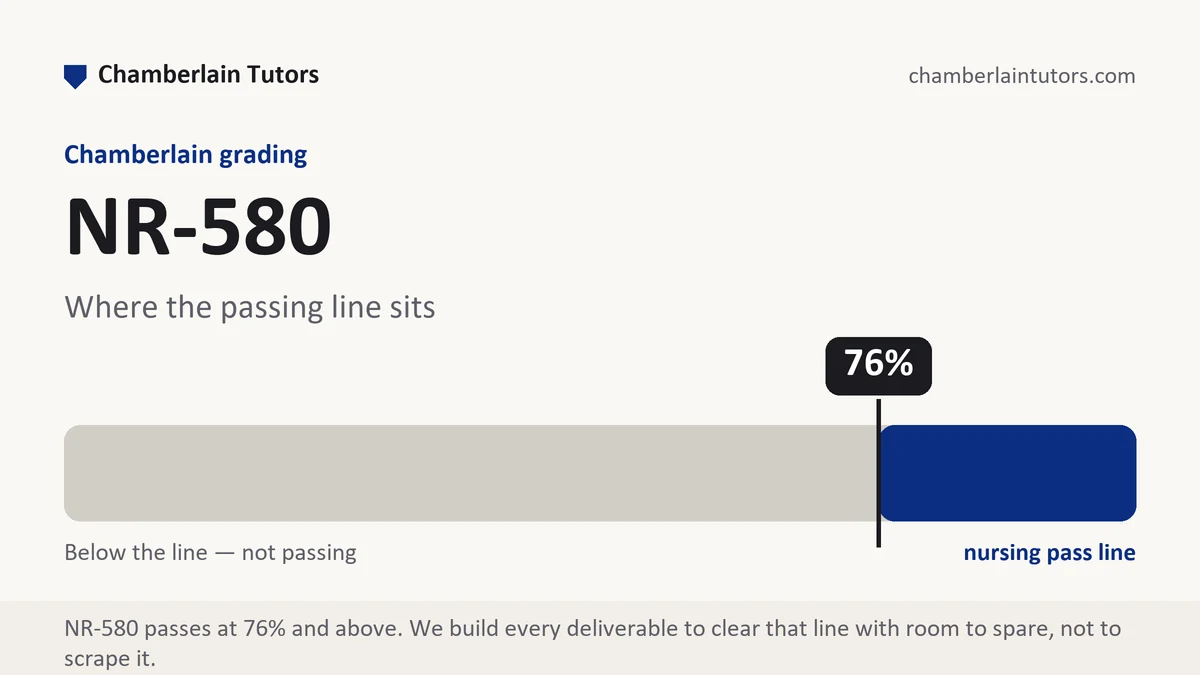
Two structural facts sit under all of it. MSN nurse practitioner tracks at Chamberlain carry 625 clinical hours, and this course is where the last of them are logged, so students arrive tired and behind on writing. The specialty scale has no C, which means 84 is the last passing number, and a capstone graded in the low 80s is a track-ending problem rather than a disappointing one.
How we help in this course
We work on the written layer only. Send the rubric and the prompt from Canvas along with a de-identified sketch of the encounter you plan to write about, and we build the draft, the structure and the source support around your clinical judgment. Hours, preceptors, site paperwork and logs stay entirely with you, and so does the certification exam itself. What we can carry is the part that consumes your evenings: turning a fifteen-minute visit into a document that reads like an experienced clinician wrote it.
Capstone drafting also works well as tutoring. Many students in this course want the walkthrough more than the page, because the reasoning being rehearsed is the same reasoning the certification exam tests.
Finishing the AGPCNP track?
Send the rubric and a de-identified case sketch. We will scope the written piece the same day.
Read the rubric before the prompt
The prompt in a capstone course tends to be short, because the assumption is that you already know what a write-up looks like. The rubric is where the actual instructions hide. Open it first, copy the criterion rows into a blank document, and reduce each row to the single verb it uses: gather, prioritize, justify, plan, evaluate, reflect. Those verbs are your headings, kept in the rubric's order so a grader working down the rows keeps landing on the section they were about to look for.
Then convert weight into words, because a percentage is a depth instruction. Suppose your week's guide caps the write-up at 2,000 words across four rows weighted 35, 25, 25 and 15 percent. The arithmetic gives 700 words to the 35 percent row, 500 each to the two 25 percent rows, and 300 to the 15 percent row. In this course the 700-word row is almost always the justification row, the one asking why this plan and not the obvious alternative. Students who skip the budget write 900 words of history and physical, then justify a plan in two sentences, and the score lands exactly where the weights predicted.
Write each target beside its heading and cross it off as the section reaches it. A section finishing 200 words short of its share is not efficient, it is under-argued, and the row it belongs to is the row you were paid most to answer.
The shape of a capstone encounter write-up
Most graded writing in NR-580 is an encounter turned into an argument. Each stage below carries one job, and a grader either finds it or does not.
| Stage | What it has to settle | The version that scores low |
|---|---|---|
| Presenting picture | Age band, relevant history and the reason for the visit in a few lines, with nothing included that will not be used later. | A full intake transcribed, so the reader cannot tell which details mattered. |
| Focused data | The specific findings you sought and why you sought them, including the pertinent negatives that narrowed the field. | A head-to-toe list with no sign that any of it was chosen. |
| Differential, ranked | Three or four candidates in order, each with the finding that raises it and the finding that lowers it. | A list of possible diagnoses with no ranking and no evidence attached. |
| The decision | Which diagnosis you worked from and what would have changed your mind. | A diagnosis announced as if it were obvious from the start. |
| Plan, itemized | Diagnostics, therapeutics, education and follow-up interval, each traceable to a line above it. | A generic plan that would fit any patient with that label. |
| Population fit | What the adult-gerontology context changes: comorbidity load, medication burden, function, caregiver reality. | A paragraph about older adults in general, with no link to this patient. |
| Self-evaluation | What you would do differently and which knowledge gap the encounter exposed. | A confidence statement with no gap named. |
Evidence craft when the patient is the source
Capstone writing mixes your own observation with published evidence, and the two carry different burdens.
Recency has to be argued, not assumed. Where your guide sets no rule, treat five years as the default window and write the justification into the sentence when you go past it. A guideline superseded two years ago is a defect in a capstone even when the reasoning still seems sound.
Design and sample before the finding. Never let a number arrive before its provenance. Twelve words of setup, such as "in a randomized trial of 1,140 adults over 65 followed 18 months", turns a claim into evidence. Without that, a grader reads assertion.
Verbs your source can pay for. Observational data supports "was associated with", "occurred more often among" and "predicted". Only controlled experimental evidence buys "reduced" or "caused". Borrowing a causal verb for a cohort finding is the writing equivalent of documenting something you did not observe.
Denominator and window before any rate. "About one in six of the 480 patients screened returned within 30 days" earns its place. "Sixteen percent were readmitted" does not, because the reader cannot tell out of what or over how long.
Passing and strong look different on the page
A passing NR-580 submission is complete and safe. Nothing is wrong in it. It reports the visit, names a reasonable diagnosis, and attaches a plan that no reviewer would call dangerous. On a scale with no C, complete and safe is closer to the edge than it feels, because a run of adequate submissions averages under 84 quickly and supplementary work cannot rescue a weak weighted average.
A strong submission does three things the passing version does not. It shows the alternative you rejected and why, so the reader watches a decision get made rather than reported. It carries the population context into the plan itself, with the dose adjustment, the function question or the caregiver instruction written where it belongs instead of parked in a paragraph about geriatrics. And it names a specific gap in your own knowledge and what you did about it, which is the reflective move graders in a capstone are trained to look for and rarely find.
Six habits that cost marks in NR-580
- Transcribing the visit instead of building an argument. Length spent on data collection is length taken from justification, which is where the weight sits.
- Leaving the differential unranked. A flat list reads as hedging. Ranked candidates with evidence attached read as clinical thinking.
- Writing the population section as a lecture. Adult-gerontology content earns marks when it changes something in your plan, not when it sits in its own paragraph.
- Treating a graded post as a rough draft. Chamberlain discussion posts close to editing the moment they are submitted, so compose elsewhere, read it aloud once, then paste.
- Letting identifiers slip in. Dates, initials, room numbers and site names have no place in coursework. Strip them before the draft exists, not after.
- Saving the writing for after the hours are logged. The clinical load in this course peaks at the same time the written work is due, and an eight-week session gives that collision nowhere to go.
Questions NR-580 students ask
My write-ups are clinically fine but the grades sit in the low 80s. What is missing?
Can I use the same patient across more than one written piece?
How do I write about a case where my preceptor and I disagreed?
Where NR-580 sits in Chamberlain's programs
Open the exact program map for sequence, credit, and option context. The current student schedule and syllabus remain authoritative after transfer evaluation, electives, state rules, and approved plan changes.
The weeks, one by one
Week 1
A capstone practicum opens differently from every earlier clinical course, because the written frame you build in the first stage has to carry three things at once: independent primary care practice under a preceptor, a scholarly component, and preparation for the AGPCNP certification examination. Read the full Week 1 manual.
Week 2
Early in a capstone the written work usually turns to the encounter write-up: a de-identified account of a visit you conducted, structured in a subjective-objective-assessment-plan shape, submitted for academic review rather than filed anywhere clinical. Read the full Week 2 manual.
Week 3
By the third stage a capstone usually pushes the written work upstream, from documenting what happened to preparing what has not happened yet. Read the full Week 3 manual.
Week 4
Around the midpoint a capstone usually shifts the written work from single encounters to longitudinal management: the patient with four chronic conditions whose treatments interact, the visit that has to choose which problem gets the twenty minutes, and the writing that shows you can prioritize. Read the full Week 4 manual.
Week 5
Somewhere in the middle of a capstone the certification strand stops being background and becomes a written deliverable: a gap analysis against published examination content areas, a plan built from it, and evidence that the plan is producing something rather than consuming evenings. Read the full Week 5 manual.
Week 6
The scholarly strand of a capstone usually comes due in the second half of the session, and it is the piece most likely to be underestimated. Read the full Week 6 manual.
Week 7
Late in the session a capstone with an on-ground intensive brings the two strands together: concentrated review alongside a written layer that usually asks you to analyze your own reasoning rather than report content. Read the full Week 7 manual.
Week 8
The last stage of a capstone asks you to argue that a nurse practitioner exists where a student used to be. Read the full Week 8 manual.