NR-581NP sits in Chamberlain's MSN-NP core, the progression gate, on the MSN-NP core path. This is its help page: what the course really grades and how our team carries it, floor check included.
What NR-581NP actually grades
The first course of the shared NP core, and for bridge students a formal gate: a B or higher here is required to progress. It lands graduate-register writing, scholarly voice, and the weekly discussion cadence on students in their first Chamberlain weeks, under the specialty scale where below 84 already fails.
How we help in this course
We treat 581 orders as gate defense: drafts banked at the A band from week one, walkthroughs written like a private orientation to graduate rubrics, and the floor math tracked so the gate never gets interesting. Clients who start here need visibly less help by the sciences.
Deliverables run the standard promise: a premium original draft in 24 to 48 hours, targeted at the A band of your course's actual scale, through the eight-person pipeline with both QA passes and the floor check, revised free until it lands.
How to write this course's deliverables
Read the scoring guide first and the prompt second. A prompt describes the subject. A rubric decides the grade, and the two are rarely shaped the same way. Open your week in Canvas, paste the criterion rows at the top of an empty file, and make every one of them a heading you owe writing under. Anything the rows do not ask for is optional, and in a first graduate course optional writing is where the hours disappear. Do this before you draft a board post especially, because a Chamberlain post is graded the moment it is submitted and there is no edit button behind it. Everything below is that method, worked out for the writing NR-581NP actually asks for.
In NR-581NP right now?
Send the week and the rubric from Canvas. First premium sample free, floor-checked, back in 24 to 48 hours.
The gate arithmetic, run before your first grade posts
NR-581NP grades on the specialty scale from the opening week, which means the last passing number is 84 and a C does not exist anywhere on the ladder. For bridge students the course doubles as a formal progression gate: a B or higher is required to move on, so the working minimum is 86, not 84, and the sensible target sits in the 94-plus A band where a rough later week cannot drag the average near either line. Nothing curves, nothing earns extra credit, and the boards cannot be edited once posted, so every deliverable in this course is a number you keep permanently.
What a same-day scope needs from you
Three items in chat get NR-581NP scoped before the day ends: the syllabus page that shows the assignment weighting, the current week's prompt and rubric out of Canvas, and a gradebook screenshot if anything has already been scored. The desk replies with what the week owes, which pieces carry the most weight, and a delivery slot that beats the 11:59 p.m. Mountain-Time cutoff with room to spare.
Does the 76 percent core rule apply to this course?
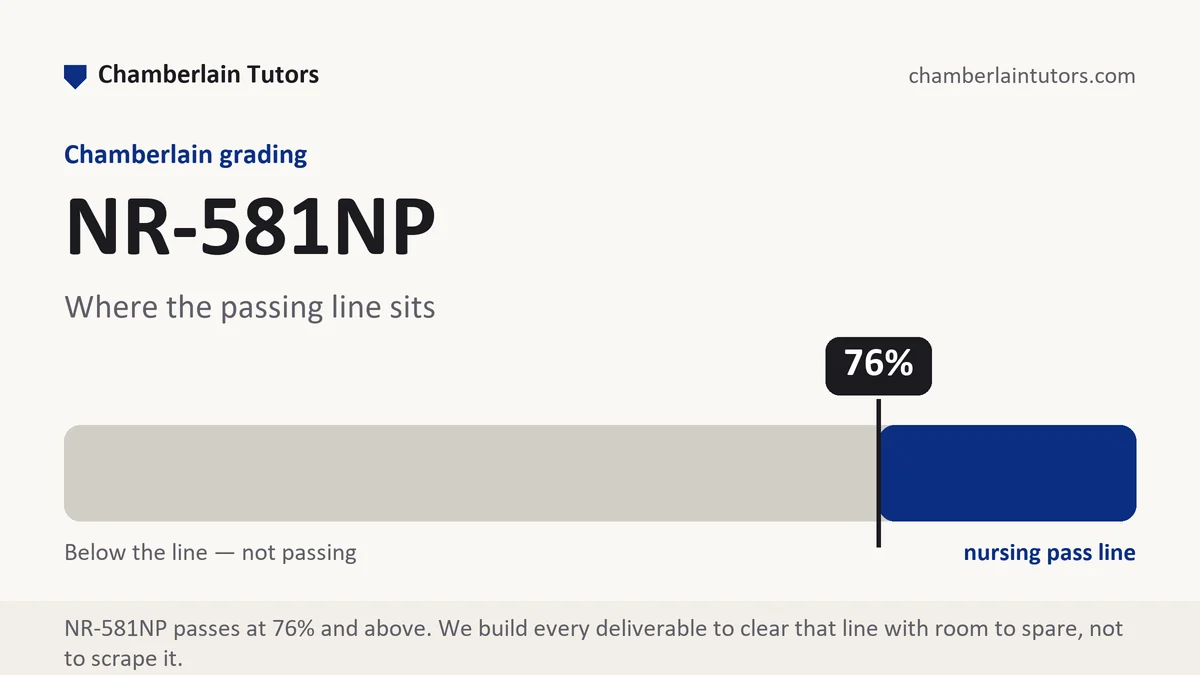
No. That floor governs pre-licensure nursing courses. What governs NR-581NP is the no-C specialty scale, plus the bridge-progression requirement of a B, which is stricter in practice than the floor it replaces.
Can the free first sample be a discussion post?
Yes, and it is a popular choice here, because the sample arrives final-quality with sources placed and the rubric checked, exactly the standard an uneditable board demands on the first click.
Turning criterion rows into a section plan
A criterion row is a promise about where points live. A prompt only describes a topic. Students who read the prompt alone write a decent essay and score in the middle of every row, which on this scale is not a middle result. The repair takes ten minutes: list the rows in a column, write one sentence under each saying what a reader would have to see to believe you met it, then convert weight into words.
Say your week's scoring guide carries four rows worth 40, 25, 20 and 15 points, and the post is expected to run about 800 words. Reserve roughly 80 words for the opening claim and the close, which no row scores directly. That leaves 720 to divide by weight: about 290 words for the 40-point row, 180 for the 25, 145 for the 20, and 105 for the 15. Now hold that plan against your last submission. If a row you gave two sentences turns out to own 290 words of the budget, you have found the reason the score came back where it did, and you have found it before the submit button instead of after.
Weights differ by week and by section, so pull yours from your own guide. The arithmetic is the part that transfers.
The parts of a graduate discussion post, and what each has to prove
The dominant graded object in the first core course is the board, and its shape is unforgiving because it is written once. Where your week's rubric does not dictate an order, this spine answers the rows most first-core scoring guides carry.
| Part | The job it does | The version that fails |
|---|---|---|
| Opening claim, one or two sentences | That you have taken a position the rest of the post defends. | An agenda sentence. "This post will discuss" burns the one line a grader will certainly read closely. |
| The frame | That you can define the concept in graduate register, and say which definition you use when more than one exists. | A textbook definition dropped in whole, or cited to a source nobody in the field would use. |
| Evidence | That the position rests on current literature, with design and population visible before the finding. | A citation parked at the end of a sentence you would have written anyway. |
| Application | That you can move from evidence to what a provider would do differently, in a setting specific enough to be real. | "This is important for nursing practice." It fits everything, so it proves nothing. |
| The limit | That you know where your claim stops: the population it does not cover, the finding that would change it. | Skipping it. Rows rewarding analysis over summary are usually satisfied right here. |
| Close and handoff | That the thread can continue, through a question classmates can answer from their own practice. | A rhetorical question, or a summary that repeats the opening claim in weaker words. |
Replies are graded work under the same permanence rule. A reply that agrees and extends with a source of its own answers a rubric row; a reply that agrees and compliments answers nothing. Draft both in a document, check them against the rows, then paste once.
Evidence and citation habits to build now
Most of the citation points in the NP core come down to four habits, and this is the cheapest course in which to install them.
Currency. Check your scoring guide for the window it names, and treat a foundational theory source as the only fair exception. A landmark paper can anchor a definition; it cannot carry a claim about what practice does now.
Say what the study was before you say what it found. Write the study before the result: what kind, in whom, how many. "A randomized trial in 412 adults with type 2 diabetes reported" gives a grader something to weigh. "Studies show" gives them nothing, and it is the phrase that appears most often in posts that stall mid-band.
Let the design pick the verb. Where a study observed rather than assigned, the honest options are associated with, linked to, more common among. Only a design that controls assignment earns reduced, caused, led to. Swapping one verb moves a sentence from defensible to wrong.
A bare percentage is not evidence. A number with no base is not evidence. Not "readmissions fell by 30 percent" but "readmissions fell from 18 percent of discharges to 12.6 percent across the six months after the program started." Say what was counted, out of what, over how long.
Passing and strong are different documents here
A passing post in this course is accurate, sourced, on topic and on time. It restates what the literature says and connects it loosely to practice. On the specialty scale that work tends to land in the low 80s, which in a course with no C band is not a pass at all.
A strong post does three things the passing version does not. It commits to a position early enough that the reader knows what is being argued. It puts sources in conversation, saying where two findings pull against each other rather than stacking them in agreement. And it names its own limit. Those three moves cost about a hundred words and they are the whole distance between a ticked row and a top-band one.
Six things that cost points in NR-581NP
- Writing the post inside the reply box. Whatever posts is what is graded, typos and all. Draft in a document, check it against the rows, paste once.
- Undergraduate register. Opinion first, evidence bolted on afterward. Graduate register puts the claim and its support in the same breath.
- Sources that were never opened. Citing a study you met inside a review is a secondary citation, and it breaks the moment a grader opens the original.
- A reference list that disagrees with the in-text citations. An entry with no citation, or a citation with no entry, is a free deduction on a row you could have banked.
- Replies posted at the cutoff. Late replies get read fastest and scored hardest, and there is no way to add the sentence you forgot.
- Treating an 83 as nearly passing. On this scale it is a repeat, and for bridge students the progression requirement makes 86 the real working minimum. Run the arithmetic the week the score posts, not in week seven.
Questions from the first core course
How many sources does one discussion post actually need?
I posted, then realized I misread the prompt. What are my options?
My first graded paper came back at 82 with comments I do not understand. Where do I start?
The weeks, one by one
Week 1
NR-581NP Week 1 is where the first NP core course usually starts its story: the history of advanced practice nursing, and why the role you are entering looks the way it does. Read the full Week 1 manual.
Week 2
NR-581NP Week 2 typically moves from where the NP role came from to what now defines it: professional standards and scope of practice, the documents that say what an advanced practice nurse is prepared and permitted to do. Read the full Week 2 manual.
Week 3
NR-581NP Week 3 is where the course's theoretical underpinnings usually arrive: grand nursing theories and conceptual models, the large frameworks the discipline built to say what nursing is. Read the full Week 3 manual.
Week 4
NR-581NP Week 4 usually brings theory down to working altitude: middle range theories, the frameworks small enough to guide an actual clinical problem, and the writing that shows you can fit one to the other. Read the full Week 4 manual.
Week 5
NR-581NP Week 5 usually opens the course's third catalog strand: the ethical underpinnings of advanced practice, meaning the principles, autonomy, beneficence, nonmaleficence, justice, and the professional code that turns them into obligations. Read the full Week 5 manual.
Week 6
NR-581NP Week 6 tends to be where the ethics strand goes to full depth: a complete dilemma worked through a structured decision process, stakeholders and options and justification included, usually as the heaviest paper of the course's back half. Read the full Week 6 manual.
Week 7
NR-581NP Week 7 is where a foundations course usually asks for the integrating deliverable: a philosophy of advanced practice paper that pulls the course's three strands, standards, theory, and ethics, into one stated position about the provider you intend to be. Read the full Week 7 manual.
Week 8
NR-581NP Week 8 closes the first core course, and closing weeks in an 8-week session usually ask for synthesis: a reflective deliverable that looks back across the history, standards, theory, and ethics work and names what changed in your thinking, plus whatever final discussion your section runs. Read the full Week 8 manual.
Where NR-581NP sits in Chamberlain's programs
Open the exact program map for sequence, credit, and option context. The current student schedule and syllabus remain authoritative after transfer evaluation, electives, state rules, and approved plan changes.