NR-583NP, MSN-NP core sequence in the MSN-NP core path, gets the same promise as every course we cover, with the Chamberlain-specific machinery this school's rules demand.
What NR-583NP actually grades
Mid-core, where evidence work typically sharpens: appraising literature and arguing from it in discussion and paper form, with rubric rows that reward analysis over summary and punish citation drift.
How we help in this course
Drafts here get the research analyst's full pass: current sources mapped to criteria before writing starts, appraisal made visible in the prose. The APA QA earns its keep in this stretch of the core more than anywhere.
Orders run the full machinery: rubric decoded, core-versus-supplemental tagged, a program-matched writer, rubric QA then a separate APA and originality pass, the scale check, delivery inside 24 to 48 hours.
How to write this course's deliverables
Build the paper from the scoring guide, then go looking for sources. Mid-core writing collapses when a student reads five articles first and tries to organize them afterward, because an article list and a set of criterion rows almost never line up on their own. Open your week's guide in Canvas, put the criterion rows across the top of a blank table, and make each source a line underneath. A cell you cannot fill marks a source you have not finished reading or a row you have not answered. The sections below run that method out: the matrix, the shape of an appraisal paper, and the citation habits this stretch of the core actually scores.
In NR-583NP right now?
Send the week and the rubric from Canvas. First premium sample free, floor-checked, back in 24 to 48 hours.
How appraisal writing grades when no C exists
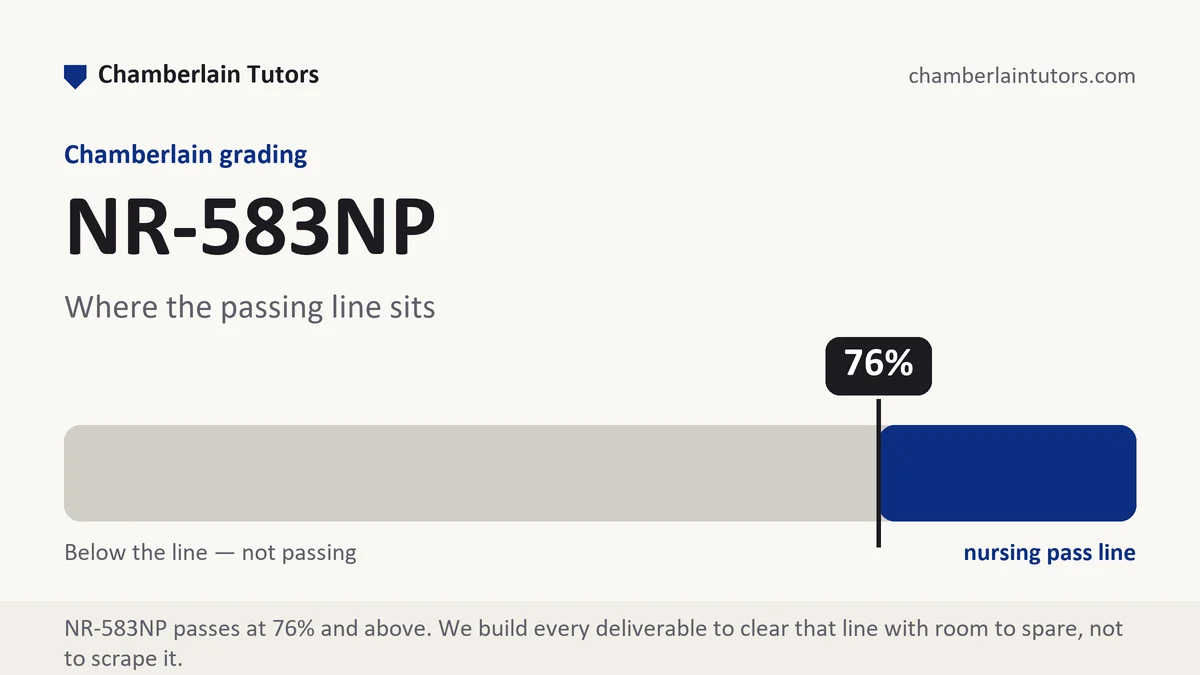
Mid-core weeks in NR-583NP put literature appraisal under the specialty scale, and the combination is unforgiving in a specific way: rubric rows that reward analysis over summary sit on a ladder where 83 is an F. A paper that recites five sources competently can score in exactly the band that no longer exists, which is why our drafts weigh evidence against evidence, keep citations current, and make the appraisal visible in the prose rather than implied by it. The separate APA and originality pass matters most here, because citation drift is the quiet point-leak of this stretch.
Scoping an evidence week the same day
Send the week's prompt, the rubric, and any required source list from Canvas, and the desk returns a scope in hours: which rows carry the grade, what the search strategy should be, and when the draft lands inside the standard 24 to 48. If the week includes a board, the post comes back paste-ready and final, since nothing on a Chamberlain board can be revised after the click.
Do you find the sources or work from mine?
Either. The research analyst maps current peer-reviewed sources to the rubric before writing begins, and any articles your section requires get woven in alongside.
What if my average is already sliding?
Send the gradebook screenshot. The recovery arithmetic on the 84-line scale comes back free, with an honest read on what the remaining weeks must hold. Appraisal-heavy stretches respond well to intervention, because the deliverables are large enough to move an average quickly.
The matrix, and the word budget behind it
A source matrix is a table with the criterion rows as columns and one source per line. Under each column you write what that source contributes to that row, in a phrase. Three things fall out of it immediately. Sources that fill no column get dropped, which is faster than discovering in paragraph nine that a study was never going to help. Columns with only one line show you where the paper is thin while there is still time to search. And columns with six lines show you where the synthesis has to happen, because six sources in one column is not six paragraphs, it is one argument.
Then turn weight into length. Say your guide carries six rows worth 50, 40, 30, 25, 20 and 10 points, against a 2,200-word target. Take 200 off the top for framing sentences that belong to no row at all. Splitting the remaining 2,000 by weight gives roughly 570 words to the 50-point row, 455 to the 40, 345 to the 30, 285 to the 25, 230 to the 20 and 115 to the 10. The number that usually shocks people is the last one: a row worth 10 points deserves a tight paragraph, not the page it often gets because it was the easiest to write. Weights vary by week, so divide using your own.
The six moves of an appraisal paper
Unless the prompt dictates a layout, build the paper as these six moves. The order is doing work: it stops summary standing in for the analysis a mid-core guide is actually scoring.
| Move | What it must establish | How it goes wrong |
|---|---|---|
| The practice question | That the question is narrow enough to be answerable: a population, a comparison, an outcome, a setting. | A topic instead of a question. "Telehealth in primary care" cannot be answered, so nothing after it can be judged. |
| Search and selection | That someone else could repeat your search: databases, terms, date window, and why you excluded what you excluded. | Leaving it out. Without it a grader cannot tell a systematic search from four articles that happened to be free. |
| Appraisal of each study | That you can judge quality, not just report results: design, sample, attrition, and what the design cannot show. | Study by study summary. It reads as an annotated bibliography, and it answers the summary row while leaving the analysis rows empty. |
| Synthesis | That you can say where the studies agree, where they conflict, and which finding you weight more heavily and why. | Agreement by omission. If nothing in your evidence disagrees, you have either read too little or reported selectively. |
| The recommendation | That the recommendation follows from the evidence just presented, at the strength that evidence supports. | A recommendation stronger than its evidence, or one that could have been written before the search began. |
| Limitations of the evidence | That you know what your evidence base cannot tell anyone: populations missing, settings untested, outcomes not measured. | Writing about your own limitations instead. The row is about the literature, not about how little time you had. |
Citation craft at appraisal level
This is the stretch where citation habits stop being tidiness and start being the grade.
Currency, with one exception. Use the window your scoring guide names. A seminal methods paper can be older because it is the origin of the method; a clinical claim cannot.
Design, sample and attrition before the finding. Lead with what kind of study, in whom, how many, and how many were lost. A trial that randomized 300 and analyzed 190 is a different piece of evidence from one that analyzed 295, and the row rewarding appraisal is asking whether you noticed.
Size and precision, not just direction. Report the effect and its interval where the paper gives them. A difference described only as significant tells a reader nothing about whether it would matter to a patient, and an interval that crosses no difference is worth saying out loud.
Claim only what the design allows. Cohort and cross-sectional work supports associated with, more frequent among, predicted. Reserve prevented, reduced and caused for designs that decided who received what. One wrong verb converts careful appraisal into an overclaim in a single line.
Percentages mean nothing on their own. Not "errors dropped 40 percent" but "4.2 medication errors per 1,000 doses dispensed over the 24 weeks following the change, against 7.0 per 1,000 in the 24 weeks before." Counted what, out of what, when.
Cite what you opened. If you did not read it, do not cite it. Attribute the review, or go and read the trial you want to lean on.
Where the strong version pulls ahead
The version that passes finds relevant, current sources, reports them accurately, cites them cleanly and ends with a sensible recommendation. It is also, structurally, a list. Where 83 is a retake rather than a near miss, a well-made list leaves very little daylight.
A strong paper does the thing the word appraisal is asking for. It ranks its evidence and says why, so a reader knows which study is carrying the argument. It reports the disagreement in the literature rather than smoothing it. It states the recommendation at the strength the evidence supports, including the version where the honest answer is that the evidence is not yet strong enough to change practice. That last move frightens students and reads, to a grader, as the first sign of a clinician who can be trusted with evidence.
Six ways NR-583NP papers lose points
- The annotated bibliography in disguise. Six paragraphs, one per study, no paragraph comparing any two. The analysis rows stay empty however good each paragraph is.
- No search method. A grader cannot judge selection they cannot see, and the row is usually worth more than students expect.
- A recommendation the evidence does not reach. Two small observational studies do not support should be implemented.
- Rates with no base. Percentages with no denominator and no time window are decoration, and in this course they are marked as errors.
- Secondary citations. Citing through a review is the most common integrity-adjacent slip in the sequence, and one click by a grader exposes it.
- An in-text list and a reference list that disagree. Cheap to fix, expensive to leave, and it lands on a row you would otherwise have banked.
Questions students ask about appraisal writing
How current does a source actually have to be?
Do I have to include a study that contradicts my recommendation?
Is a systematic review one source or several?
The weeks, one by one
Week 1
NR-583NP Week 1 opens Chamberlain's Informatics for Advanced Nursing Practice course, and in an 8-week session the opening week sets habits the other seven inherit. Read the full Week 1 manual.
Week 2
NR-583NP Week 2 usually moves from definitions to the machine every provider lives inside: the electronic health record. Read the full Week 2 manual.
Week 3
NR-583NP Week 3 typically belongs to the coded languages underneath the record: the standardized terminologies that let one system's chest pain mean the same thing in another system, another state, another payer's database. Read the full Week 3 manual.
Week 4
NR-583NP Week 4 sits at the midpoint of the session, and the course arc points it at clinical decision support: the alerts, order sets, and reminders that put evidence in front of a prescriber at the moment of choice. Read the full Week 4 manual.
Week 5
NR-583NP Week 5 is where the course's emerging-technology thread, named right in the catalog, usually takes the stage: telehealth, remote monitoring, mobile applications, and the machine-learning tools arriving in clinical software. Read the full Week 5 manual.
Week 6
NR-583NP Week 6 belongs, by the course's own catalog language, to the ethical and legal side of information management: privacy, security, and the duties that follow a clinician into every login. Read the full Week 6 manual.
Week 7
NR-583NP Week 7 usually turns from single patients to populations: the dashboards, registries, and aggregate queries that tell a practice how it is actually doing. Read the full Week 7 manual.
Week 8
NR-583NP Week 8 closes the course, and closing weeks in an 8-week session carry a predictable double load: a synthesis deliverable that pulls seven weeks of informatics into one argument, and a hard calendar wall behind it, because the session ends when the week does. Read the full Week 8 manual.
Where NR-583NP sits in Chamberlain's programs
Open the exact program map for sequence, credit, and option context. The current student schedule and syllabus remain authoritative after transfer evaluation, electives, state rules, and approved plan changes.