NR-576 is the AGPCNP practicum where diagnostic reasoning is done in an office rather than a hospital: 125 precepted hours across adolescents, adults, older adults and women, with a small theory component carrying the written work. Primary care changes the arithmetic of diagnosis. Most people who walk in are well, most presentations are undifferentiated, and the written work is graded on whether you reason from that reality instead of importing hospital probabilities into a clinic.
What NR-576 actually grades
Probability and restraint. The same complaint that would trigger a full work-up on a ward frequently deserves a focused history, one test and a defined follow-up interval in primary care, and the rubric rows are scored on whether your reasoning shows you know why. That means saying what you think is likely before you say what you would order, and choosing tests because the result would change what you do rather than because the panel exists.
The second graded thread is the safety net. Ambulatory diagnosis is often provisional, and a strong write-up says so out loud: what you are treating as the working explanation, what would tell the patient it was wrong, and when you will see them again. A note that reaches a confident diagnosis with no return criteria is weaker than one that names the uncertainty and manages it, and graders in this course reward the second.
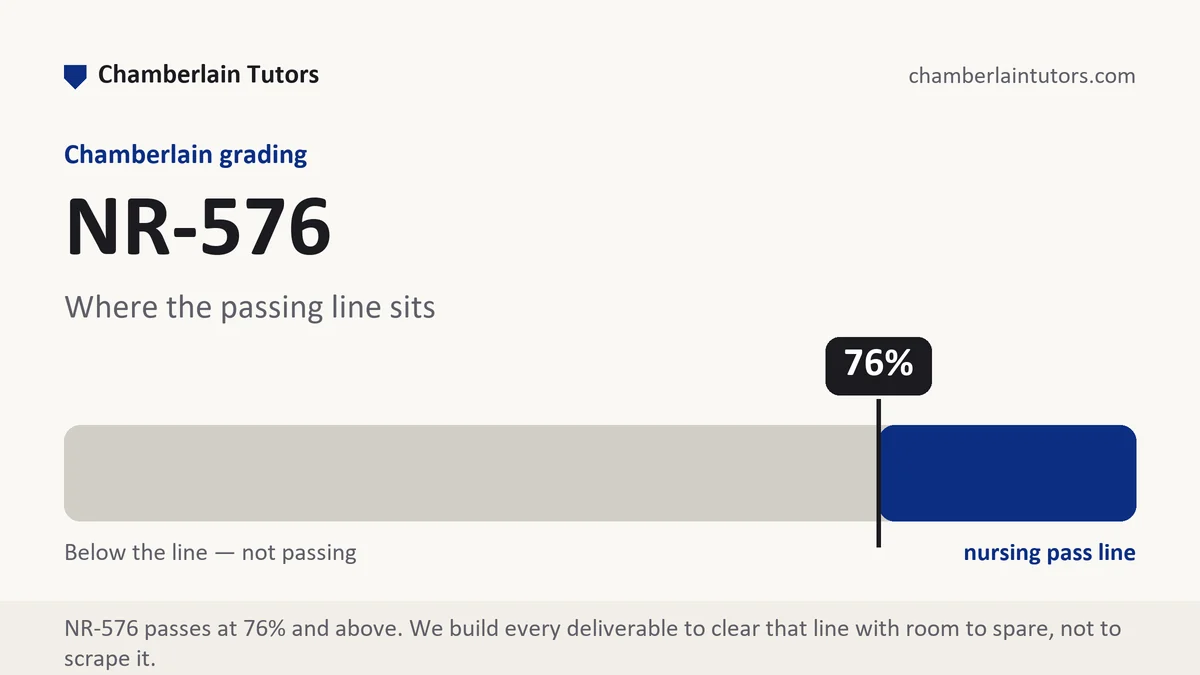
The specialty scale carries no C, which sets the pass line at 84, and supplementary work does not repair a weighted average that has already drifted. Practicum writing is done around clinic days, so it is the pieces produced at the end of a long week that decide where the average lands.
How we help in this course
We draft the diagnostic reasoning papers, focused note write-ups, case analyses, discussion posts and reflective pieces that attach to your primary care hours. What our drafts add is the ambulatory shape: a differential ranked by what is actually common in an outpatient population, a testing plan justified by what each result would change, and a safety net section written with specific findings and a specific interval rather than a general instruction to return if worse.
The placement side stays with you entirely. We do not complete clinical hours, contact preceptors, faculty or clinics, sign or fill any placement document, complete an hour log, or sit assessments. Your 125 hours here belong to the 625 clinical hours the MSN NP tracks carry. We build the documents that surround them.
In NR-576 right now?
Send the week and the rubric from Canvas. First premium sample free, floor-checked, back in 24 to 48 hours.
Work the scoring guide before the case
Primary care case assignments look small and are scored across several rows, which is how a competent student loses a band without noticing. Lift the rows into a blank document and cut each to its verb, gather, differentiate, justify, plan, educate, then write those as headings in the guide's order so nothing has to be hunted for.
Then spend the words in the rubric proportions. Take a 1,200 word focused case with rows weighted 30, 30, 25 and 15 percent: roughly 360 words for the history and examination selection, 360 for the differential and its ranking, 300 for the diagnostic and management plan, and 180 for education and follow-up. Most submissions spend 500 words reproducing the history, because the transcript is available, and then rank three diagnoses in a paragraph. The row that pays best is the one where you argue about likelihood, and it is nearly always the row that gets the least attention.
Keep the numbers next to each heading while drafting. If the education and follow-up section will not fill 180 words, the plan has no safety net in it yet, and that is a content gap the grader will find first.
The shape of a primary care focused write-up
Whatever the assignment is titled, the graded object usually contains these parts.
| Part | What it has to establish | The version that reads as hospital work |
|---|---|---|
| Reason for the visit | Why the patient came today, in their own framing, including what they are worried about. | A chief complaint reduced to two words with no context. |
| Focused history | The questions that separate the plausible causes, plus the context that changes risk: work, home, function, access. | A complete review of systems with nothing selected. |
| Targeted examination | The manoeuvres performed because a specific finding would move the differential. | A full examination recorded in template order. |
| Differential by likelihood | Three to five candidates ranked using outpatient frequency, with the feature supporting each. | A hospital differential led by rare conditions. |
| Serious possibilities addressed | The dangerous causes named, with what makes them unlikely or what excludes them today. | Silence about anything that cannot be diagnosed in the room. |
| Testing chosen for value | Each test justified by the decision it would change, with cost and access acknowledged. | A broad panel ordered to be thorough. |
| Safety net and follow-up | Specific return criteria, the interval, and what the next visit will decide. | Return if symptoms persist. |
Evidence and citation craft in ambulatory diagnosis
Diagnostic evidence behaves differently at low prevalence, and this course grades whether you understand that.
Currency where it moves. Where the guide sets no limit, treat screening intervals, diagnostic criteria and thresholds older than five years as needing a stated reason. Descriptions of a physical finding are durable; the age at which a screening test is recommended, or the cutoff that defines a condition, is exactly the kind of thing that changes between cycles.
Predictive value, not just sensitivity. A test with strong sensitivity and specificity still produces mostly false positives when the condition is rare in the population you are testing. Write the pretest reasoning explicitly, then say what a positive result would actually mean in this clinic. This is the analytic move that separates the top band from the rest in primary care case work, and it takes two sentences.
Match verbs to designs. Diagnostic accuracy and cohort studies support was more common among and predicted; they do not support caused. Where a study measured a symptom's association with an outcome in a referred population, say referred, because that word changes the number more than any other detail in the sentence.
Denominator and window on every rate. Among the 2,050 adults presenting to primary care with the symptom over two years, 31 were found to have the condition is an argument about pretest probability. A 1.5 percent rate with no base and no period cannot be reasoned from, and in ambulatory diagnosis the base rate is the entire argument.
What a strong ambulatory case does differently
A passing primary care case is complete and cautious. It gathers everything, lists a wide differential, orders a broad set of tests and reaches a reasonable conclusion. It reads as safe and it scores in the middle, because nothing in it required judgment.
Strong cases show three things. They state the likelihood before the plan, so the reader can see the reasoning that produced the testing rather than inferring it. They use time deliberately, saying that reassessment in a stated interval is itself a diagnostic step rather than a delay, which is a specifically ambulatory skill. And they write the safety net in the patient's terms: the two or three findings that mean come back sooner, phrased so a person could recognise them at home. Likelihood first, time used on purpose, a safety net a patient could follow.
Mistakes that cost points here
- Importing hospital base rates. A differential led by conditions that are common on a ward and rare in a clinic tells the grader where you have been rather than where you are.
- Testing to be thorough. Every test needs the sentence that says what a positive and a negative result would each change.
- No return criteria. Ambulatory diagnosis is provisional, and a note without a safety net is incomplete regardless of how good the differential was.
- Ignoring the patient's agenda. If the write-up never says what the patient was worried about, the education row has nothing specific to answer.
- Health maintenance left out. Where the visit reasonably allowed it, the missed screening or immunisation is a point the guide will look for.
- Composing in the discussion box. Chamberlain posts do not reopen after submission, so write it out, check the ranking, then paste.
Questions NR-576 students ask
How do I justify not ordering a test when the rubric asks for a diagnostic plan?
The patient has several complaints in one visit. How do I structure the write-up?
How much of my write-up should cover women's health presentations?
Where NR-576 sits in Chamberlain's programs
Open the exact program map for sequence, credit, and option context. The current student schedule and syllabus remain authoritative after transfer evaluation, electives, state rules, and approved plan changes.
The weeks, one by one
Week 1
The opening stage of a primary care practicum sets up two things at once: your orientation to a clinic that runs on short visits and undifferentiated complaints, and the written system you will use to capture reasoning across the session. Read the full Week 1 manual.
Week 2
Early in a differential diagnosis practicum the written work turns to the history, and the graded question is not whether you collected information but whether you selected it. Read the full Week 2 manual.
Week 3
This is the stage the course is named for, and it is where the highest-weighted rows usually sit. Read the full Week 3 manual.
Week 4
The middle of a differential diagnosis practicum is where testing gets argued rather than ordered. Read the full Week 4 manual.
Week 5
This course names adolescents and women among the populations its precepted hours cover, and writing about those encounters carries obligations that a general adult write-up does not. Read the full Week 5 manual.
Week 6
The gerontology half of this course's title changes the shape of a write-up more than most students expect. Read the full Week 6 manual.
Week 7
Late in this course the writing turns to what happens after the visit ends, and the section that separates strong students from competent ones is the safety net. Read the full Week 7 manual.
Week 8
The closing stage of a practicum asks you to argue, from evidence you produced yourself, that your diagnostic reasoning changed over 125 precepted hours. Read the full Week 8 manual.