NR-709C takes DNP Project and Practicum IV at 4 credits and 256 clinical hours, the final and largest block. The writing it usually carries is dissemination: the same project told several times for several audiences. An executive summary that fits on one page, a poster narrative, a manuscript-shaped final document, a staff-facing version, a short talk. Each has a different reader, a different length and one thing it must land. Reusing a single document for all of them is the most common way to lose marks at the end of a good project.
No hour is worked here, no preceptor or site is approached, no placement form is signed, no log is filled and no assessment is taken by us, and we do not present your project on your behalf. Our part is the writing: the executive summary, the poster and manuscript text, the staff-facing version and the scholarly sections your rubric grades.
What NR-709C actually grades
The first row is audience fit. An executive reader wants the decision and the number in the first paragraph and will not reach page two. A poster reader is standing up, gives you about ninety seconds, and reads headings and a figure. A journal-shaped document expects method detail an executive would skip entirely. Staff want to know what changes for them on Monday. Writing that shows you understand those differences is the point of the block, and it is visible in the first three sentences of each piece.
The second row is consistency across the set. The number in the executive summary has to match the number on the poster and in the manuscript. Different denominators or periods creeping between versions is a credibility problem that reviewers notice immediately, and it usually happens because one version was updated after the data changed and the others were not.
How we help in NR-709C
Our doctoral writers build the dissemination set from one verified data table so the figures agree everywhere, then write each version for its own reader rather than trimming one long document. Drafts return with the single message identified for each audience, which is what makes a one-page summary readable rather than compressed.
Deliverables run the standard promise: a premium original draft in 24 to 48 hours, targeted at the A band of your course's actual scale, through the eight-person pipeline with both QA passes and the floor check, revised free until it lands.
In NR-709C right now?
Send your rubric, your results and your discussion. First premium sample free, floor-checked, back in 24 to 48 hours.
Read the rubric before the prompt
Final-block rubrics often list several artifacts, and each one carries rows of its own. Copy the criterion rows into a blank file and group them by artifact before you write anything, because the most expensive error in this block is producing an excellent long document and a rushed set of short ones when the marks were distributed evenly.
Then price the set rather than a single piece. Suppose the block asks for roughly 2,000 words across the artifacts, with three rows at 40, 35 and 25 percent. That leaves 800, 700 and 500 words. In practice the 500-word allocation is often the executive summary, and it is the hardest of the four to write, because the compression ratio from a full project to one page is brutal and it has to survive a reader who stops after two sentences.
Write the executive summary first, not last. Forcing the project into a page early tells you what the single message is, and every other version becomes an expansion of that message rather than a contraction of the long document. Students who write the manuscript first almost always produce a summary that reads as an abstract of a paper rather than a decision document.
The shape of the dissemination set
These are the artifacts and what each one has to do. A grader checks them against their audience, not against each other.
| Artifact | Reader and the one thing it must land | How a thin version looks |
|---|---|---|
| Executive summary | A senior decision-maker: the result, the cost, and what you are asking them to decide, in the first paragraph. | Background and method before any finding. |
| Poster narrative | A conference reader on their feet: the aim, one figure, the result, and the practice implication. | Paragraphs of prose in poster-sized font. |
| Manuscript-shaped final | A scholarly reader: enough method to judge the work and to repeat it. | Method compressed to a paragraph. |
| Staff-facing version | The people who do the work: what changed, why it matters to them, what happens next. | Academic language and effect sizes. |
| Short talk or slides | A mixed audience with limited time: three points and one figure. | Slides carrying the full text of the summary. |
| One verified data table | A single source for every number so the versions cannot drift apart. | Each artifact carrying its own recalculated figures. |
| Limitations, kept in | An honest constraint stated even in the short versions, in one sentence. | Limitations dropped from anything public-facing. |
| Permissions and anonymity | Confirmation of what may be named and what must be generalized, checked before circulation. | The site identified without asking anyone. |
Evidence craft in dissemination
Four habits keep the set trustworthy.
Follow a reporting guideline for the scholarly version. Published reporting frameworks for improvement work exist and rubrics often expect them. Name the one you used, and let its items drive your headings, because that is what makes the write-up recognizable to a scholarly reader.
Keep denominators visible even in short formats. A poster that shows a rise from 51 percent to 78 percent should still show the counts underneath. Compression is about removing explanation, not about removing the basis for the number.
Do not upgrade the verbs for a public audience. The temptation at dissemination is to write that the project reduced an outcome, because that is what an audience wants to hear. If the design supports only association, every version says association, including the poster and the slides. Where you compare your result to published studies, keep their designs attached, and give sources older than five years a stated justification unless your guide says otherwise.
Check permissions before anything circulates. Naming your organization, using its data publicly, or reproducing an instrument or a figure may require approval, and requirements differ between your site and the university. Confirm what may be identified, keep patient and staff detail out entirely, and cite your own protocol and earlier project documents rather than reusing them silently.
What separates a pass from a strong pass here
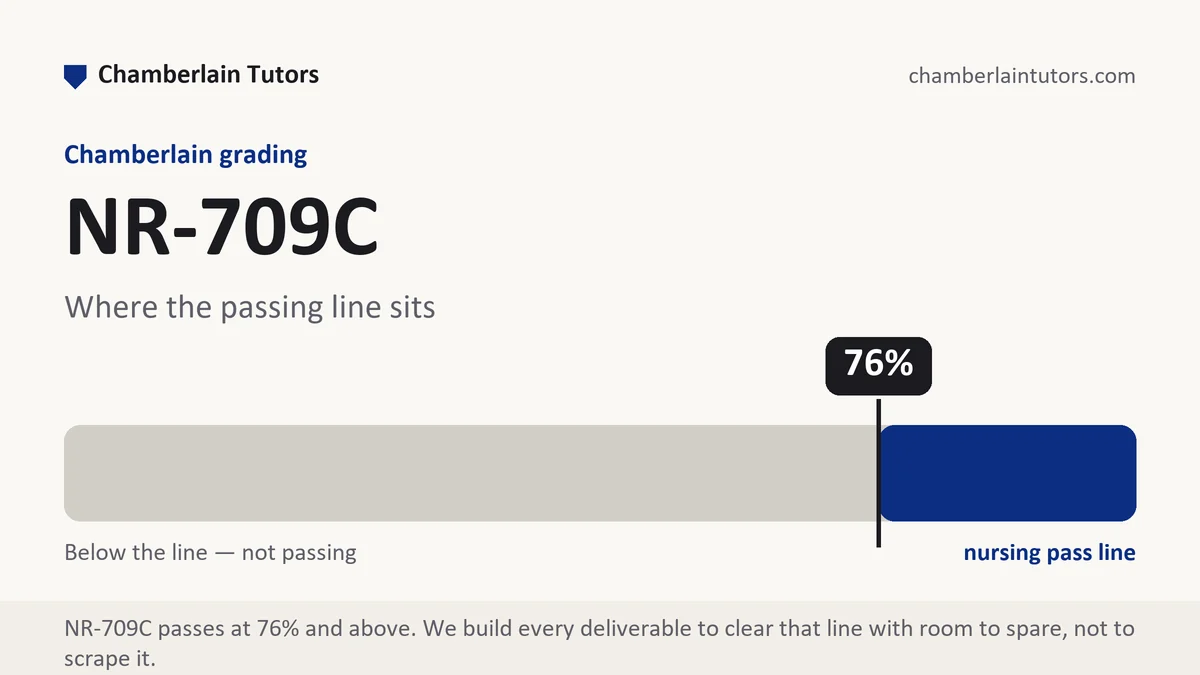
A passing NR-709C set is complete and repetitive: four versions of the same document at four lengths. Its usual weakness is that the executive summary opens with background and the staff version reads like a journal article. The last passing number in a Chamberlain core nursing course is 76, and supplementary work will not raise a weighted average that has slipped, so a final block where the marks are spread across artifacts is not the place to let three of them be afterthoughts.
Strong dissemination reads as though four different people wrote it for four different rooms. The executive version leads with the number and the ask. The poster gives up detail without giving up the denominator. The scholarly version carries method a reader could repeat. The staff version says what changes on their next shift and thanks the people who did the work, because the ones who delivered the change are the audience most often forgotten. And every version carries one honest limitation, which is what makes the whole set credible rather than promotional.
Six mistakes that cost points in NR-709C
- One document reused for every audience. Trimming is not adapting, and the mismatch is visible in the first sentence.
- An executive summary that buries the number. If the finding is not in the first paragraph, it will not be read.
- A poster of paragraphs. Posters are read standing up. Headings, one figure and short lines.
- Limitations dropped from the public versions. Removing them turns reporting into promotion and readers discount the whole set.
- Numbers that disagree between artifacts. Build every version from one verified table and update all of them together.
- Identifying the site or its staff without permission. Confirm what may be named before anything leaves your hands.
Questions NR-709C students ask
How long should the executive summary actually be?
Can I write the final document as though it were for publication?
What goes in the staff-facing version that does not go anywhere else?
Where NR-709C sits in Chamberlain's programs
Open the exact program map for sequence, credit, and option context. The current student schedule and syllabus remain authoritative after transfer evaluation, electives, state rules, and approved plan changes.
The weeks, one by one
Week 1
NR-709C carries 4 practicum credits and 256 clinical hours, roughly thirty-two hours a week across an eight-week session, and it is the largest block in the sequence. Read the full Week 1 manual.
Week 2
Before a project is told five ways, its numbers have to be settled once. Read the full Week 2 manual.
Week 3
An executive summary is not a shortened paper. Read the full Week 3 manual.
Week 4
A poster is read standing, from three feet away, by someone who will give it about ninety seconds before moving on. Read the full Week 4 manual.
Week 5
The staff-facing version answers one question: what changes for me on Monday. Read the full Week 5 manual.
Week 6
The manuscript-shaped version is the one written for a reader in another organization deciding whether to try what you tried. Read the full Week 6 manual.
Week 7
Spoken language is not written language read aloud. Read the full Week 7 manual.
Week 8
The last stage of this 256-hour block, in our teaching order, is assembly and verification: the final scholarly document completed, every dissemination product reconciled against it, the appendices ordered, and a reflection written that analyzes practice rather than narrating a term. Read the full Week 8 manual.