The staff-facing version answers one question: what changes for me on Monday. In our teaching order, this stage of the 256-hour block writes the materials the unit actually uses, which usually means a single-page summary for a huddle board, a short piece of education content, and sometimes a scenario for a simulation lab or skills day. The register is direct, second person, specific about actions and times, and completely free of methodology. It is the version most likely to keep the change alive. Your section may print this as NR 709C or NR709C; it is the same course. Chamberlain publishes no syllabi outside Canvas. The placement here is our teaching judgment from the course's catalog arc; your section's rubric decides what your week actually asks.
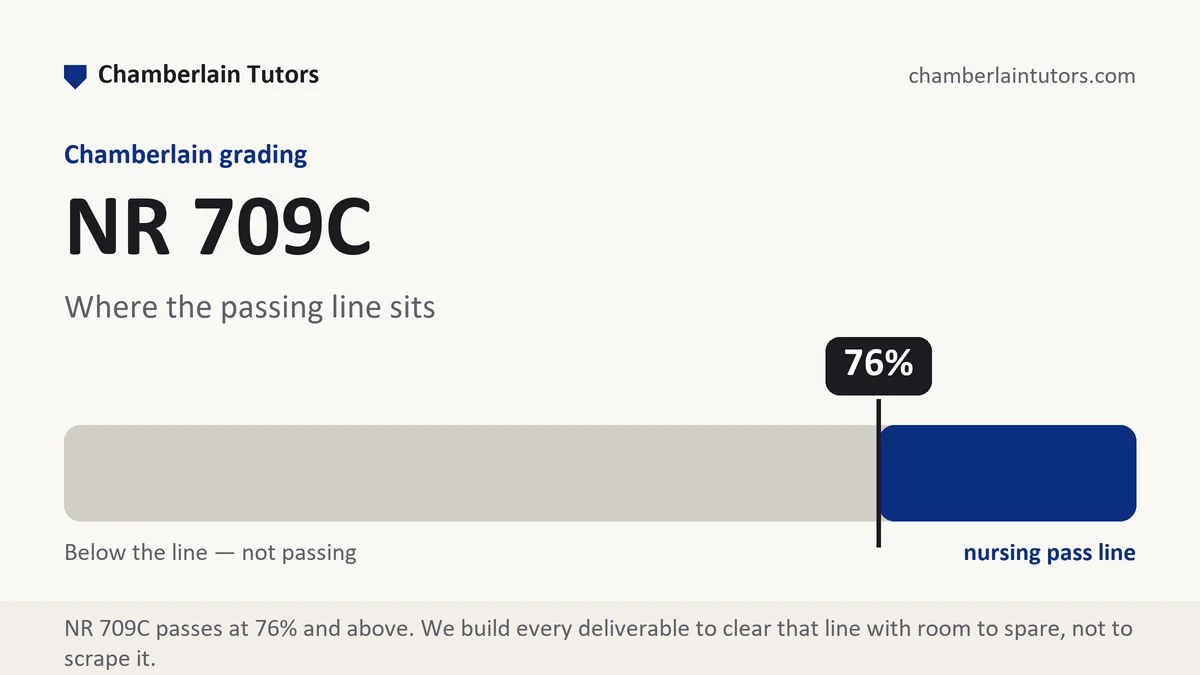
What NR-709C Week 5 asks for
Night shift in a medical intensive care unit, 0300, and a nurse who was on orientation during your entire implementation is looking at a laminated sheet on the huddle board to work out whether a new assessment applies to her patient. She has ninety seconds and a call light going. Whatever your project produced, this sheet is the artifact that decides whether the change happens for that patient. Most doctoral students spend fifty hours on a manuscript that four people will read and ninety minutes on this page, which is backwards in every way that matters to practice.
The writing problem is specificity under compression. Staff-facing material fails in two directions. It fails by being vague, telling people to consider assessing rather than telling them what to do, when, and where to document it. It fails by being long, arriving as three pages of rationale that nobody reads at 0300. What works is a short document organized around the moment of action: this is what changed, this is who it applies to, this is what you do, this is where it goes, and this is who to ask.
The boundary, unchanged across every product in this block. Practicum hours, hour logs, encounter counts, preceptor or mentor evaluations, site paperwork and every signature on them are your own record of your own work, and are never drafted, reconstructed, estimated or edited toward acceptance with anyone's help. Delivering education at your site is likewise yours. The supportable layer is the writing: how a huddle page is organized, how an instruction is phrased so it cannot be misread, how a teaching scenario is structured. Every clinical illustration is constructed or de-identified before it is written.
Simulation content deserves a note of its own, since it is often where a change is taught most effectively. A scenario written for a skills day needs a stated objective, a short setup, the decision point the change is about, and a debrief structure with questions rather than answers. Writing one is a teaching skill that the practice doctorate expects, and it is graded on whether the scenario would actually produce the learning it claims, not on how detailed the clinical picture is.
The NR-709C Week 5 method, step by step
Six moves for writing material a unit will actually use.
-
Open with what changed and who it applies to
Two sentences. A reader who reads nothing else should know whether this affects their patient tonight, which is the only question they came to the board with.
-
Write the action as steps with a trigger and a time
When this happens, do this, within this window, and record it here. Verbs and timings, not principles. Consider and as appropriate are the two phrases that make an instruction unusable.
-
Name the documentation location exactly
The screen, the flowsheet row, the field. Half of all compliance failures in acute care are documentation location failures rather than clinical ones, and one precise sentence removes them.
-
Give one reason, in a single sentence
Staff comply better with a change they understand, and they need one reason, not a literature review. Your result with its base is usually the most persuasive sentence available.
-
Answer the three objections you have already heard
You know what people said on the unit during implementation. Write short honest answers to the three most common, including the one about workload, because unanswered objections travel faster than instructions.
-
Test it on a nurse who was not involved
Hand it over, ask what they would do with a specific patient, and rewrite whatever they got wrong. This test takes ten minutes and improves the document more than any amount of redrafting alone.
A layout and word budget for staff-facing materials
Our frame for a one-page unit summary, roughly 250 to 400 words, plus an optional scenario of similar length. It is our own outline rather than anything the university issues, and your week's rubric outranks it wherever the two disagree.
| Block | What it must do | Word target |
|---|---|---|
| What changed | The change and the patients it applies to, in two sentences with no preamble. | 35 to 50 |
| What you do | Numbered steps with a trigger, an action, a time window and the person responsible. | 80 to 120 |
| Where it goes | The exact documentation location, named as staff see it on screen. | 25 to 40 |
| Why it matters | One sentence of reason, ideally your own result with its denominator. | 25 to 40 |
| Common questions | Three objections answered plainly, including the workload one. | 70 to 110 |
| Who to ask | The role to contact and where the full protocol lives, with a date on the sheet. | 20 to 35 |
Evidence craft for staff-facing writing
Keep the number honest even here. Sharing your result on a unit sheet is good practice and it still carries its base. Documented reassessment rose from 46 to 71 percent of eligible patients over three months is short, true and more motivating than a claim staff cannot check against their own experience.
Write to the clinical reality staff know. A sheet that ignores what happens when the unit is short or the patient is off the floor for a procedure loses credibility immediately. Address the awkward case explicitly, because the awkward case is the one people ask about.
Do not moralize. Language implying that previous practice was negligent guarantees resistance. The frame that works is that the process was harder than it needed to be and this change makes the right action easier, which is usually also true.
Date the sheet and name a maintaining role. Undated material outlives its accuracy and quietly teaches the wrong thing. A date and a role in small type at the bottom is the whole fix.
Constructed examples only. Any patient scenario used for teaching should be built rather than borrowed from a real chart. If a real case inspired it, change enough that no one could identify it, and say in your scholarly document that teaching examples are constructed.
Five mistakes that cost points in this week's territory
- Methodology on a huddle sheet. Nobody at 0300 needs your framework, and its presence pushes the instruction off the page.
- Instructions without a trigger or a time. Consider assessing is not an instruction anyone can follow or audit.
- No documentation location. A change that is done but not recorded looks like a change that never happened.
- Ignoring the workload objection. The question everyone is thinking should be answered in writing rather than in the break room.
- A real chart used as a teaching example. Constructed scenarios exist precisely so this never has to happen.
Before you submit
- The first two sentences say what changed and who it applies to
- Every action carries a trigger, a time window and a responsible role
- The documentation location is named as staff see it on screen
- Three real objections are answered, including workload
- All clinical examples are constructed, and the sheet is dated with a maintaining role
- No hours, logs, evaluations or site paperwork are drafted or reconstructed anywhere
Writing the NR-709C staff-facing materials?
Send the rubric and your protocol out of Canvas. A premium original draft comes back in 24 to 48 hours written for a nurse at 0300, with actions, timings and documentation locations exact, and revisions run until the grade lands.