The last stage of this 256-hour block, in our teaching order, is assembly and verification: the final scholarly document completed, every dissemination product reconciled against it, the appendices ordered, and a reflection written that analyzes practice rather than narrating a term. The technical task is consistency across a set that was written over eight weeks in five registers. The scholarly task is saying what the project means and what you now know about leading change. Your section may print this as NR 709C or NR709C; it is the same course. Chamberlain publishes no syllabi outside Canvas. The placement here is our teaching judgment from the course's catalog arc; your section's rubric decides what your week actually asks.
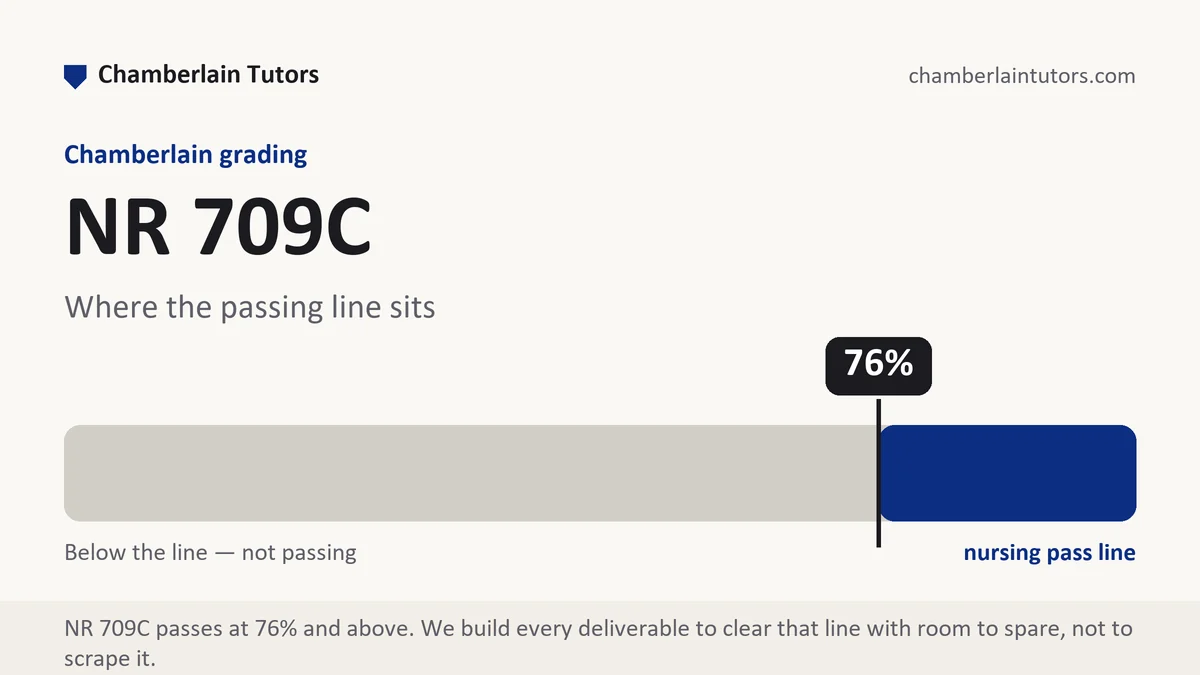
What NR-709C Week 8 asks for
A level II trauma center project ends the block with seven files: the long document, an executive brief, a poster, a huddle sheet, a slide deck, an abstract and a set of appendices. Opened side by side in the final week, the brief quotes a figure the long document later corrected, the poster title claims a reduction the discussion carefully described as an association, and the abstract describes a population the methods section defines differently. Each file was competent when written. The set is not, and the set is what gets submitted.
Verification is therefore the first half of this stage, and it is mechanical work that rewards a system. Take the figures register, and check every number in every product against it, one row at a time, including numbers inside charts and captions. Then check claim language: every product's strongest sentence should be sizeable to the same design. Then check definitions: the population, the intervention name and each measure should be described identically everywhere, allowing for length.
The second half is the closing scholarly writing. A conclusion that says what was established, what was not and what happens next. A dissemination summary describing where the project went, to whom, and with what response, which is often a graded element in this block. And a reflection built around decisions rather than chronology, connected where your section asks to your program's competency framework.
Give the verification a fixed order and it stops being daunting. Numbers first, because they are objective and mechanical. Names and definitions second, since a single renamed measure can create half a dozen apparent contradictions. Claim language third, which requires judgment and is best done when the factual layer is already settled. Appendices and references last, when nothing upstream will change again. Working in that order means each pass is final, whereas working file by file means revisiting the same document three times and still missing something.
The boundary, holding to the final page. Practicum hours, hour logs, encounter counts, preceptor and mentor evaluations, site paperwork and every signature on them are your own record of your own work, never drafted, reconstructed, estimated or edited toward acceptance with anyone's help. Presentation and defence are yours. The supportable layer is the writing: assembly, verification, register, structure and the analytic quality of a reflection about work you genuinely performed. De-identification applies to every appendix as much as to the body.
The NR-709C Week 8 method, step by step
Six moves for closing a dissemination block cleanly.
-
Run the register against every product
Row by row, file by file, including chart labels, captions and abstract text. This is tedious and it is the single highest-value hour of the week.
-
Standardize names and definitions across the set
One name for the intervention, one for the population, one for each measure, used identically in all seven files. Synonyms invented late in a term are a common source of apparent contradiction.
-
Check the strongest sentence in each product
Find the boldest claim in every file and confirm the design can pay for it. Short formats are where causal language creeps in, and the poster title is where it does the most damage.
-
Order and clean the appendices
Every appendix referenced in the text, in the order first mentioned, each de-identified, each with a title a reader can understand without the body.
-
Write the dissemination summary factually
What went where, on what date, to which audience, and what happened as a result. Submitted, presented, accepted and under review are different states and should be named precisely.
-
Write the reflection around two or three decisions
Reasoning then, knowledge now, and what changes in your practice. Attach each to something published rather than to impression, and keep chronology out of it.
A layout and word budget for the closing work
Our frame for the final week's new writing, sized for roughly 1,200 to 1,500 words on top of verification time. It is our own outline rather than anything the university issues, and your week's rubric outranks it wherever the two disagree.
| Piece | What belongs in it | Word target |
|---|---|---|
| Conclusion | What was established, what was not, and what should happen next. No new material. | 200 to 250 |
| Dissemination summary | Each product, its audience, its date and its status, stated precisely. | 220 to 280 |
| Response and uptake | What audiences did with it: decisions taken, questions raised, adoption requested. | 170 to 220 |
| Reflection on decisions | Two or three choices examined with reasoning then, knowledge now, and the practice change. | 350 to 430 |
| Competency mapping | Where your section requires it, evidence tied to specific artifacts rather than assertions. | 180 to 230 |
| Verification pass | Not prose but a task: figures, names, claims and appendices reconciled across every file. | Time, not words |
Evidence craft for closing a dissemination block
State dissemination status accurately. Presented at a system congress on a named date, submitted to a journal and under review, and accepted for publication are three different claims. Overstating any of them is a checkable misstatement and the least worthwhile risk in the entire degree.
Evidence competency with artifacts. Where a mapping is required, point to a specific document and a specific passage rather than asserting that a competency was met. An assessor should be able to open the artifact and see it.
Keep the translation frame in the closing sentences. The last paragraphs are where research vocabulary returns. What you have is a local implementation of existing evidence, evaluated, disseminated and handed over. Say that plainly rather than reaching for the language of discovery.
Write the reflection in a register you can defend. First person is normally appropriate here even where the rest of the document avoids it, but it does not license looseness. A sentence beginning I realized still needs to say what was realized, on what evidence, and what changed as a result. The reflections that score are the ones where an assessor could disagree with you, because a claim nobody could dispute is a claim carrying no analysis.
Reconcile the reference list once at the end. Eight weeks of drafting across several documents guarantees drift. Every in-text citation present in the list, every entry cited somewhere, formatting consistent, and any source that migrated between products checked in both.
Check every appendix for identifiers one last time. Audit tools, sample forms, screenshots, education handouts and photographs are where identifying detail survives longest, because they are usually pasted rather than written. Read each as a stranger would.
Five mistakes that cost points in this week's territory
- Products that contradict each other. A set assembled without verification undermines every figure in it.
- A poster title the discussion disowns. Causal language survives in short formats longer than anywhere else.
- Overstated dissemination status. Submitted is not accepted, and the distinction is trivially checkable.
- A reflection that recounts the term. Chronology is not analysis, however sincerely it is written.
- Identifiers surviving in an appendix. The body is usually clean; the pasted materials are where the leak happens.
Before you submit
- Every number in every product has been checked against the figures register
- Intervention, population and measure names are identical across all files
- The strongest claim in each product is sized to the evaluation design
- Dissemination status is stated precisely for each product with dates
- The reflection examines decisions and connects them to published work
- No hours, logs, evaluations or signatures are drafted anywhere, and every appendix is de-identified
Closing out NR-709C this week?
Send the rubric and every product out of Canvas. A premium original draft comes back in 24 to 48 hours with the set reconciled, claims sized to the design and a reflection that analyzes, and revisions run until the grade lands.