NR-709B takes DNP Project and Practicum IV at 3 credits and 192 clinical hours. Where the smaller block reports the numbers, this one interprets them and plans what happens after you leave. Two pieces of writing carry it: a discussion that weighs your result against rival explanations and against the literature, and a sustainability plan that names an owner, embeds the change in something permanent, and sets a review date. A project that depends on the student to keep running has not finished.
The practicum belongs to you: its hours, its preceptor and site relationships, its paperwork, its log and any assessment attached to it. We do not touch those. Our part is written: the discussion, the limitations, the sustainability and handoff sections and the scholarly narrative your rubric grades.
What NR-709B actually grades
The first row is whether alternative explanations are taken seriously. A measure that moved during your project could have moved for several reasons: a secular trend already underway before you started, attention effects from being observed, regression toward the mean after an unusually poor baseline period, a simultaneous initiative, a staffing or case-mix change. A discussion that considers each and says which it can and cannot rule out is doing doctoral work. One that mentions limitations in a closing paragraph is not.
The second row is sustainability with a named owner. Committees have read many projects that improved something for eight weeks and left no trace. What earns marks is a plan that puts the change into a standing structure: a written policy, a documentation default, an item on an existing audit schedule, a role that already exists and now has this in its remit. Ownership by an individual who happens to be enthusiastic is the weakest form and should be named as such if it is all you have.
How we help in NR-709B
Our doctoral writers construct the discussion as a weighing exercise, with each rival explanation examined against your own data rather than dismissed. The sustainability section comes back with an owner, an embedding mechanism and a review cadence, so the handoff is a document rather than a hope.
Deliverables run the standard promise: a premium original draft in 24 to 48 hours, targeted at the A band of your course's actual scale, through the eight-person pipeline with both QA passes and the floor check, revised free until it lands.
In NR-709B right now?
Send your rubric and your results. First premium sample free, floor-checked, back in 24 to 48 hours.
Read the rubric before the prompt
Discussion rubrics reward structure that students rarely impose on themselves. Copy the criterion rows into a blank file and check whether the guide separates interpretation, comparison with the literature, limitations, implications and sustainability into distinct rows. Where it does, use those as headings, because a single flowing discussion tends to answer three rows partly and none fully.
Then price it. A 2,000-word discussion with four rows at 30, 26, 24 and 20 percent leaves 600, 520, 480 and 400 words. The 600-word row is normally interpretation with alternative explanations, and the 400 is often sustainability. Students routinely reverse this, writing a long plan for the future and a short paragraph about what the data means, which leaves the heaviest row underwritten.
Before drafting, write the strongest argument against your own conclusion in three sentences. If your measure improved, that argument is usually a trend already present in the baseline or a simultaneous change you did not control. Confronting it first shapes an honest discussion, and it means the objection appears in your writing rather than in a committee question you have not prepared for.
The shape of a discussion and sustainability plan
These are the parts a committee reads for. Each carries a judgment, and a committee can see whether the judgment was actually made.
| Part | What it has to prove | How a thin version looks |
|---|---|---|
| What the result means | A cautious statement of the finding in language the design supports, without restating the numbers. | The results section repeated in sentences. |
| Comparison with the evidence | How your result sits against the studies you appraised, including where it disagrees. | A claim that findings are consistent with the literature, unsupported. |
| Alternative explanations | Each rival cause named and tested against your own data, with a verdict on each. | A general acknowledgment that other factors may have contributed. |
| Limitations by design | What this design could never have shown, separated from what went wrong in execution. | A boilerplate paragraph about small sample size. |
| Implications for practice | What a reader in a similar setting should do differently, and under what conditions. | A recommendation that others consider the intervention. |
| Sustainability owner | The role that holds the change after you leave, with the change written into that role's work. | Continued support from staff assumed. |
| Embedding mechanism | The policy, standard work, documentation default or audit schedule that carries it. | Ongoing education named as the mechanism. |
| Review cadence and handoff | What is measured after handoff, how often, reported to whom, and the document that transfers it. | A hope that the practice will continue. |
Evidence craft in interpretation
Four habits keep a discussion credible.
Test each rival explanation against your own data. A secular trend can often be examined by looking at whether the baseline was already rising. Attention effects can be assessed by whether the change persisted after your visible involvement reduced. Regression toward the mean is more plausible when the baseline period was unusually bad. Saying which check you ran, and what it showed, is far stronger than listing possibilities.
Compare with the literature honestly, including where you differ. If your improvement was smaller than the published effect, say so and offer a reason grounded in fidelity, setting or dose. Reporting a result as consistent with the literature when the magnitudes differ substantially is the kind of claim a committee checks.
Separate design limits from execution problems. A pre-post design without a control is a limit of the design and would have applied however well you ran the project. A shortened data collection period is an execution issue. Mixing them makes both harder to assess, and rubrics usually reward the distinction explicitly.
Keep verbs at the level the evidence supports, including in the sustainability section. The measure improved during the intervention period is available; the intervention improved the measure is not, unless your design earned it. For sustainability, avoid promising that the change will continue and instead state what has been put in place, who owns it and when it will next be checked. Where you cite sustainability literature, give sources older than five years a stated justification unless your guide sets another rule.
What separates a pass from a strong pass here
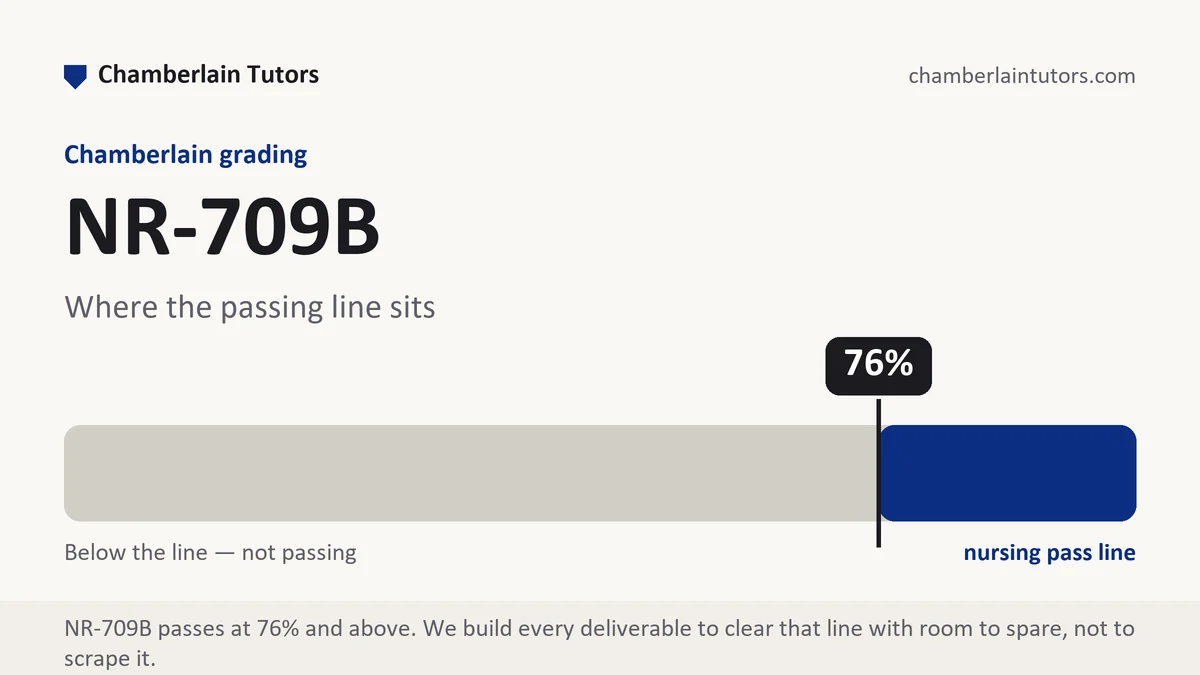
A passing NR-709B discussion interprets the result, mentions limitations and proposes that the practice continue. Its usual weaknesses are limitations written as boilerplate, no serious engagement with rival explanations, and a sustainability plan with no owner. Chamberlain's core nursing courses stop at a 76 percent floor, and additional work does not recover an average that has already dropped, so a discussion stage that skips the hard thinking is a costly place to be efficient.
Strong discussions argue with themselves. They name the explanation that would most undermine the conclusion and then examine it properly, sometimes conceding it. They state what the project genuinely establishes, which for most doctoral projects is that a change is feasible in a real setting and was followed by a movement in a measure, and they treat that as a worthwhile finding rather than apologizing for it. And they hand the work over concretely: a named role, a written mechanism, a measure with a review date, and a short handoff document that would still make sense to someone reading it a year later.
Six mistakes that cost points in NR-709B
- A discussion that repeats the results. Numbers belong in the results section. This section is for what they mean and what else could explain them.
- Boilerplate limitations. Small sample and single site are true of nearly every doctoral project and earn nothing without specifics.
- No alternative explanation examined. The rival cause you did not consider is the first question a committee will ask.
- Sustainability with no owner. A change that belongs to nobody reverts, and readers know it.
- A plan that depends on you. If your continued presence is the mechanism, the project has not been handed over.
- No review date. Without a scheduled check, nobody will notice when performance drifts back.
Questions NR-709B students ask
My result was positive but I think a simultaneous initiative caused it. Do I have to say so?
How do I write a sustainability plan when I am leaving the organization?
What if nothing improved at all?
Where NR-709B sits in Chamberlain's programs
Open the exact program map for sequence, credit, and option context. The current student schedule and syllabus remain authoritative after transfer evaluation, electives, state rules, and approved plan changes.
The weeks, one by one
Week 1
NR-709B carries 3 practicum credits and 192 clinical hours, which is roughly twenty-four hours a week across an eight-week session. Read the full Week 1 manual.
Week 2
A discussion opens by saying what happened, once, in a sentence the design can actually pay for. Read the full Week 2 manual.
Week 3
Something else may have moved your measure. Read the full Week 3 manual.
Week 4
Your result has to be read against the evidence that justified the change in the first place. Read the full Week 4 manual.
Week 5
A limitation that does not say which way it pushed the result is not a limitation; it is a disclaimer. Read the full Week 5 manual.
Week 6
A project that stops when you stop has not finished. Read the full Week 6 manual.
Week 7
The sustainability plan argues that the change will persist. Read the full Week 7 manual.
Week 8
The final stage of this 192-hour block, in our teaching order, is assembly: the separate movements written across the session become one discussion that runs from result to implications to conclusion, followed by a reflection that analyzes rather than narrates. Read the full Week 8 manual.