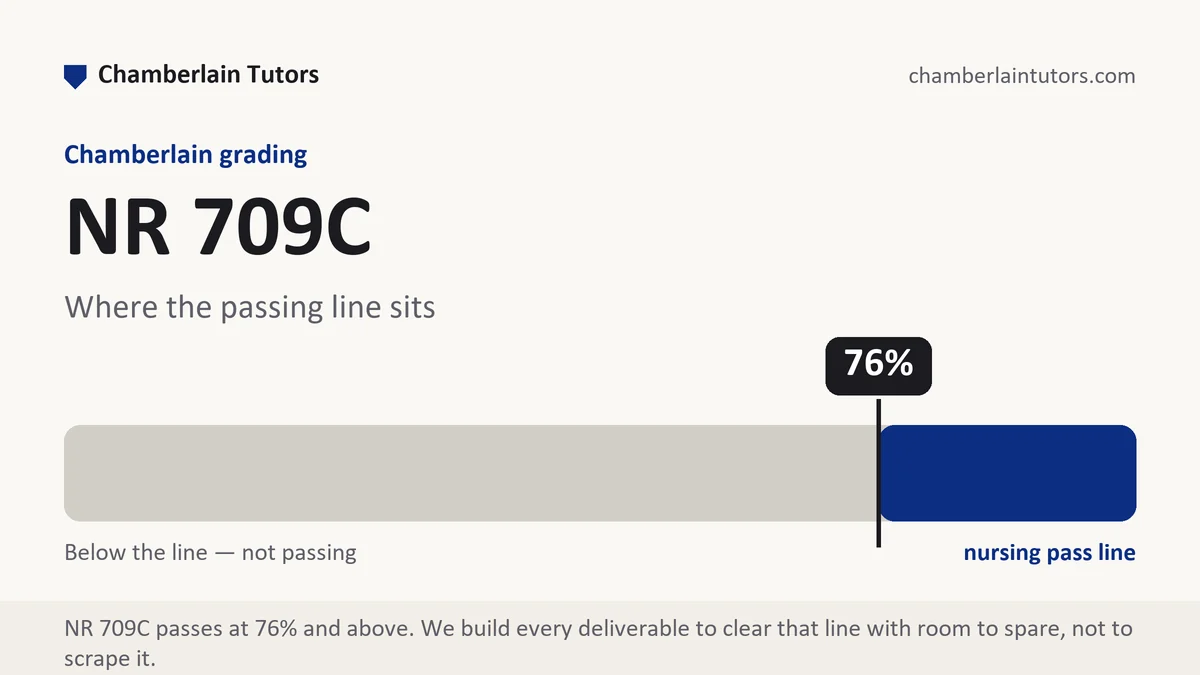
An executive summary is not a shortened paper. It is a decision document written for a reader with about ninety seconds and authority over resources. In our teaching order, this stage of the 256-hour block asks you to put the ask and the number in the first paragraph, follow with the evidence that supports the ask, name what it costs and who owns it, and stop at one page. Compression is the hardest writing in the block and it is where doctoral communication is most visible. Your section may print this as NR 709C or NR709C; it is the same course. Chamberlain publishes no syllabi outside Canvas. The placement here is our teaching judgment from the course's catalog arc; your section's rubric decides what your week actually asks.
What NR-709C Week 3 asks for
A nursing director is walking into an operations meeting at a 400-bed acute care hospital with eleven items on the agenda and eighteen minutes. Your project is item seven. She will read the first paragraph of your page in the corridor. If that paragraph tells her what changed, by how much, what you are asking the group to approve and what it costs, she can advocate for it. If it opens with background on the clinical problem and a description of your framework, she will present something vague from memory and the item will be deferred.
The structural inversion is the whole lesson. Scholarly writing builds toward its conclusion; executive writing begins with it. That inversion feels wrong to a doctoral student who has spent two years learning to earn a claim before making it, which is why this page is worth practising deliberately. It is not a lowering of standards. Every number still carries its denominator, every claim is still sized to the design, and the recommendation is still the one your evidence supports. What changes is order and length, not rigor.
The boundary, restated because it applies to every product in this block. Practicum hours, hour logs, encounter counts, preceptor or mentor evaluations, site paperwork and every signature on them are your own record of your own work and are never drafted, reconstructed or estimated with anyone's help. Nor does anyone present or speak to your leadership on your behalf. The supportable layer is the writing: structure, compression, sequencing, evidence handling and register. Anything drawn from real cases or site data is de-identified before it is written.
Expect the deliverable to be a one-page brief, sometimes accompanied by a short reflection on audience adaptation. Two hundred and fifty-six hours gives you room to test it, which is the step most students skip: give the draft to somebody at your site who was not involved in the project, ask them what you are requesting, and rewrite based on what they say back rather than on what you meant.
The NR-709C Week 3 method, step by step
Six moves for writing one page an executive can act on.
-
Decide the ask before you write anything
Approval, resources, policy adoption, spread to other units, or simply awareness. A brief written without a decision in mind becomes a report, and reports get filed rather than acted on.
-
Write the first paragraph last but place it first
Change, magnitude with denominator, ask, cost. Four elements in about seventy words. If the reader stops here, they should still know what you want and why it is reasonable.
-
Give the evidence in three sentences, not three paragraphs
What was implemented, over what period, in what population, and what the primary measure did. Methodology detail belongs in the full document and is a distraction here.
-
State cost and resource in terms the reader budgets in
Hours per month, one-time education time, a licence, a report build. Executives translate everything into labour and money, and a brief that leaves them to do it themselves is asking for a deferral.
-
Name the risk and the boundary honestly
One sentence on what the evidence cannot support and one on the main risk of proceeding. Written well, this increases trust rather than weakening the case, and it forestalls the question that would otherwise derail the item.
-
Cut to one page and then cut again
Delete adjectives, background, framework names and every sentence that does not change a decision. Length discipline is the visible evidence that you know what matters in your own project.
A layout and word budget for a one-page brief
Our frame for an executive summary, sized for roughly 380 to 450 words so it genuinely fits a page with a figure. It is our own outline rather than anything the university issues, and your week's rubric outranks it wherever the two disagree.
| Block | What it must do | Word target |
|---|---|---|
| Lead paragraph | Change, result with denominator, the ask, and the cost, in that order. | 60 to 80 |
| What was done | The intervention, the setting, the period and the population, without methodology. | 60 to 80 |
| What happened | The primary measure and one supporting measure, both with bases, plus the balancing measure in a clause. | 70 to 90 |
| What it costs | Ongoing labour, one-time effort and anything requiring purchase or a build, quantified. | 60 to 80 |
| Risk and limits | One sentence on what the evaluation cannot show, one on the risk of proceeding. | 50 to 70 |
| Decision requested | The specific decision, the owner, the date it is needed, and what happens without it. | 60 to 80 |
Evidence craft for executive writing
Compression never removes the denominator. Short does not mean loose. Seventy-one percent of 146 activations is four words longer than 71 percent and is the difference between a defensible brief and a promotional one. Executives who have been misled by a dashboard once look for the base.
Keep association language even under compression. The verb that would be wrong in your manuscript is still wrong on one page. Improved alongside, rose during, was associated with. The temptation to write reduced grows as the sentence gets shorter, and it should be resisted with the same discipline.
Quantify the ask. Support for continued monitoring is not an ask. Two hours of unit educator time each quarter and inclusion of one measure on the existing dashboard is an ask, and it can be approved in a meeting.
Use one figure at most, and make it self-explanatory. A single chart with a labelled axis, a stated denominator and a marked intervention point does more than three tables. If a reader has to ask what the chart shows, it is costing you the page rather than earning it.
Do not cite in the body; footnote if you must. A brief that carries parenthetical citations reads as an academic document delivered to the wrong room. Where an authority matters, name it in plain words, and keep the full referencing in the scholarly document where it belongs.
Five mistakes that cost points in this week's territory
- Opening with background. The reader knows the clinical problem; they do not know what you want.
- No decision requested. A page that informs without asking will be received warmly and change nothing.
- Methodology on an executive page. Framework names and design descriptions consume the space the ask needed.
- Unquantified cost. Minimal additional resources is the sentence that guarantees the item is deferred for costing.
- Two pages. An executive summary that runs over is evidence that the writer could not decide what mattered.
Before you submit
- The first paragraph contains the change, the number with its base, the ask and the cost
- Every figure on the page matches the figures register exactly
- Cost is expressed in hours, money or a build, not in adjectives
- One sentence states what the evaluation cannot show
- The decision requested names a person or role and a date
- No hours, logs, evaluations or signatures are drafted anywhere in the work
Writing the NR-709C executive summary?
Send the rubric and your results out of Canvas. A premium original draft comes back in 24 to 48 hours built as a decision document, with the ask and the number in the first paragraph, and revisions run until the grade lands.