NR-547 Week 8 usually gathers the term into one artifact: a complete diagnostic case presentation, a single client carried from raw data through ranked differential, discrimination, rule-outs and lifespan weighting to a defended working diagnosis. Closing weeks of a session synthesize rather than introduce, and this practicum's synthesis is the document a psychiatric clinician actually produces for colleagues. This manual assembles it and prepares its defense. Your section may print this as NR 547 or NR547; it is the same course.
Chamberlain publishes no syllabi outside Canvas. The placement here is our teaching judgment from the course's catalog arc; your section's rubric decides what your week actually asks.
What NR-547 Week 8 asks for
An 8-week session ends by making students prove the arc happened, and in a diagnostic practicum the proof is a full case: not a new skill but every prior one operating in a single document. Expect the territory to be a comprehensive case presentation, frequently drawn from your own supervised practicum experience with identifiers removed, and often paired with a reflective component on how your reasoning changed across the term.
The deliverable's usual shapes are a capstone-style diagnostic paper, a formal case presentation with a defense of the working diagnosis, or a final discussion where classmates challenge each other's reasoning. If your section stages the challenge on a board, prepare your case and your anticipated objections offline first; posted defenses are permanent. As all term, your week's rubric owns the requirements, and reading it twice before assembling anything is the cheapest hour this week offers.
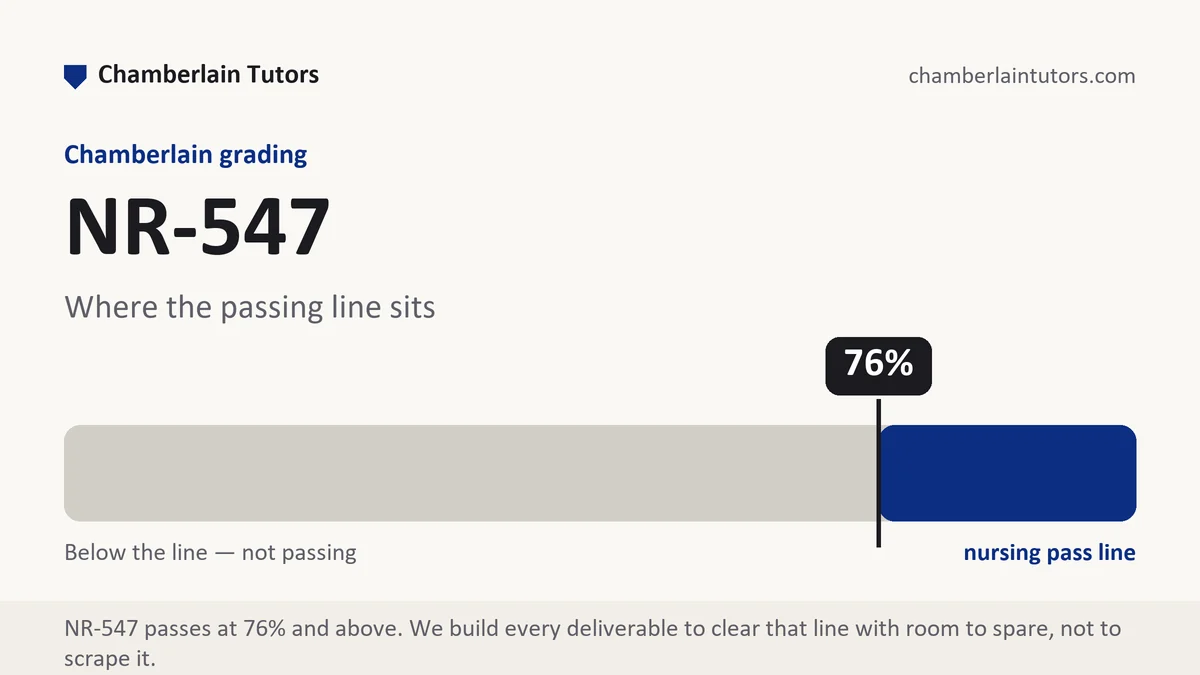
The arithmetic is now at its sharpest: on a scale where 84 passes and no C exists, the final heavy deliverable decides whether the term's margin holds, and the practicum's 125 supervised hours, always yours alone, are closing alongside it.
The NR-547 Week 8 method, step by step
Six moves that assemble a term of reasoning into one defensible presentation.
-
Choose the case that shows range
Pick a client whose workup exercised the term's skills: a real differential, a live rule-out, some lifespan or comorbidity dimension. The richest case you can document cleanly beats the most dramatic one you cannot.
-
De-identify before drafting, not after
Strip names, dates, places, employers and facility details at the note-gathering stage, and check your course's rules on using practicum encounters in graded work. Retro-fitted privacy always leaks a detail.
-
Rebuild the reasoning arc in order
Data, salience, candidates, discrimination, exclusions, weighting, impression: the presentation walks the same sequence the term taught, and the grader should recognize the method from its shape alone.
-
Write the defense before anyone attacks
Add a section that names the strongest alternative reading of your case and answers it with client data. A presentation that raises its own best objection is very hard to score low on reasoning.
-
State the working diagnosis with its horizon
Commit to where the reasoning lands, the confidence it deserves, and the data or interval that would revise it. Working is the operative word; the document should say what would change its mind.
-
Close the reflective loop honestly
Where a reflection is asked for, contrast a specific early-term habit with its week-eight replacement, evidenced from your own writing. Generic growth claims score generically.
A structure for the case presentation
Planning guides from our desk for a presentation in the 1,100 to 1,400 word range, not Chamberlain requirements. Your rubric's weighting always wins.
| Section | What belongs in it | Suggested length |
|---|---|---|
| Case introduction | The de-identified client and presentation, framed neutrally with the encounter context. | 120-150 words |
| Data and salient findings | The organized database, reported and observed separated, with the driving findings justified. | 200-240 words |
| Differential with ranking | The candidate list, anchored and ordered, with the ordering logic stated. | 200-240 words |
| Discrimination and exclusions | The close pair worked, and the medical and substance candidates kept or removed with bases. | 200-240 words |
| Working diagnosis and defense | The committed impression, criteria mapped to findings, the strongest objection raised and answered. | 200-240 words |
| Horizon and reflection | What would revise the diagnosis, and the term's documented change in your own method. | 150-180 words |
Evidence and citation craft for a synthesis week
The reference list should mirror the arc. A complete presentation cites the criteria edition, at least one discrimination-relevant source, and clinical support for any rule-out claim; a capstone with two references announces that the synthesis is thinner than it looks.
Late-term work is held to the term's full verb standard. By week eight, is consistent with and best accounts for are reflexes; a confirms in the final paper reads as regression and gets graded as one.
Cite yourself honestly. If the presentation reuses reasoning from your earlier weekly write-ups, check the course's policy on building on your own submitted work and follow it explicitly; final-week similarity flags are the most avoidable disaster this course offers.
Presentation-quality sourcing means placement, not volume. One citation attached to the exact sentence doing argumentative work outperforms five stacked at a paragraph's end, and in a defense document the difference is visible immediately.
Five mistakes that cost points in a final case week
- Choosing spectacle over documentation. A dramatic case you cannot fully evidence forces invented detail or visible gaps. The graded object is the reasoning, and the quiet case usually shows more of it.
- Summarizing instead of synthesizing. Eight weeks recapped in sequence is a book report. The presentation must run the method on one case, not describe the method in the abstract.
- A defense section that shadowboxes. Raising a weak objection to knock it down is transparent. Name the alternative a good clinician would actually press, and answer it with data.
- An identifier surviving into the draft. One facility name or date of service in a practicum-drawn case is simultaneously a privacy failure and a rubric row, and it is the most preventable loss of the week.
- Reflection written as testimonial. Praising the course is not the assignment. Show one concrete reasoning habit that changed, with the before and after visible in your own sentences.
Before you submit the case presentation
- The case is fully de-identified and its use conforms to your course's rules
- The reasoning arc appears in order: data, candidates, discrimination, exclusions, impression
- The strongest real objection is raised and answered with client data
- The working diagnosis names its confidence and its revision conditions
- Criteria are mapped to findings in your sentences, with the edition cited
- Any reuse of your earlier weekly work follows the course's stated policy
Final case presentation on the line?
Send the prompt, the rubric and your de-identified case notes from Canvas. A complete presentation with the defense built comes back in 24 to 48 hours, floor-checked against the 84 line, first premium sample free.