NR-547 Week 6 usually completes the lifespan sweep at its other end: older adults, where the classic three-way problem, depression, delirium and dementia, waits for every diagnostician. The three can imitate each other, coexist, and hide behind medical burden and long medication lists, so the write-up this week lives or dies on onset, course and attention. This manual builds the older-adult differential so those separators do their work on paper. Your section may print this as NR 547 or NR547; it is the same course.
Chamberlain publishes no syllabi outside Canvas. The placement here is our teaching judgment from the course's catalog arc; your section's rubric decides what your week actually asks.
What NR-547 Week 6 asks for
A lifespan differential course that has visited childhood almost has to close the arc in late life, where diagnosis changes shape again. Cognitive and mood presentations intertwine, medical comorbidity is the rule rather than the exception, and the sharpest diagnostic evidence is usually temporal: how fast the change arrived and how it moves across a day. Expect the week's territory to be an older-adult case worked through the full method with those dimensions carrying the argument.
The deliverable usually takes the form of a case write-up whose candidates span cognitive, mood and medical explanations, often with the three-way discrimination at its center. A discussion variant might hand the class one presentation and ask what distinguishes the three D's in it; if your section runs one, compose it offline and post once, because boards keep every submitted word. Word counts, required candidates and format all belong to your week's rubric, which outranks any manual.
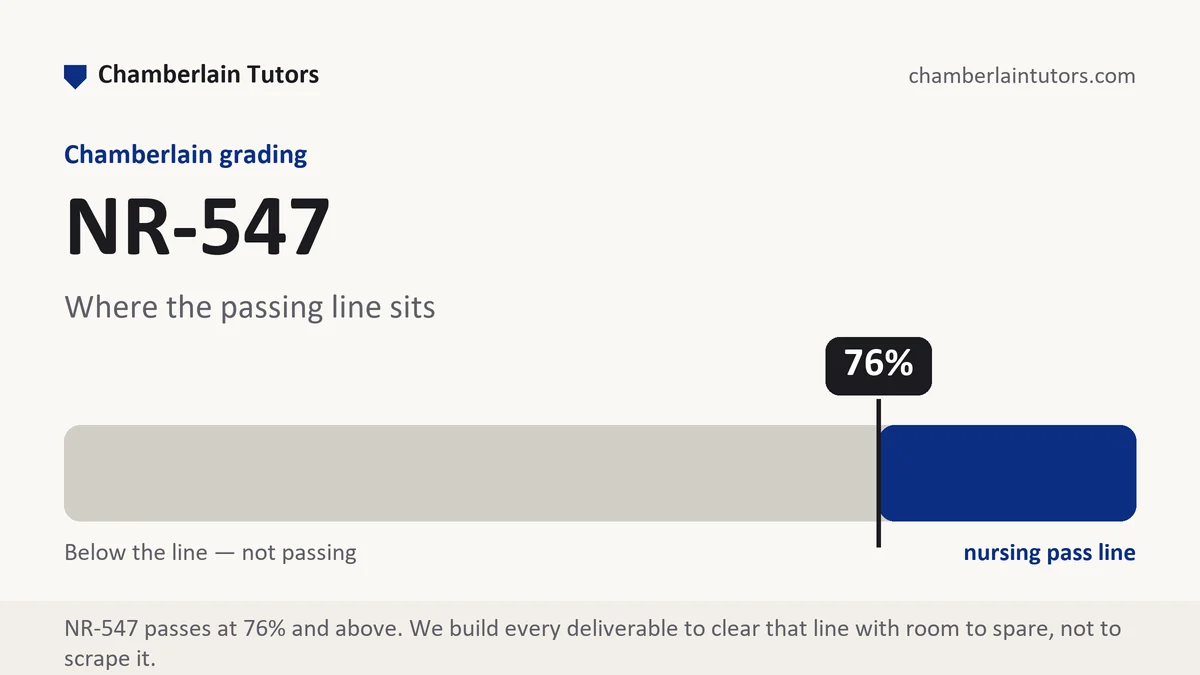
Underneath sits the usual arithmetic: the NP specialty scale passes nothing below 84 and holds no C band, and the practicum's supervised hours continue in parallel, yours alone to complete while the documentation around them takes the grades.
The NR-547 Week 6 method, step by step
Six moves for a differential where time is the chief witness.
-
Plot the change curve before naming anything
Establish the client's baseline function and when it shifted: hours to days suggests one family of causes, weeks to months another, years a third. Write the curve in intervals first; it will end up deciding more than any symptom does.
-
Test attention early
Fluctuating attention and clouded awareness push toward an acute confusional picture and demand urgency in the write-up. Record what the attention findings were and when they varied across the encounter or the day.
-
Interrogate the effort pattern
Answers of I do not know delivered without trying, against near-miss answers delivered with effort, point in different directions in late-life assessment. Describe the pattern you observed rather than only the scores.
-
Weigh the medical and medication load
Recent infections, new agents, anticholinergic burden and dose changes belong inside this differential, not appended to it. Correlate each with the change curve explicitly.
-
Let the candidates coexist where the data says so
Late-life presentations are frequently mixed: a mood process on top of cognitive decline, an acute state on top of both. Rank combinations honestly instead of forcing a single winner the data does not crown.
-
Close on safety-relevant next steps
The next-data section this week carries clinical urgency: what needs assessment soon, what can wait for an interval, and which finding would escalate the timeline. Write it with that ordering visible.
A structure for the older-adult differential write-up
Planning guides from our desk for a write-up in the 900 to 1,100 word range, not Chamberlain requirements. Move words to your rubric's heavier rows.
| Section | What belongs in it | Suggested length |
|---|---|---|
| Baseline and change curve | Prior function and the tempo of the change, in explicit intervals, with the informant who described it. | 150-180 words |
| Cognitive findings | Attention, orientation, memory and language observations, with the effort pattern described. | 150-180 words |
| Mood and vegetative findings | Mood, interest, sleep, appetite and hopelessness data, attributed to reporter. | 120-150 words |
| Medical and medication load | Conditions, recent events, agents and changes, each correlated with the curve. | 140-170 words |
| The three-way discrimination | Depression, delirium and dementia weighed against this client's tempo, attention and effort data, mixed pictures allowed. | 200-240 words |
| Working impression and next steps | Where the weighing lands, what gets assessed next, and what would escalate urgency. | 120-150 words |
Evidence and citation craft for a late-life week
Tempo claims deserve geriatric sources. The assertion that acute onset points away from a degenerative process is a claim with a literature; cite work in older populations rather than general adult texts stretched upward.
Cognitive screening results carry their education and sensory caveats. Instruments used in late life are sensitive to schooling, hearing and vision. Naming the caveat next to the score, with a source, is precision this week explicitly rewards.
Medication-effect claims need agent-level support. If your reasoning blames a drug class for cognitive or mood change, cite the evidence for that class in older adults, where altered metabolism changes the calculus.
Prevalence in late life needs its own denominators. Base rates shift with age, and importing midlife rates into an eighty-year-old's differential is a quiet error graders catch. Say the rate, the age band and the source in one sentence.
Five mistakes that cost points in an older-adult week
- Writing the differential without a tempo. If onset speed and course appear nowhere, the three-way discrimination has no engine, and the reasoning row has nothing to pay.
- Reading assessment scores without context. A low cognitive score in a client who is acutely inattentive, sensory-impaired or severely low in mood measures the state, not the trait, and treating it as settled evidence overclaims.
- Calling late-life depression normal. Framing low mood as an expected feature of aging dismisses a treatable condition and reads to faculty as both a clinical and an attitudinal error.
- Leaving the medication list out of the argument. In this age group the list is a live diagnostic suspect; a differential that never interrogates it has ignored an obvious candidate.
- Forcing a single diagnosis onto a mixed picture. When the data supports coexistence, the accurate write-up says so. Premature closure into one tidy answer is the week's most penalized shortcut.
Before you submit the older-adult write-up
- The change curve is written in intervals with its informant named
- Attention and fluctuation findings appear early and are used in the weighing
- The effort pattern is described, not just scored
- Every recent medication change is correlated with the timeline
- Mixed presentations are ranked honestly where data supports them
- Next steps are ordered by urgency, with the escalating finding named
Three-way discrimination due this week?
Send the case and rubric from Canvas. An older-adult differential with the tempo argument built and the mixed pictures handled honestly comes back in 24 to 48 hours, first premium sample free.