NR-547 Week 4 usually turns to the question every psychiatric differential must answer before it is allowed to be psychiatric: could a medical condition, a substance or a medication be producing this picture? Thyroid disease can wear depression's face, intoxication can mimic mania, and a diagnosis reached without excluding them is unsafe on paper. The middle of an 8-week practicum is where this discipline usually installs the habit, and this manual covers writing the rule-out so it scores. Your section may print this as NR 547 or NR547; it is the same course.
Chamberlain publishes no syllabi outside Canvas. The placement here is our teaching judgment from the course's catalog arc; your section's rubric decides what your week actually asks.
What NR-547 Week 4 asks for
Differential diagnosis in psychiatric-mental health carries a standing obligation the catalog's DSM framing builds in: the criteria sets themselves exclude presentations better explained by a substance or another medical condition, so a differential that never addresses those exclusions has skipped a required step. After the early weeks teach generation and discrimination, the arc's natural next move is this exclusion discipline, applied deliberately rather than as an afterthought.
The deliverable usually asks you to work a case whose presentation could plausibly be medical, substance-induced or medication-related, and to document the reasoning that keeps or removes those explanations. Sometimes that is a full write-up with a dedicated rule-out section; sometimes it is a focused paper on one mimic; a discussion version may hand different students different candidate causes. Draft any board post offline first, since posted reasoning cannot be revised, and let your week's rubric fix the exact shape.
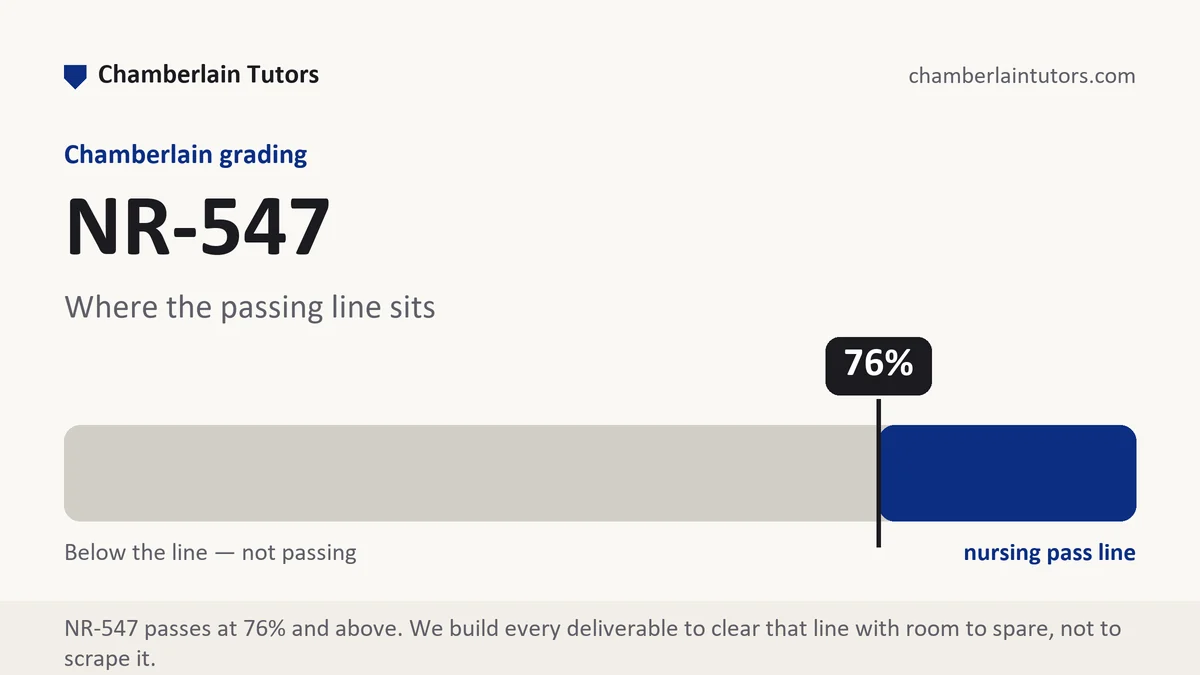
The grading backdrop does not move: the NP specialty scale fails everything below 84 with no C band to soften it, and rule-out sections are among the most mechanically scoreable rows a rubric offers, which makes them points you can bank with method alone.
The NR-547 Week 4 method, step by step
Six moves that put the exclusion reasoning on paper where a grader can pay it.
-
Confirm what the rubric means by rule-out
Some rows want the reasoning that excludes causes; others want the workup you would order to exclude them. Those are different paragraphs, and finding out which your week pays for is the first two minutes of work.
-
Sweep the medical history for candidate causes
Endocrine, neurological, metabolic, infectious and autoimmune conditions all have psychiatric presentations. List the ones this client's history, age and findings make plausible, with a sentence each on why.
-
Reconcile the full substance and medication list
Prescribed agents, recently stopped agents, alcohol, recreational substances, caffeine and anything bought without a prescription. For each, note whether intoxication, withdrawal or a side effect could produce part of the picture.
-
Correlate the timelines
The rule-out's sharpest tool is sequence: did symptoms begin before or after the exposure, the dose change, the illness? Write the correlation explicitly, in dates or intervals, because timeline is what separates coincidence from cause.
-
State the basis for each exclusion or retention
For every candidate cause, one sentence: excluded because of this finding, or retained pending this data. An unexplained exclusion reads as a guess, and a silent retention reads as a miss.
-
Name the data you would order and why
Where exclusion needs information you do not have, say what you would obtain and which candidate each result addresses. Requesting data is a graded skill; pretending completeness is a penalized one.
A structure for the rule-out write-up
Planning guides from our desk for a rule-out section in the 750 to 950 word range, not Chamberlain requirements. Rebalance where your rubric's weights differ.
| Section | What belongs in it | Suggested length |
|---|---|---|
| Why exclusion matters here | The features of this presentation that could plausibly be non-psychiatric, framed without alarm. | 90-120 words |
| Medical candidates | Each plausible condition with the client findings that raise it and its expected presentation. | 150-190 words |
| Substance and medication candidates | The reconciled list, with intoxication, withdrawal and side-effect possibilities mapped to symptoms. | 150-190 words |
| Timeline correlation | Symptom onset against exposures, dose changes and illnesses, in explicit intervals. | 120-150 words |
| Exclusions and retentions | Each candidate kept or removed, with the one-sentence basis on the record. | 130-160 words |
| Data still required | What you would obtain next and which candidate cause each result speaks to. | 90-120 words |
Evidence and citation craft for a rule-out week
Medical claims take medical sources. The assertion that a condition can present psychiatrically belongs to the clinical literature, not to a psychiatric text's aside. Cite the source that studied the presentation, and keep it current.
Substance timing claims need pharmacology behind them. How long a withdrawal picture lasts or when a side effect emerges is dose-and-agent specific. Source those windows rather than estimating them, because a grader who knows the pharmacology will check.
Population claims still need denominators. Saying a mimic is common in older adults or in a given condition requires the rate, the population and the study window; unsourced commonness is as weak here as anywhere in the differential.
Exclusion verbs must match exclusion evidence. On history alone you may write makes less likely or argues against; ruled out belongs only where the data actually rules out. This is the week where verb discipline is most visibly tested, because the safety stakes are the highest.
Five mistakes that cost points in a rule-out week
- Skipping the section entirely. To a psychiatric grader an absent rule-out is the most conspicuous hole a differential can have, and it is graded as an unsafe document rather than an incomplete one.
- A ritual sentence instead of reasoning. Writing that medical causes were considered and excluded, with no candidates named and no basis given, earns as little as omission and reads worse.
- An unreconciled medication list. Copying the med list without asking what each agent could contribute leaves the strongest candidate causes unexamined in plain sight.
- No timeline correlation. Exposure and onset written in separate paragraphs, never brought together, means the write-up holds the key evidence and declines to use it.
- Ruling out on vibes. Excluding a candidate because the psychiatric story feels stronger, without a finding doing the work, inverts the burden this specific section exists to carry.
Before you submit the rule-out write-up
- At least one medical and one substance-linked candidate are named and worked
- The medication list is reconciled agent by agent, non-prescription included
- Every symptom-exposure correlation is written in dates or intervals
- Each exclusion states its basis; each retention states its pending data
- No verb claims more exclusion than the evidence performed
- The data-still-required section maps each request to a candidate cause
Want the rule-out section built properly?
Send the case, the med list and the rubric from Canvas. A rule-out write-up with the timelines correlated and every basis on the record comes back in 24 to 48 hours, first premium sample free.