NR-547 Week 1 usually belongs to the reasoning method itself: how client information gets collected, ordered and carried toward a defensible diagnostic impression. The catalog describes this practicum as processing client information in a logical, progressive manner, and an 8-week session has exactly one week to install that habit before cases start arriving with real weight. This manual builds the opening case write-up from rubric decode to submission. Your section may print this as NR 547 or NR547; it is the same course.
Chamberlain publishes no syllabi outside Canvas. The placement here is our teaching judgment from the course's catalog arc; your section's rubric decides what your week actually asks.
What NR-547 Week 1 asks for
A course that ends in ranked differentials across the lifespan has to begin with the order of operations, and disciplines that grade reasoning teach the sequence before the content. Expect the opening week's territory to be the diagnostic method: what counts as data, how subjective report and observed finding stay separated, and how an impression is reached step by step rather than announced in the first line.
The deliverable usually takes one of three shapes here: an opening discussion about the reasoning process, a short write-up from a supplied vignette that asks you to walk your thinking in order, or a practicum orientation piece that maps how you will document clinical reasoning during the term. If your section runs a discussion this week, compose it outside Canvas and paste it once, because posts cannot be edited after submission. Whatever arrives, your week's rubric is the only authority on the deliverable, so decode it before you write a word.
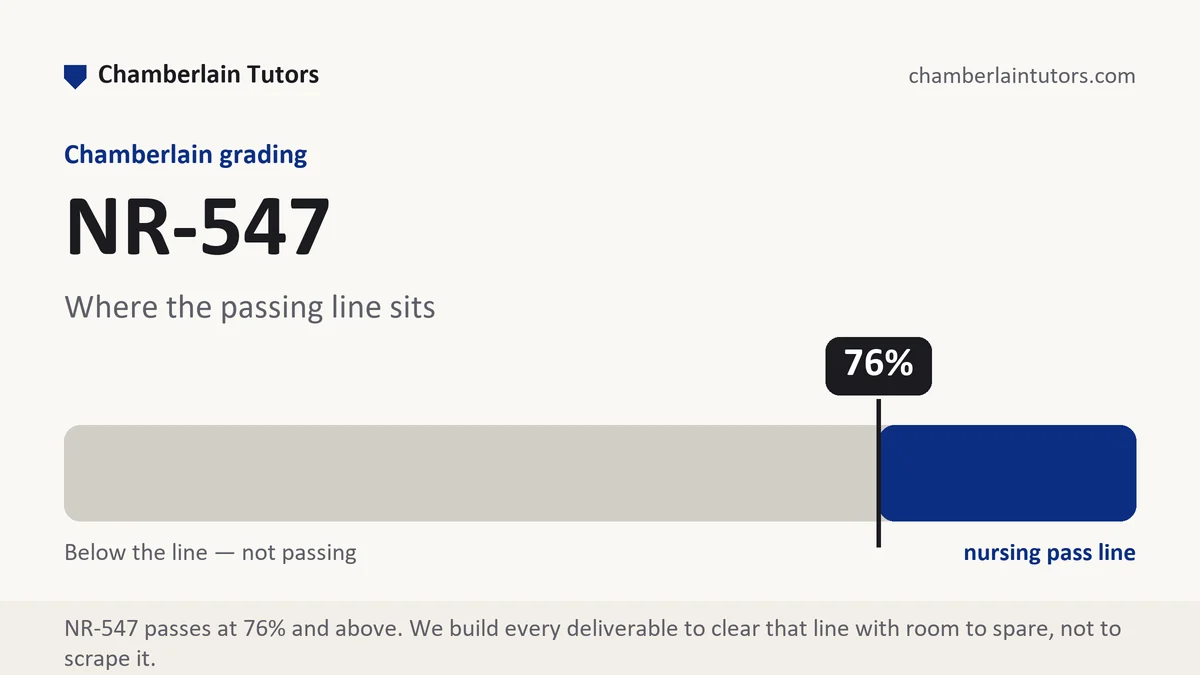
Two structural facts frame everything. NR-547 sits on the NP specialty scale, where 84 is the lowest passing number and no C exists to catch a stumble. And the course carries 125 hours of supervised clinical practicum alongside the writing; the hours belong entirely to you, while the graded documentation around them is where this manual and our desk can help.
The NR-547 Week 1 method, step by step
Six moves that turn a pile of client information into a reasoning chain a grader can follow and score.
-
Decode the rubric for reasoning rows
Mark which rows pay for gathering data, which pay for ordering it, and which pay for the conclusion. In a reasoning course the middle rows usually carry the most weight, and knowing that before drafting stops the conclusion from swallowing the word budget.
-
Inventory the case before interpreting it
List every fact the vignette or encounter actually gives you: statements, behaviors, history, timelines. Facts you wish you had go on a separate list. This split becomes the spine of the write-up and proves you know data from inference.
-
Sort reported from observed
What the client said and what anyone watched or measured are different databases, and psychiatric graders check the boundary first. Tag every inventory item as one or the other before a single interpretive sentence gets written.
-
Name the salient findings and say why
Choose the handful of findings that will drive your thinking and give each one a sentence of justification. Salience is a judgment, and showing the judgment is the point of the week.
-
Write the chain in the order you thought it
Data, then pattern, then possibilities, then the impression you are carrying forward. A paragraph that starts at the destination and argues backward inverts the sequence the course exists to teach, and rows written for progressive reasoning cannot score it.
-
Close with what you still need
End on the data you would gather next and what each result would change. In this discipline an ending that admits incompleteness reads as stronger reasoning, not weaker writing.
A structure for the opening reasoning write-up
The lengths below are planning guides from our desk for a write-up in the 900 to 1,100 word range, not Chamberlain requirements. If your week's rubric weights differently, move words toward the heavier rows.
| Section | What belongs in it | Suggested length |
|---|---|---|
| Case summary | The client and the presenting picture in neutral language, nothing interpreted yet. | 100-140 words |
| Data inventory | Reported findings and observed findings, explicitly separated, with timeline anchors. | 200-250 words |
| Salient findings | The three to five findings driving your reasoning, each with a sentence of justification. | 150-180 words |
| Reasoning narrative | How the findings combine into a pattern, and the possibilities the pattern raises, in the order you actually thought them. | 250-300 words |
| Working impression | Where the chain lands for now, stated with a verb the evidence can carry. | 80-120 words |
| Next data needed | What you would gather next and what each result would change about the impression. | 100-140 words |
Evidence and citation craft for a reasoning week
Anchor the method to the current diagnostic manual. The reasoning this course grades runs on criteria from the current edition, so cite it when your write-up leans on a defined threshold, and map criteria to findings in your own sentences rather than quoting blocks.
Cite reasoning literature for reasoning claims. If you assert that structured diagnostic approaches reduce error, that claim has a research base; name it. A methods claim sourced to nothing reads as opinion in exactly the week that grades method.
Keep sources within five years unless you defend the exception. Diagnostic frameworks evolve by edition and clinical guidance moves faster. When an older source is genuinely the standard, say so in the sentence rather than hoping the date goes unread.
Let verbs carry only what one vignette can support. Suggests, is consistent with, and raises the possibility of are honest at this stage. Confirms and establishes are not, and faculty in this specialty read verb inflation as a reasoning error rather than a style choice.
Five mistakes that cost points in an opening reasoning week
- Announcing the diagnosis in the first paragraph. The week grades the path, not the destination. A conclusion up front tells the grader the chain was written after the verdict.
- Dumping data without hierarchy. Copying the whole vignette back proves reading, not reasoning. The salience step, choosing what matters and saying why, is where the marks live.
- Blending reported and observed findings. One sentence that treats a client's statement as an observed fact tells a psychiatric grader the databases are already blurred.
- Ignoring what argues against your pattern. A chain built only from supporting findings is advocacy. Include the finding that does not fit and say how it constrains your impression.
- Skipping the next-data section. Ending at the impression reads as reasoning that stopped early, and in week one it forfeits the easiest paragraph of credit the course offers.
Before you submit the reasoning write-up
- The rubric's reasoning rows each map to a visible section of your draft
- Every interpretive sentence sits after the data it interprets, never before
- Reported and observed findings are labeled or separated structurally
- Each salient finding carries a one-sentence justification
- The working impression uses a verb the evidence can actually support
- The closing names specific next data and what each result would change
Want the opening write-up modeled first?
Send the Week 1 prompt and rubric from Canvas. A complete reasoning-chain draft comes back in 24 to 48 hours, floor-checked against the 84 line, first premium sample free.