NR-547 Week 2 typically moves from method to product: the ranked differential list, where several candidate diagnoses are generated from criteria and placed in an order that each one earned. Ranking is the skill that separates a differential from a list of conditions, and this early in an 8-week practicum it is usually taught on a supplied case before your own clients raise the stakes. This manual covers generating, ordering and writing the entries. Your section may print this as NR 547 or NR547; it is the same course.
Chamberlain publishes no syllabi outside Canvas. The placement here is our teaching judgment from the course's catalog arc; your section's rubric decides what your week actually asks.
What NR-547 Week 2 asks for
Once a reasoning order exists, the discipline's next move is candidate generation: casting a net wide enough that the right diagnosis is on the page, then ranking so the net does not read as indecision. The catalog's phrase for the course, formulating differential diagnoses across the lifespan, names this exact product, and the second week of a session is where a course usually makes students build one under supervision.
The deliverable often takes the shape of a differential write-up from a case: a ranked list with support for each entry, sometimes inside a fuller diagnostic paper, sometimes as a focused table-plus-narrative. A discussion version asks you to post your ranked list and defend a rank in replies; if that is your section's format, draft everything outside Canvas first, because a posted rank cannot be quietly revised. Your week's rubric decides the format and the required number of candidates, and it outranks every convention in this manual.
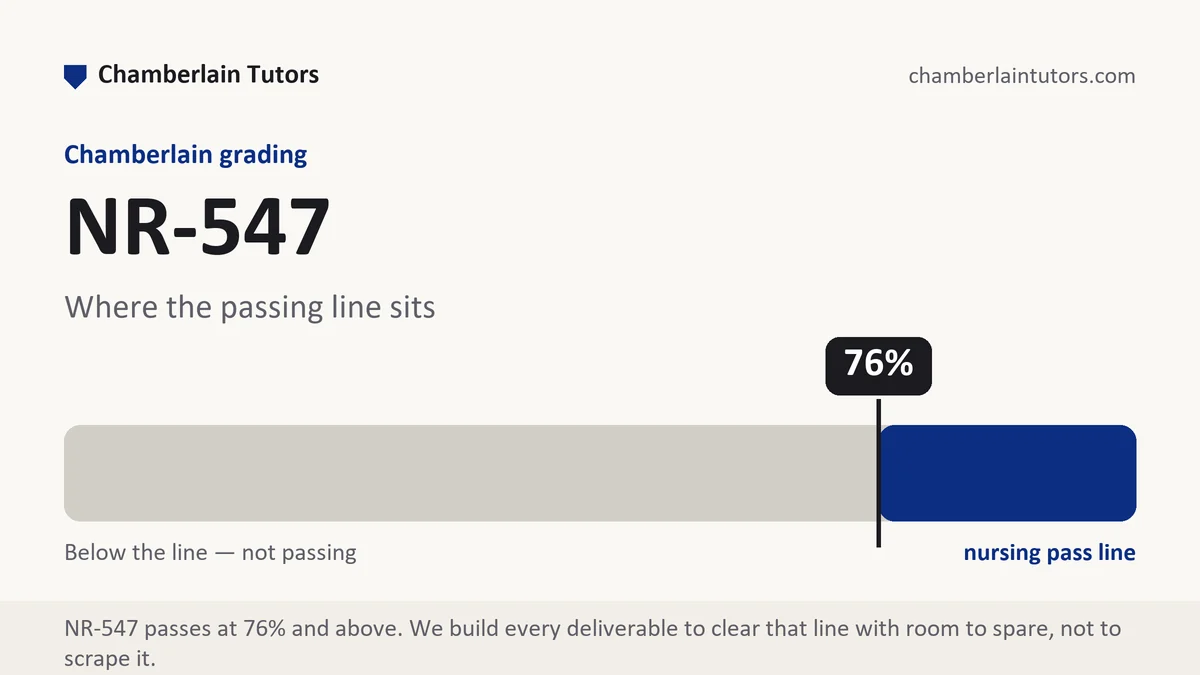
Remember the scale you are graded on: the NP specialty ladder passes nothing below 84 and offers no C band. A ranked list that a grader can score row by row is the cheapest reliable credit this stretch of the course offers.
The NR-547 Week 2 method, step by step
Five moves that produce a ranked differential a rubric can pay in full.
-
Read the rubric for the two differential rows
Most guides split the skill: one row pays for a defensible candidate list, another pays for the ordering logic between candidates. Confirm how your week splits it, because each row needs its own visible section to score.
-
Generate wide before you rank
From the case's salient findings, list every condition a reasonable clinician would weigh, including at least one that is not primarily psychiatric where the presentation allows. Breadth here is cheap; a missing candidate later is not recoverable.
-
Anchor each candidate to criteria
For every entry, name the specific client findings that map to the condition's defining features. An entry with no anchoring findings is a guess wearing a diagnosis, and it weakens the whole list.
-
Rank by explanatory power, not familiarity
Order the list by how much of this client's picture each candidate explains, weighing timeline fit and symptom coverage. Write one sentence per entry saying why it sits above the one below it; those sentences are the ranking row's entire evidence.
-
Stress-test the top two
Ask what single finding, if present, would swap positions one and two. If nothing could, your ranking is either airtight or unfalsifiable, and stating which, briefly, reads as exactly the judgment this practicum grades.
A structure for the ranked differential write-up
Planning guides from our desk for a differential section in the 800 to 1,000 word range, not Chamberlain requirements. Rebalance toward whichever rows your rubric weights hardest.
| Section | What belongs in it | Suggested length |
|---|---|---|
| Case anchor | A compressed restatement of the findings the list is built from, so the differential reads as derived rather than imported. | 100-130 words |
| Candidate one | The leading diagnosis, its anchoring findings, the criteria they map to, and the timeline fit. | 170-200 words |
| Candidate two | Same anatomy, plus the sentence naming why it sits below the leader. | 150-180 words |
| Candidate three | Same anatomy, ordered and justified; often the non-psychiatric or substance-linked possibility. | 130-160 words |
| Ranking rationale | The ordering logic across the whole list in one place: explanatory power, timeline, coverage. | 120-150 words |
| What would reorder it | The specific findings that would promote or demote entries, showing the rank is falsifiable. | 80-110 words |
Evidence and citation craft for a differential week
Every candidate cites the current criteria edition once. The list runs on defined thresholds, so the diagnostic manual appears in your references, cited properly, while your sentences do the matching between requirement and finding.
Prevalence claims need a population and a window. Writing that a condition is more common in a demographic is an epidemiological claim; give it a denominator and a source. Rank justified by unsourced commonness is the most quietly penalized sentence in differential writing.
Use clinical guidance for the non-psychiatric entries. When a medical mimic makes your list, cite the clinical source that says the presentation warrants that consideration; a psychiatric text alone cannot carry a medical claim.
Rank with hedged verbs. Best explains, accounts for more of, and fits the timeline better than are rankable claims. Is the diagnosis is not available in week two, and graders on a reasoning practicum notice the difference immediately.
Five mistakes that cost points in a differential-building week
- A list with no order logic. Three diagnoses in a row, each plausible, none compared, satisfies the generation row and forfeits the ranking row entirely.
- Six candidates in the space of three. Word budgets divided six ways give each entry a phrase, not an argument. Wide generation happens in your notes; the page gets the survivors.
- Anchorless entries. A diagnosis included because it is common, with no client finding attached, tells the grader the list came from memory rather than from this case.
- No candidate outside the psychiatric column. Where the presentation allows one, its absence is conspicuous in a course built for practicum-level thoroughness.
- Ranking by severity instead of fit. The scariest condition is not automatically the likeliest. Rank by explanatory power and handle danger in a sentence about what cannot be missed.
Before you submit the ranked list
- Every candidate has at least one client finding anchoring it
- Each entry carries the sentence explaining its position above the next
- One entry addresses the non-psychiatric or substance possibility where the case allows
- The number of candidates matches what your rubric names, when it names one
- A reordering condition is stated, proving the rank is falsifiable
- Criteria are mapped in your sentences, with the manual cited, not quoted at length
Want your differential built to this standard?
Send the case, the prompt and the rubric from Canvas. A ranked, anchored, falsifiable differential comes back in 24 to 48 hours, floor-checked, first premium sample free.