NR-547 Week 7 usually confronts the cases the tidy method was built to survive: comorbid presentations, where two or more conditions are genuinely present at once and the write-up must decide which is principal, which is co-occurring, and which symptoms belong to whom. Substance use braided through a mood disorder, trauma running under almost anything, this is integration week, and the deliverable is the term's most demanding so far. Your section may print this as NR 547 or NR547; it is the same course.
Chamberlain publishes no syllabi outside Canvas. The placement here is our teaching judgment from the course's catalog arc; your section's rubric decides what your week actually asks.
What NR-547 Week 7 asks for
Every skill the arc has installed, generation, discrimination, exclusion, lifespan weighting, assumed one disorder was hiding in the data. The seventh week of a session is where a practicum typically withdraws that assumption, because real psychiatric caseloads run heavily to co-occurrence and a clinician who can only find one answer per client is not finished training. The territory is diagnosing in the plural: establishing that multiple conditions are each independently supported, then organizing them.
The deliverable usually looks like a complex case write-up: a client whose data cannot be honestly explained by a single diagnosis, graded on whether each retained condition earns its place and on the reasoning that names one principal. Discussion versions often stage the classic dispute, one disorder or two, across the board; draft your position offline and post it once, since the board preserves everything. Format, required diagnoses and length live in your week's rubric, which is the only authority.
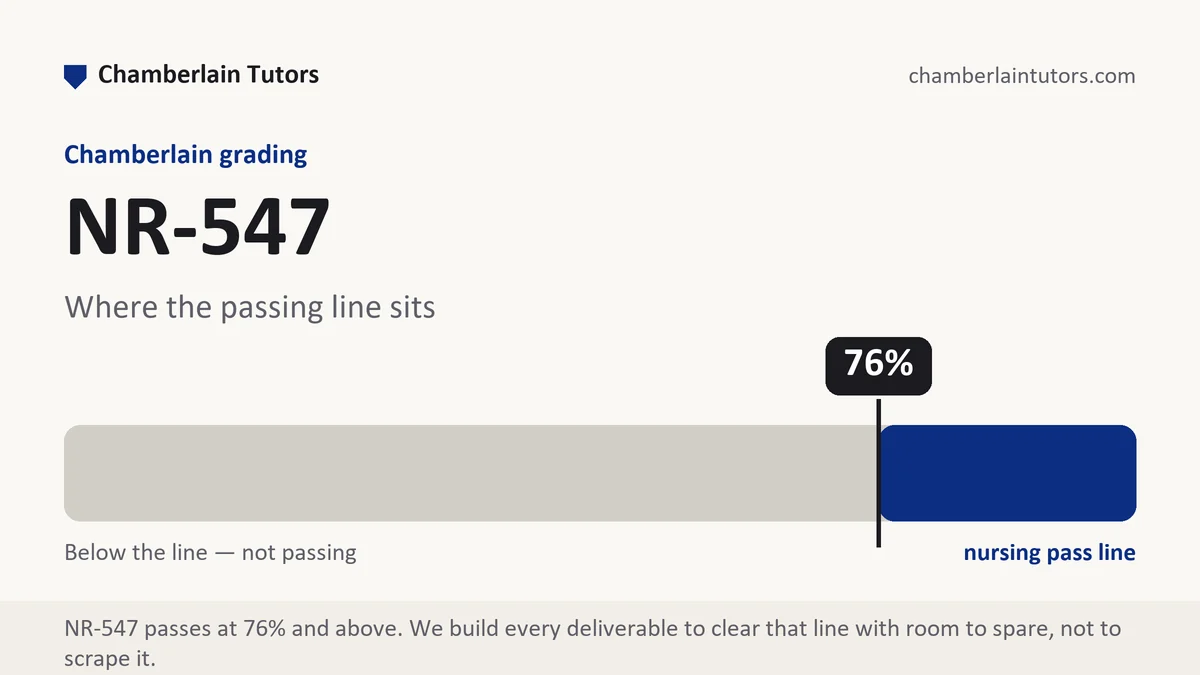
The scale beneath has not moved: 84 is the floor, no C exists, and by week seven the gradebook has little room left to absorb a weak heavy paper, which makes method the cheapest protection available.
The NR-547 Week 7 method, step by step
Five moves for diagnosing in the plural without double counting or sprawl.
-
Test the one-disorder explanation first
Before accepting two conditions, write the strongest case that a single one explains everything. Only when that case visibly fails have you earned the plural, and showing the failed attempt is itself scoreable reasoning.
-
Give every symptom one home
Build an allocation ledger: each finding assigned to the condition that best explains it, with shared findings flagged rather than counted twice. Double-counted symptoms inflate both diagnoses and graders look for exactly that.
-
Sequence the conditions in time
Which came first, and did one emerge only inside the other's episodes? Independence over time argues for true co-occurrence; strict containment argues for one condition wearing two faces. The temporal map is this week's discrimination engine.
-
Apply the hierarchy and exclusion notes
Some criteria sets defer to others by rule, and some diagnoses cannot be made inside another's boundaries. Check each retained pair against the manual's own notes and cite the rule you applied.
-
Name the principal and defend it
Choose which condition currently drives impairment or would lead treatment planning, and give the choice a justification a colleague could dispute. An unranked pile of diagnoses is this week's version of the unranked list.
A structure for the comorbid case write-up
Planning guides from our desk for a write-up in the 1,000 to 1,200 word range, not Chamberlain requirements. Follow your rubric where its weights differ.
| Section | What belongs in it | Suggested length |
|---|---|---|
| Integrated case summary | The full picture in neutral language, complexity included rather than smoothed. | 130-160 words |
| The single-disorder test | The best one-condition explanation and the findings it fails to cover. | 140-170 words |
| Symptom allocation | Findings assigned to their best-explaining condition, shared ones flagged and argued. | 200-240 words |
| Temporal map | Onset and course of each condition against the other, in intervals, with independence or containment stated. | 150-180 words |
| Hierarchy and exclusion check | The manual's own rules applied to each retained pair, with the applied note cited. | 100-130 words |
| Principal diagnosis and rationale | Which condition leads, why, and what would change the ordering. | 130-160 words |
Evidence and citation craft for a comorbidity week
Co-occurrence rates are citable and impressive when real. The claim that two conditions frequently travel together has actual numbers in the epidemiological literature; using one, with its population and window, elevates the whole argument.
Cite the manual's hierarchy notes precisely. When you invoke a rule that one diagnosis yields to another, name where the criteria say so. A hierarchy applied from memory is the easiest citation gap for faculty to catch.
Substance-symptom interaction claims need their own sources. What a substance does to mood, sleep or anxiety over what timeframe is pharmacology, and borrowing it without citation weakens the exact paragraphs doing your hardest work.
Keep the verbs plural-honest. Each retained condition gets its own evidence-matched verb: one may be well supported while the second is only provisionally retained pending sober-period data. Uniform confidence across unequal evidence is a reasoning error graders in this course are primed to see.
Five mistakes that cost points in a comorbidity week
- Stacking diagnoses instead of testing them. Listing every condition the symptoms brush against, without the single-disorder test, reads as generation when the week grades integration.
- Counting one symptom for two conditions. Insomnia cannot fully anchor both a mood and an anxiety diagnosis at once. Unflagged double counting is the week's defining error.
- Ignoring the substance timeline. Where use is present, diagnosing a co-occurring condition without addressing symptom behavior during abstinent or low-use periods leaves the central question untouched.
- No principal diagnosis. Three conditions listed as equals is a differential that never finished. Someone has to lead, and the rationale for the choice is where the synthesis marks sit.
- Losing the client in the taxonomy. A write-up that reads as three disorder essays stapled together has stopped describing a person. The integrated summary and allocation ledger exist to prevent exactly that.
Before you submit the comorbid write-up
- The single-disorder explanation is tested on the page and shown insufficient
- Every finding has one home, with shared findings flagged and argued
- The temporal map states independence or containment for each pair
- Hierarchy and exclusion notes are checked and cited for retained pairs
- A principal diagnosis is named with a disputable rationale
- Confidence verbs differ where the evidence for each condition differs
Complex case week getting heavy?
Send the case and rubric from Canvas. A comorbid write-up with the allocation ledger built and the principal defended comes back in 24 to 48 hours, floor-checked, first premium sample free.