NR-584NP Week 4 usually arrives at the doing of improvement: the models that structure change, small-cycle testing chief among them, and the working tools, cause-and-effect diagrams, process maps, run charts, that make problems visible before anyone tries to fix them. The writing tends to apply one model to one small problem, and the grading rewards smallness done rigorously. Your section may print this as NR 584NP or NR584NP; it is the same course. Chamberlain publishes no syllabi outside Canvas. The placement here is our teaching judgment from the course's catalog arc; your section's rubric decides what your week actually asks.
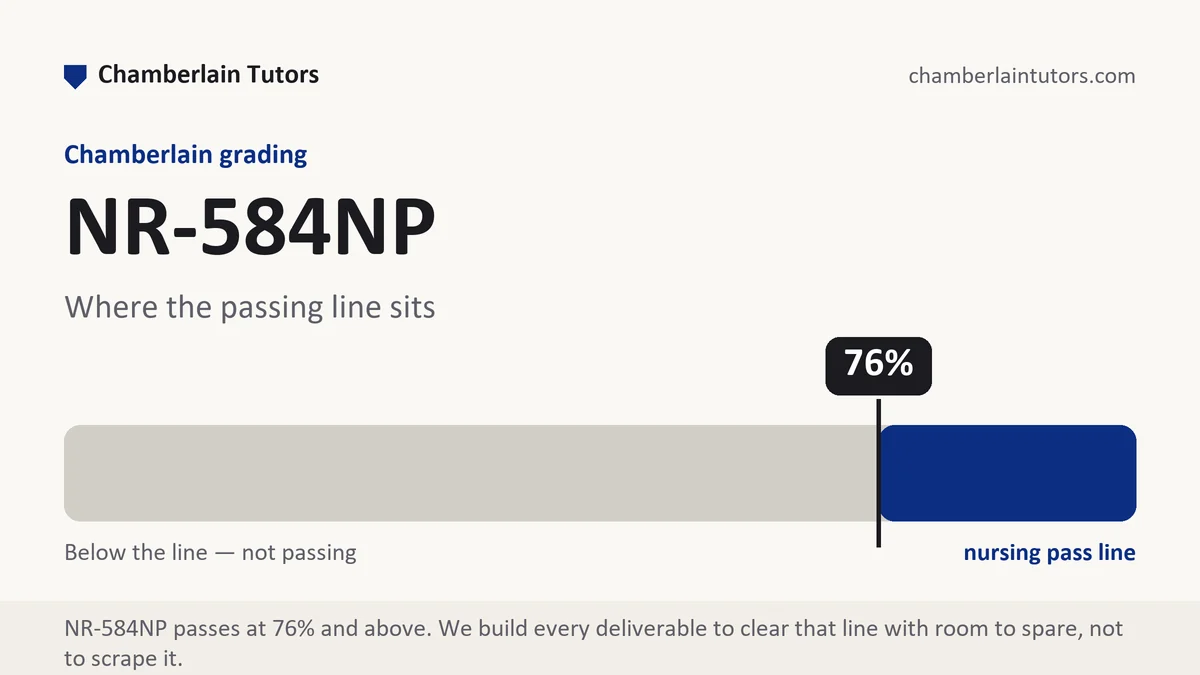
What NR-584NP Week 4 asks for
The catalog promises tools for continuous improvement, and mid-course is where they get taught. The likely territory: the improvement model built on three questions, what are we trying to accomplish, how will we know a change is an improvement, what change can we test, driving repeated small test cycles; the industrial traditions beside it, one focused on removing waste from processes, the other on reducing variation; and the diagnostic toolkit that precedes any intervention. If your section runs a discussion this week, expect to name a tool and apply it to a familiar problem. A paper usually wants a full test cycle planned on paper: aim, prediction, the small test, and what you would do with the result.
The counterintuitive grading truth: scope works backward here. Students instinctively propose department-wide rollouts, and rubrics built on small-cycle logic mark that instinct down. One medication, one clinic day, one pilot provider is the A-range shape.
The NR-584NP Week 4 method, step by step
-
Write the aim with a number and a date
An aim is a promise you could be held to: raise same-day teach-back documentation from an estimated baseline to a stated target for one clinic's discharges within a stated number of weeks. If the aim has no measure and no deadline, everything downstream inherits the vagueness.
-
Answer the model's three questions in order
Accomplish what, know how, test what. Write each answer as its own sentence before drafting sections, because the questions are the skeleton your grader will look for, and papers that answer them out of order usually answer them incompletely.
-
Diagnose with one tool, visibly
Choose the diagram that fits your problem, cause grouping for a messy multi-driver problem, a process map for a workflow with hidden steps, and actually use it: name the categories you drew, the step where the process breaks. A tool mentioned but never applied earns the mention's worth of points.
-
Design the smallest honest test
One change, one place, one short period, with the logistics named: who does the new step, starting when, recorded where. The discipline is subtraction; keep removing scope until failure would be cheap and informative.
-
Predict before you test
State what you expect the test to show, numerically if the aim allows. The prediction is what turns a try into an experiment, and its presence or absence is the fastest way graders sort papers this week.
-
Write the study-and-act turn, then verify
Describe how results compare against the prediction and name the three exits: adopt with a bigger test, adapt and rerun, or abandon with the lesson recorded. End by checking every rubric row has its sentence, and submit ahead of the clock.
A test-cycle paper due in NR-584NP this week?
Send the problem and rubric. We return a cycle with a numbered aim, a real prediction, and clean tool work, floor-checked, in 24 to 48 hours.
A structure for the test-cycle write-up
Built for roughly 1,000 words; keep the plan and study sections dominant whatever your window.
| Section | What it must show | Words |
|---|---|---|
| The aim | Measure, target, population, and deadline in one sentence, plus one line of why now. | 100 |
| The three questions | Each answered explicitly, in the model's order, before any detail begins. | 160 |
| The diagnosis | One tool applied for real, with what it revealed that intuition had missed. | 200 |
| The plan, with prediction | The small test specified to the person and the day, and the stated expected result. | 210 |
| The study | How results will be compared to the prediction, including the display you would use. | 180 |
| The act, three exits | Adopt, adapt, or abandon, each with the condition that would trigger it. | 150 |
Papers rarely lose points for a test that seems too small; they hemorrhage them for a test too large to learn from. When in doubt, halve the scope again.
Evidence and citation craft for improvement week
Method sources and clinical sources do different work. The improvement model and its tools are cited from methodology literature, much of it institutional and properly labeled as such. The change you are testing needs clinical evidence that it works somewhere. A strong paper visibly carries both stacks.
Institutional improvement guidance is citable, labeled. The major improvement organizations publish the canonical how-to material. Cite it as organizational guidance with dates, and let peer-reviewed improvement studies carry the claims about effectiveness.
Keep the traditions apart when you invoke them. Waste removal and variation reduction are different logics with different tools. Borrowing vocabulary across them untracked reads as tourism; one accurate sentence about which tradition your approach draws on reads as fluency.
Baseline estimates must wear their labels. If your baseline is an estimate from observation rather than a measured rate, say estimated at every use. The improvement literature itself models this honesty.
Run chart conventions exist; follow them. If your study section proposes a display, describe it by the field's conventions, time ordered, enough points to read a pattern, annotated when the change began. Getting the display right is a citable, checkable craft.
Five mistakes that cost points in Week 4
- The rollout in cycle clothing. A hospital-wide implementation described as a test cycle misses the model's entire premise and rubrics are written to catch it.
- An aim without arithmetic. Improve compliance names a direction, not a destination. No number, no date, no full credit.
- The skipped prediction. Testing without predicting is trying things. The prediction line is short, cheap, and disproportionately graded.
- Decorative diagrams. A cause diagram inserted but never referenced in the prose is furniture, and graders bill furniture at zero.
- Traditions blurred. Calling everything lean, or attributing variation logic to waste tools, signals secondhand reading in a week built on primary method.
Pre-submission checklist
- The aim carries measure, target, population, and deadline in a single sentence
- The model's three questions are answered explicitly and in order
- One diagnostic tool is applied with its findings used in the plan
- The test is small enough that failure would be cheap and informative
- A numeric prediction precedes the test description
- All three act-stage exits appear with their trigger conditions