NR-584NP Week 8 typically asks the question improvement work most often fails: not whether a change can be made, but whether it holds after the attention moves on. Sustainability, spread, and the culture that carries both are the closing territory, usually braided into a final synthesis about the NP as a quality leader. The session also ends when this week does, which puts a hard wall behind the last deliverable. Your section may print this as NR 584NP or NR584NP; it is the same course. Chamberlain publishes no syllabi outside Canvas. The placement here is our teaching judgment from the course's catalog arc; your section's rubric decides what your week actually asks.
What NR-584NP Week 8 asks for
Closing weeks in quality courses tend to gather three threads. Sustainability: the mechanisms, ownership, data cadence, hardwired process, that keep a gain from decaying to baseline. Culture: why improvements survive on units where speaking up is safe and starve where it is not. And the role synthesis: what kind of quality leader the coursework has equipped you to be, argued rather than announced. The deliverable is usually a final paper or a capstone-flavored discussion, and it commonly builds directly on the Week 7 proposal, extending it one honest step: after the project works, what keeps it working?
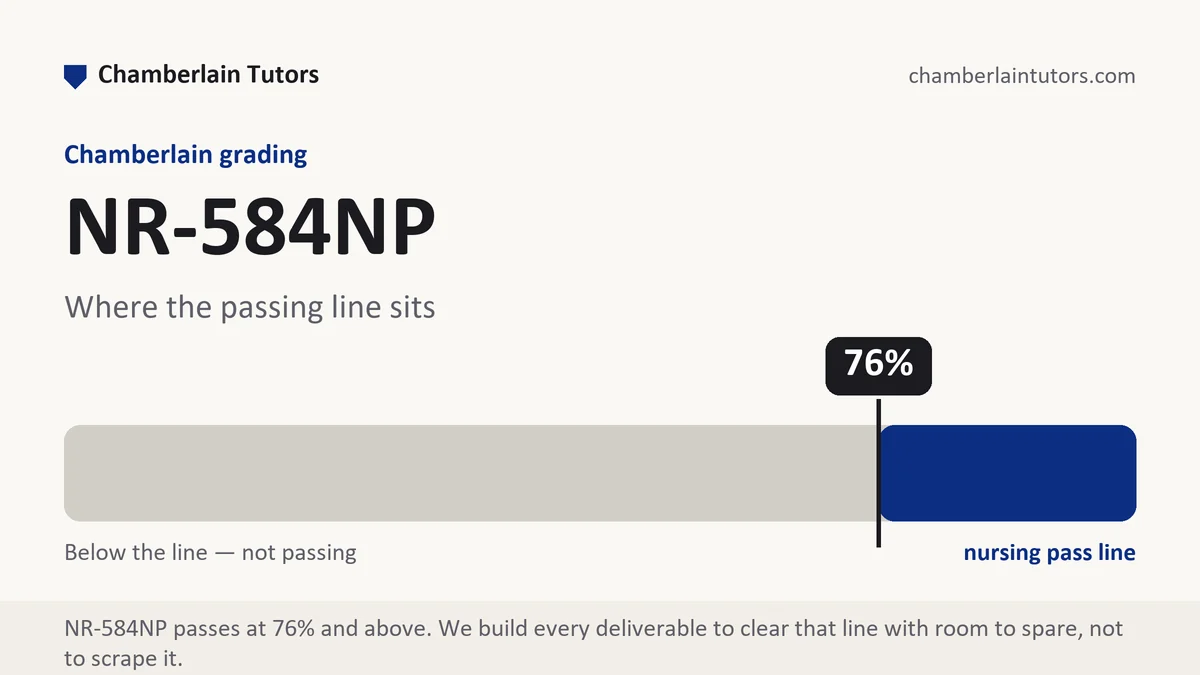
The calendar is part of the assignment. The final deliverable often decides which side of the 84 line a close gradebook settles on, and a session that has ended accepts nothing late. Build your week backward from an upload a full day early.
The NR-584NP Week 8 method, step by step
-
Carry one project forward, not a new one
Take the improvement you proposed or analyzed earlier in the session and ask only the closing question of it: what sustains this? Final weeks punish new topics, because a fresh project cannot demonstrate the course-long thinking the synthesis rows grade.
-
Define sustained as a number over time
Sustainability claims are testable or they are hopes. Write the definition explicitly: the measure holds at or above the target for a stated number of months after active project attention ends. That sentence converts the whole discussion from sentiment to plan.
-
Name the owner and the cadence
Improvements decay when they stop belonging to anyone. Assign the gain a role, not a hero: whose standing work now includes the audit, which meeting reviews the number, at what interval the review can safely stretch. Ownership by role survives turnover; ownership by champion leaves with the champion.
-
Argue the culture mechanism, not the culture slogan
Connect your project's survival to a specific cultural behavior: the assistant who flags the skipped step without fear, the huddle where the falling number gets said out loud early. One mechanism argued concretely outperforms every invocation of a culture of safety.
-
Write the leadership claim at believable altitude
The role synthesis should sound like a plan, not an acceptance speech: the meetings you will sit in, the measures you will ask about first, the way you will respond to the first error report a colleague brings you. Modesty with specifics reads senior; grandeur without them reads student.
-
Bank the submission a day early
Finish, verify citations both directions, confirm every rubric row has its sentence, and upload with twenty-four hours of margin. The last week of a session is when technology fails people, and the wall behind this deadline is real.
Closing week of NR-584NP with the grade on the line?
Send the final rubric and your Week 7 work if you have it. A floor-checked closing draft returns in 24 to 48 hours, built to finish the course.
A structure for the sustainability synthesis
Shaped for about 1,100 words; if your section runs a closing discussion instead, compress each row proportionally and keep the order.
| Section | What it argues | Words |
|---|---|---|
| The position | One claim about what decides whether improvements last, stated as yours. | 110 |
| The project, briefly resumed | The improvement being carried forward, in just enough detail to follow, no re-litigation. | 140 |
| Sustained, defined | The number, the threshold, and the months that would count as holding the gain. | 160 |
| Ownership and cadence | The role that keeps the measure, the forum that reviews it, the interval that stretches safely. | 200 |
| The culture mechanism | The specific behavior that protects the gain, argued through one concrete scene. | 220 |
| The leader, synthesized | Your practice as a quality leader, in observable commitments traceable to the course. | 170 |
The sustained-defined row is the one most drafts lack entirely, and adding it is the fastest single upgrade available: it makes every later paragraph accountable to a number.
Evidence and citation craft for the closing week
Sustainability has its own literature; cite it. Studies of gains decaying after project end, and of the factors that predicted holding, exist in the improvement journals. One or two of them ground your mechanism claims in something beyond optimism.
Culture claims need measured anchors. Safety climate is surveyed and studied; speaking-up behavior has an evidence base. Citing one such study keeps the culture section from floating into poster language.
Reach back across the whole session for sources. A closing paper citing only final-week readings advertises when the engagement began. One early-course source, put to fresh work, quietly certifies the opposite.
Your Week 7 sources can return; your Week 7 sentences cannot. Originality checking sees prior submissions. Cite the same studies where they still serve, and write every sentence new from the idea.
Last-day citation hygiene. The final pass: quotations verified against originals, references reconciled both directions, currency window confirmed. Fatigue makes this the week those rows leak, and they are the easiest points in the document.
Five mistakes that cost points in Week 8
- A new project at the finish line. The synthesis rows grade continuity of thought; a fresh topic makes continuity impossible to show.
- Culture as incantation. Naming a culture of safety without one mechanism, one behavior, one scene, answers no analytic row.
- Hope as the sustainability plan. Staff will continue to see the value is decay in a party dress. Name the owner, the number, the cadence.
- The acceptance-speech synthesis. Transformational vocabulary with no observable commitment reads as filler at exactly the moment the grader is deciding your final row.
- Spending the deadline margin. Uploading at the final hour of a closing session leaves zero recovery room, and closing sessions are when uploads fail.
Pre-submission checklist
- The paper extends an earlier project rather than opening a new one
- Sustained is defined as a measure, a threshold, and a duration
- Ownership is assigned to a role, with a named review forum and cadence
- The culture argument runs through one concrete behavior, cited
- Leadership commitments are observable and traceable to course threads
- Upload completed a full day before the session's final deadline