NR-584NP Week 6 usually widens the lens from the unit to the forces above it: the regulators who require, the accreditors who survey, the payers who tie dollars to performance, and the public reporting that puts a facility's numbers where patients can read them. The catalog's policy thread lives here, and the writing is typically an analysis of one external lever traced down to what it changes at the point of care. Your section may print this as NR 584NP or NR584NP; it is the same course. Chamberlain publishes no syllabi outside Canvas. The placement here is our teaching judgment from the course's catalog arc; your section's rubric decides what your week actually asks.
What NR-584NP Week 6 asks for
The territory is the external architecture of quality: government payers whose conditions and payment rules make certain safety practices financially non-optional, accrediting bodies whose surveys and safety goals shape institutional priorities, and transparency programs that publish comparative performance. The key distinction the week teaches is between kinds of force: regulation compels by law, accreditation persuades by status and market access, payment steers by incentive, and each produces different behavior at the unit level. The deliverable shape that fits is a policy analysis: one lever chosen, its requirement stated precisely from source, and its actual effects, intended and otherwise, argued with evidence down to a single unit's Monday.
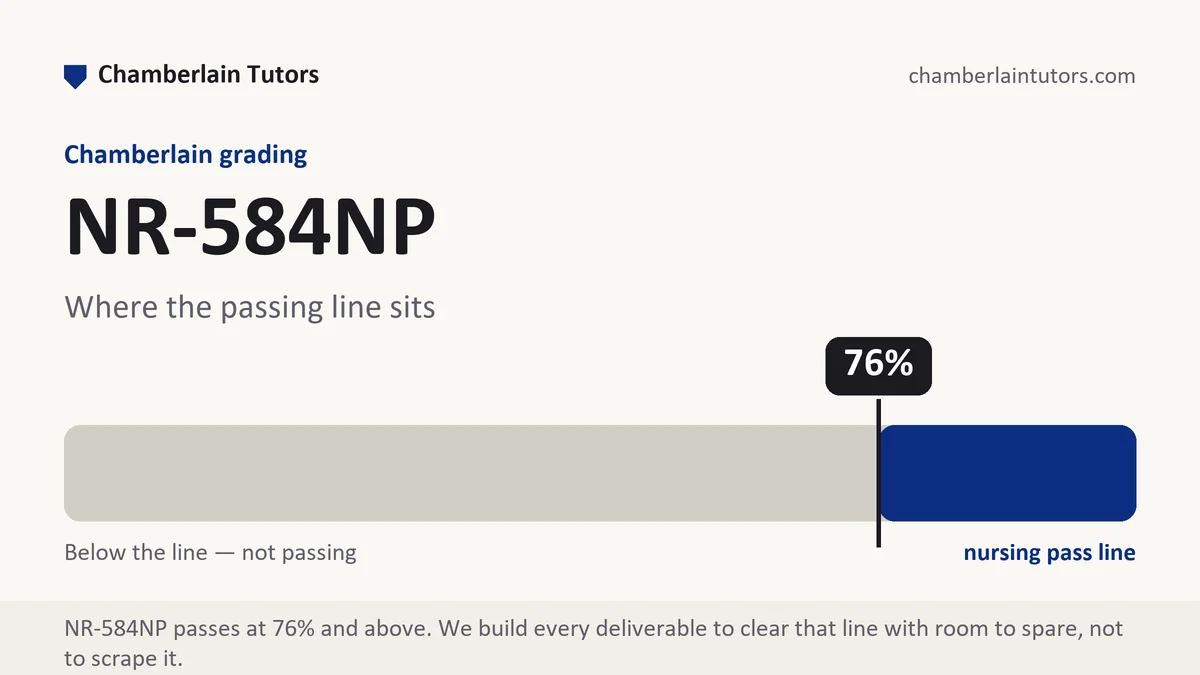
Accuracy pressure is high because the material is checkable and frequently misremembered. Students paraphrase requirements from workplace folklore, and workplace folklore is wrong just often enough to be expensive on a scale where an 83 fails.
The NR-584NP Week 6 method, step by step
-
Pick one lever, and classify it first
Choose a single external force, a payment rule tied to conditions acquired in the hospital, one national safety goal, one publicly reported measure. Then open by classifying it: regulation, accreditation standard, or payment incentive. The classification determines every argument that follows.
-
State the requirement from the source, not from memory
Find the current official text or its agency summary and state what is actually required, of whom, since when. This is the paragraph where folklore dies: many famous requirements turn out narrower, newer, or older than the versions that circulate on units.
-
Trace the lever to one observable behavior
Follow the requirement down: the audit that now happens monthly, the checklist added to admission, the huddle the manager runs because the survey window is open. One concrete behavior, described operationally, is the anchor the analysis rows need.
-
Weigh intended effect against observed evidence
The literature on these levers is genuinely mixed: some show measurable improvement, some show gaming, some show effort displaced from unmeasured work. Present what studies found about your lever specifically, both directions, and resist the urge to referee prematurely.
-
Name one unintended consequence with its mechanism
Documentation burden, measure fixation, coding drift, attention pulled from unmeasured harms: choose the one your lever most plausibly produces, and explain the mechanism rather than asserting the vibe.
-
Position the NP, then verify every requirement sentence
Close with the advanced practice stance: the NP as the clinician who meets the requirement, improves beyond it, and flags where it misfires. Before submitting, reread only the sentences that state what is required and confirm each cites a current source.
A policy analysis due in NR-584NP and the sources are a maze?
We work from the agencies' current texts, not unit folklore. Send the lever or let us choose one; a floor-checked draft returns in 24 to 48 hours.
A structure for the policy analysis
Proportioned for roughly 1,050 words; hold the effects section as the widest whatever your window.
| Section | What it must deliver | Words |
|---|---|---|
| The lever, classified | The force named and sorted: legal compulsion, accreditation status, or payment steering. | 110 |
| The requirement, sourced | What is required, of whom, since when, from current official text. | 180 |
| The trace to the unit | One observable behavior the lever produces at the point of care, described operationally. | 200 |
| The evidence, both directions | What studies found about this lever: improvements, gaming, displacement, presented before judgment. | 260 |
| The unintended consequence | One, with its mechanism argued rather than asserted. | 150 |
| The NP position | Meet, exceed, and flag: the provider's three duties toward the lever, made concrete. | 150 |
Note what the structure refuses: a tour of every agency. One lever traced deeply is the assignment; the survey-of-everything paper spreads itself below the analysis rows.
Evidence and citation craft for the policy week
Agency text is primary; commentary is secondary. What a rule requires comes from the agency that issued it, cited with a date. What experts think of the rule comes from journals. A strong paper uses both and never lets one impersonate the other.
Version-date every requirement. Safety goals renew on cycles, payment rules change fiscal years, standards get revised. Anchoring each requirement to its current version is the difference between analysis and rumor.
Evaluation literature exists for nearly every lever; use it. Public reporting, payment penalties, and survey regimes have been studied at scale. Citing two findings that point in different directions, and saying so, reads as exactly the balance the rubric's analysis language requests.
Separate facility folklore from documented policy. The rule as enforced on your unit may be your facility's stricter overlay. If you describe local practice, label it local, and let the cited requirement stand separately.
No invented survey stories. Composite anecdotes about inspections read as fabrication to graders who have lived real ones. If you need an example event, take it from published accounts and cite it.
Five mistakes that cost points in Week 6
- Requirements quoted from memory. The paraphrase your preceptor taught you is a decade old more often than not, and this is the week the grader checks.
- Accreditation called law. Conflating a surveyor's standard with a statute misclassifies the force and derails the incentive analysis built on it.
- Penalty inflation. Asserting payment consequences a program does not actually carry is a checkable error that costs credibility beyond its row.
- The grievance register. Frustration with bureaucracy is a mood, not an argument; the same critique carried by displacement evidence scores.
- No unit-level landing. A paper that stays at the policy altitude never touches the row asking what this changes in practice.
Pre-submission checklist
- One lever only, classified as regulation, accreditation, or payment in the opening
- The requirement is stated from a current official source with its date
- One observable unit-level behavior anchors the trace
- Effect evidence runs both directions before any judgment
- The unintended consequence carries a mechanism, not just a name
- Every requirement sentence was re-verified against its source before upload