NR-584NP Week 1 opens Chamberlain's Quality and Safety for Advanced Nursing Practice course, and quality courses almost universally open the same way: with the story of how patient harm became a measurable discipline, and with the vocabulary that the next seven weeks will assume you own. The likely writing is definitional and personal at once, the field's origin plus one gap you have seen yourself. Your section may print this as NR 584NP or NR584NP; it is the same course. Chamberlain publishes no syllabi outside Canvas. The placement here is our teaching judgment from the course's catalog arc; your section's rubric decides what your week actually asks.
What NR-584NP Week 1 asks for
The catalog builds this course on quality management and safety principles, and the discipline's first week is nearly always its origin story: the landmark national reports that counted preventable deaths and reframed harm as a systems product, the aims that define what good care even means, and the working distinction between quality, how well care achieves its intent, and safety, how reliably care avoids causing harm. If your section runs an introduction discussion, expect it to ask for a quality or safety concern from your own setting read through that new vocabulary. A short paper here usually wants the concepts defined, cited, and applied to one concrete gap.
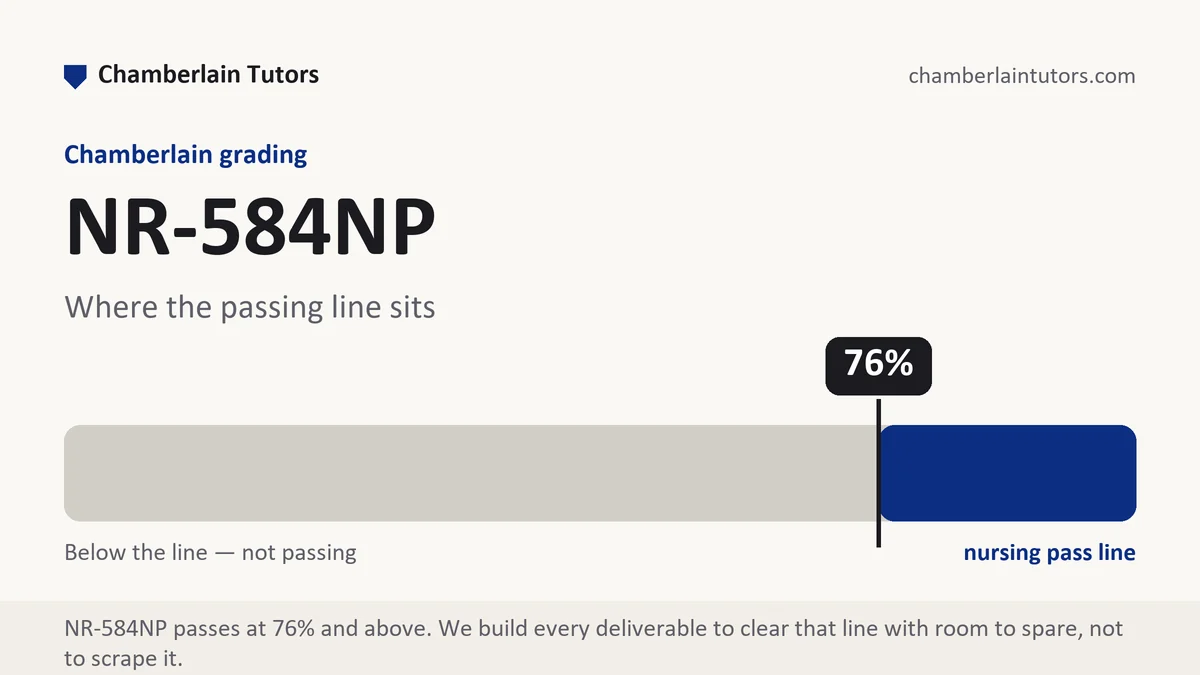
Do not let the word introduction lower your effort. On the NP specialty scale nothing below 84 passes, every point posts to the same ledger as the finale, and a first-week discussion is as permanent as any other once submitted.
The NR-584NP Week 1 method, step by step
-
Pull the graded verbs from your rubric
Read your week's rubric before the first assigned page and list what it pays for: define, differentiate, describe, apply. Those verbs, not the reading list, are the outline of your deliverable, and matching them one to one is the cheapest full-credit move in the course.
-
Learn the two-report spine as history with dates
The field's founding documents belong in this week's writing as attributed history: what was counted, roughly when, and what changed in how harm was discussed afterward. Two disciplined sentences with citations outperform a page of paraphrased legend.
-
Define quality and safety as different questions
Write one cited definition of each, then add the sentence most first drafts miss: care can be high quality by protocol and still unsafe in delivery, and safe while mediocre. Holding the two apart cleanly is the week's central intellectual test.
-
Choose one aim and one local gap
Pick a single dimension of good care, timeliness, effectiveness, equity, and one place your own setting visibly misses it. Small and observable beats large and abstract: the follow-up call that never happens is better material than healthcare disparities as a phrase.
-
Size the gap with one honest figure
Attach one number, a published national rate labeled as such, or a local observation labeled as your estimate. The habit of quantifying, started now, is what the rest of this course keeps raising the stakes on.
-
End on the NP's stake, then post once
Close with why this gap belongs to the advanced practice role: the NP as diagnostician, prescriber, and increasingly the clinician accountable for panel outcomes. Proof the draft outside Canvas and remember the board keeps your first version forever.
Opening week of NR-584NP due and the terms are still new?
Send your rubric and setting. A foundations draft with clean definitions and a sized gap returns in 24 to 48 hours, first premium sample free.
A structure for the foundations deliverable
Sized for a 500-word opening discussion; a short paper version scales each block up while keeping the order.
| Block | Job | Words |
|---|---|---|
| The origin, dated | The field's founding moment in two attributed sentences, no legend, no drama. | 70 |
| The two definitions | Quality and safety defined separately, cited, with the sentence that separates them. | 110 |
| The aim, applied | One dimension of good care located in your own setting's daily work. | 110 |
| The gap, sized | The specific miss you have observed, with one labeled figure attached. | 120 |
| The NP stake | Why this belongs to the provider role you are training into, in one forward-looking paragraph. | 90 |
The order matters: definitions before application is how the rubric reads it, and reversing them makes the grader hunt for the knowledge rows.
Evidence and citation craft for foundations week
Old landmarks are legal; date them anyway. The founding reports of this field are decades old and remain citable as origins, the recognized exception to any currency window. What breaks the rules is quoting their statistics as if they described the present. Pair the historical count with a current figure and let the gap between them be part of your point.
Attribute the famous numbers. The death estimates everyone remembers from this literature are contested and have been re-estimated repeatedly. Cite the specific report or study behind any figure you use, and resist rounding legend upward.
Definitions come from bodies, not vibes. Quality and safety each have definitions published by national organizations your readings will name. Use one, cite it, and paraphrase tightly enough that the source would recognize itself.
Your own observation is evidence of the local, only. What you have seen on your unit supports a claim about your unit. The national claim next to it needs a national source, and keeping those two scopes visibly separate is graduate-level hygiene.
Start the reference discipline now. Everything cited in text appears in the list, everything in the list appears in text, current APA edition. Week 1 is when the habit is cheap.
Five mistakes that cost points in Week 1
- Quality and safety as synonyms. The week exists to separate them; a draft that swaps the words freely fails its central task quietly.
- Legend statistics. Famous harm numbers quoted without source or date, or inflated by memory, hand the grader an easy deduction.
- History with no landing. A recap of the reports that never reaches your own setting answers half the prompt and reads as a book report.
- A gap the size of the system. Health inequity as your chosen gap cannot be sized or owned in 500 words; the missed callback can.
- No provider stake. Ending without the NP's specific accountability leaves the application row, usually the heaviest, unanswered.
Pre-submission checklist
- Each graded verb from the rubric has a visible answer in the draft
- Quality and safety carry separate cited definitions plus one separating sentence
- Historical figures are attributed and paired with a current number
- The chosen gap is observable in one setting and sized with a labeled figure
- The closing paragraph names the NP role's specific stake
- The post was drafted and proofed outside Canvas before its single paste