NR-548 sits in Chamberlain's PMHNP foundations finale, on the MSN-PMHNP path. This is its help page: what the course really grades and how our team carries it, floor check included.
What NR-548 actually grades
The last foundations course before management didactics, consolidating psychiatric assessment writing under the specialty scale. The management sequence ahead assumes this material is fluent.
How we help in this course
Finishing 548 at the A band with the register internalized is the setup the 605 sequence deserves, and the drafts plus walkthroughs are built to leave you there.
Deliverables run the standard promise: a premium original draft in 24 to 48 hours, targeted at the A band of your course's actual scale, through the eight-person pipeline with both QA passes and the floor check, revised free until it lands.
Documenting an assessment, section by section
Chamberlain keeps its syllabi inside Canvas, so no week-by-week manual for NR-548 can be written honestly and none is offered here. The useful material is the other kind. This course turns the psychiatric interview into documentation: history, review of systems by domain, mental status, risk, and a formulation that explains the person to the next clinician who reads it. It also carries two credits rather than three, which means shorter deliverables against the same scale, and short deliverables are a harder writing problem than long ones because something has to be cut. What follows is how to decide what.
In NR-548 right now?
Send the week and the rubric from Canvas. First premium sample free, floor-checked, back in 24 to 48 hours.
The last foundations course and what it hands forward
NR-548 closes the psychiatric foundations sequence, and the management didactics beginning at NR-605 assume its material is fluent. That documented position sets the strategy: finish here at the A band with the register internalized, because the courses ahead will grade provider-level judgment on top of everything this one taught. Clients who ride the desk through 548 arrive at the management sequence with voice, frameworks, and floor-check habits already in place. Those habits outlast any single grade, because the management courses compound whatever consistency you bring them.
How the desk paces a consolidation course
Consolidation weeks reward consistency over heroics, and the rhythm reflects it: each deliverable drafted within 24 to 48 hours of the hand-off, scored against the no-C scale before release, delivered with days of Mountain-Time margin rather than minutes. Boards remain the permanent-ink surface of the course, so posts and replies leave here final, sourced, and rubric-checked for their one unrevisable submission. Replies get the same protocol as posts, drafted outside the box and pasted once, since the reply rubric grades substance and the board forgives nothing.
One free draft, positioned deliberately
If you have managed the foundations alone so far, this is the calculated moment to test the desk: a free premium draft on a 548 deliverable shows you exactly what management-sequence support would read like, before the courses where the writing must sound like the provider the certification exam assumes. Send the current week and decide from evidence. The draft costs nothing either way.
The scoring guide first, then the word ceiling
Read the criterion rows before the prompt and before the case. A prompt tells you who the client is; the rows tell you which parts of that encounter carry marks, and in an assessment course those two lists never match. Copy the rows into an empty document, keep their weighting order, and let them be the headings you write under.
Then do the arithmetic that short deliverables make unavoidable. On a 900-word body with a four-row guide weighted 30, 30, 25 and 15:
- History and psychiatric review of systems, 0.30 x 900 = 270 words.
- Mental status examination across its domains, 0.30 x 900 = 270 words.
- Risk assessment and what you did about it, 0.25 x 900 = 225 words.
- Documentation quality and citation, 0.15 x 900 = 135 words, spent invisibly.
Now notice what the second line means. A mental status examination has roughly ten domains, so 270 words gives each one about twenty-seven, which is a precise clause and not a paragraph. Students who write 400 words of history in a 900-word write-up are not being thorough; they are silently taking four domains down to a phrase and losing the row that was worth the same as the history. Long deliverables forgive proportion errors. Two-credit deliverables do not.
The shape of a psychiatric evaluation write-up
Assessment documentation has a fixed anatomy, and faculty read it in order looking for the part that is missing. Each row below states the job that part is doing.
| Section | What it has to prove | Where it slips |
|---|---|---|
| Identifying data and chief concern | Who this is, and why they came, in the client's own words. | The concern already translated into your diagnostic vocabulary. |
| History of the present illness | Onset, course, duration, treatment so far, and what changed to bring them in now. | A story without dates. Interval and sequence are the whole value of this section. |
| Psychiatric history | Prior episodes, prior treatment, and what each trial actually did. | A list of past medications with no outcomes, which tells the next clinician nothing. |
| Substance, medical, family and social history | The context that changes interpretation, gathered rather than assumed. | Compressed to one line each because the word ceiling arrived early. |
| Psychiatric review of systems | That you asked across domains rather than only about the presenting concern. | Merged into the history, so the row that scores systematic inquiry finds nothing. |
| Mental status examination | Observation by domain, in the specialty's descriptive vocabulary. | Written as a paragraph of impressions, which loses the domains the row is counting. |
| Risk assessment | Ideation, intent, plan, means and access, protective factors, and the action you took. | A number from an instrument standing in for the reasoning. |
| Formulation | Why this person, why these symptoms, why now, in your sentences. | Left out. It is the section that shows a clinician was present rather than a form. |
| Impression and next step | Where your thinking landed and what the following visit is for. | A diagnosis with no plan for the data you still need. |
Observation, inference and the words between them
Assessment writing is graded on precision of attribution more than on vocabulary. Three registers exist and mixing them is the most common substantive error in this course.
- Reported, appeared, is. The client reported sleeping four hours is testimony. The client appeared to fall asleep during the interview is observation. The client is sleep deprived is a conclusion, and it belongs in the formulation rather than in the history or the mental status section.
- Denies is a report, not an absence. Writing denies suicidal ideation records what was said. If nothing was asked, nothing can be written, and a risk row can tell the difference.
- Instruments arrive with their population and their cutoff. Name the tool, the threshold applied, and the group it was validated in. Never write a score as a prediction of behavior; it estimates a construct at one moment, and it dates immediately.
- Any rate needs a denominator and a measurement window. Common in this population means nothing until you can say common relative to what, measured in whom, across how long.
Watch a single sentence improve. Before: the client is a high suicide risk. After: the client reported passive ideation without intent or plan, declined to identify means, described two people she would call, and was rated at the standard threshold on the instrument used at this site; risk was assessed as elevated for the coming week and a safety plan was completed with her before she left. The second version can be defended, dated and acted on, which is what the row is buying.
What lifts an assessment write-up above the line
A passing write-up records the interview accurately. A strong one separates data from interpretation and then rejoins them deliberately in the formulation. Try this on your draft: highlight every sentence that is an inference rather than a report or an observation. If nothing highlights, you have written a transcript and the formulation row will find nothing to score. If highlights appear inside the mental status section, they are sitting in the wrong part of the document, which costs twice, once for the section they contaminate and once for the section they were supposed to fill.
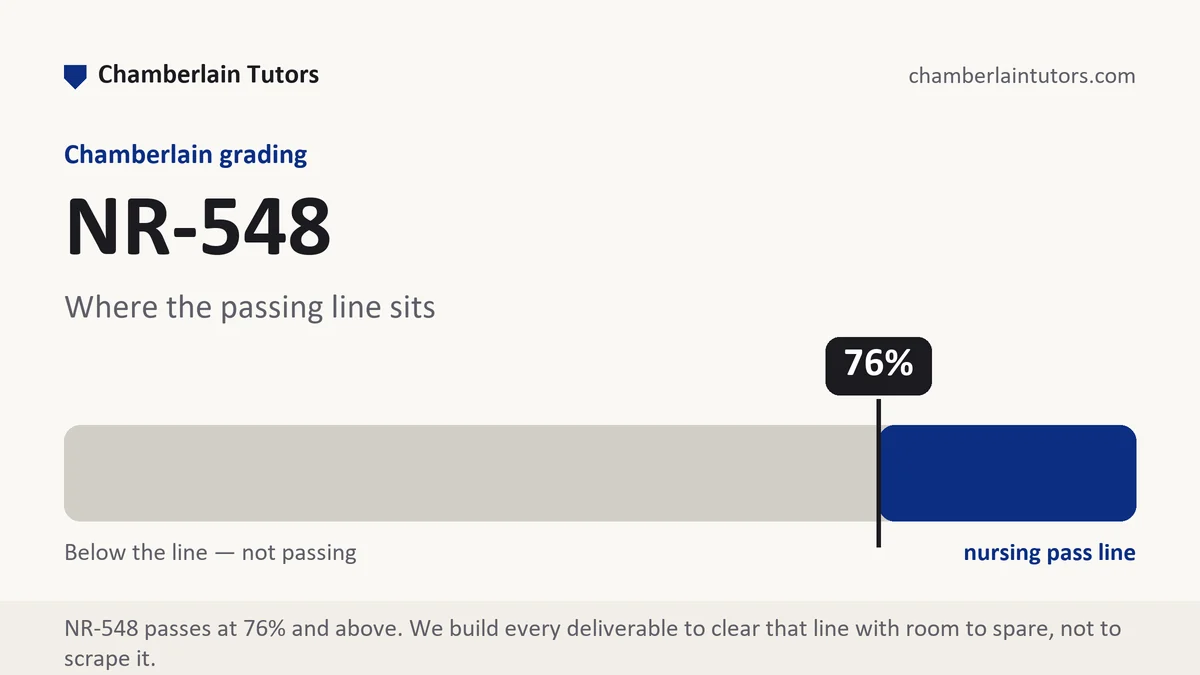
The second lift is specificity in the descriptive vocabulary. Affect described as constricted and congruent with stated mood tells the next reader something; seemed sad does not. That precision is the actual subject of this course, and on a specialty scale whose lowest passing number is 84 with no C beneath it, precision buys more of that margin than length ever does.
Six errors that cost points in NR-548
- A mental status examination written as prose. The domains are the structure. Prose hides which ones you did not cover, and the grader marks the ones that are absent.
- Within normal limits standing in for a domain. It records that you did not write anything, not that you found nothing. Say what you observed instead.
- Risk reduced to a score. The instrument supports the judgment; it is not the judgment, and the row wants the interval your assessment covers and the action you took.
- Long quotations from the client. One anchoring quote in the chief concern is strong documentation. A page of transcript is unfiltered data and spends a budget you needed elsewhere.
- No formulation. Without it the write-up is a completed form. The formulation is the only section that shows judgment, which is what a graduate assessment course is grading.
- Letting the short word count excuse thin citation. Two credits does not mean two-thirds of the sourcing rules. Interview technique and instrument claims still need current references, cited properly.
Three questions NR-548 students send us
It is only a two-credit course. Is it graded more gently?
How do I document risk without either overstating it or hedging it into uselessness?
Can I reuse the same write-up template across the term?
The weeks, one by one
Week 1
NR-548 Week 1 usually opens where the psychiatric encounter itself opens: interview technique, the deliberate craft of building enough trust in fifty minutes that a stranger tells you the truth about their mind. Read the full Week 1 manual.
Week 2
NR-548 Week 2 usually moves from how you ask to what you keep: the psychiatric history of present illness and the psychiatric history behind it. Read the full Week 2 manual.
Week 3
NR-548 Week 3 usually installs the systematic sweep: the psychiatric review of systems, where the interviewer leaves the presenting story and asks across every symptom domain, mood, anxiety, psychosis, obsessions, trauma, eating, substances, sleep and cognition, so that nothing outside the chief. Read the full Week 3 manual.
Week 4
NR-548 Week 4 usually crosses the intake's great divide: from what the client reports to what the clinician observes. Read the full Week 4 manual.
Week 5
NR-548 Week 5 usually adds instrumentation to the clinical interview: screening tools and rating scales, the standardized questionnaires that put numbers next to the narrative. Read the full Week 5 manual.
Week 6
NR-548 Week 6 usually carries the intake's heaviest section: risk assessment, the structured inquiry into thoughts of self-harm or harm to others and the documentation that turns those questions into a defensible clinical record. Read the full Week 6 manual.
Week 7
NR-548 Week 7 usually delivers on the catalog's across-the-lifespan promise: adapting the interview and history techniques the term has built to clients they were not designed around, children who show more than they say, adolescents negotiating privacy, and older adults whose intake runs through. Read the full Week 7 manual.
Week 8
NR-548 Week 8 usually asks for the whole instrument played at once: a complete psychiatric evaluation, interview through history, systematic review, examination and risk, crowned by the formulation, the paragraphs that explain why this person developed this picture now. Read the full Week 8 manual.
Where NR-548 sits in Chamberlain's programs
Open the exact program map for sequence, credit, and option context. The current student schedule and syllabus remain authoritative after transfer evaluation, electives, state rules, and approved plan changes.