NR-548 Week 8 usually asks for the whole instrument played at once: a complete psychiatric evaluation, interview through history, systematic review, examination and risk, crowned by the formulation, the paragraphs that explain why this person developed this picture now. Every prior week built one section; the closer builds the document, and the formulation is where a term of recording finally becomes a page of thinking. This manual assembles the evaluation and teaches the formulation's anatomy. Your section may print this as NR 548 or NR548; it is the same course.
Chamberlain publishes no syllabi outside Canvas. The placement here is our teaching judgment from the course's catalog arc; your section's rubric decides what your week actually asks.
What NR-548 Week 8 asks for
Final weeks of an 8-week session integrate, and an assessment course's integration is unambiguous: the full evaluation document, produced from a comprehensive case, transcript or practice encounter, with every section the term taught in its place and doing its job. The distinctive closing skill is the formulation, because it is the one section no earlier week could teach; it requires everything else to exist first.
The deliverable usually arrives as a capstone evaluation write-up, sometimes with a reflective piece on your growth as an interviewer, sometimes as a final discussion defending your formulation to classmates. Boards remain permanent, so any posted defense gets drafted offline and submitted once. Section order, required elements and length are your rubric's alone; a course that has spent seven weeks teaching you to read scoring guides expects the habit most on its last assignment.
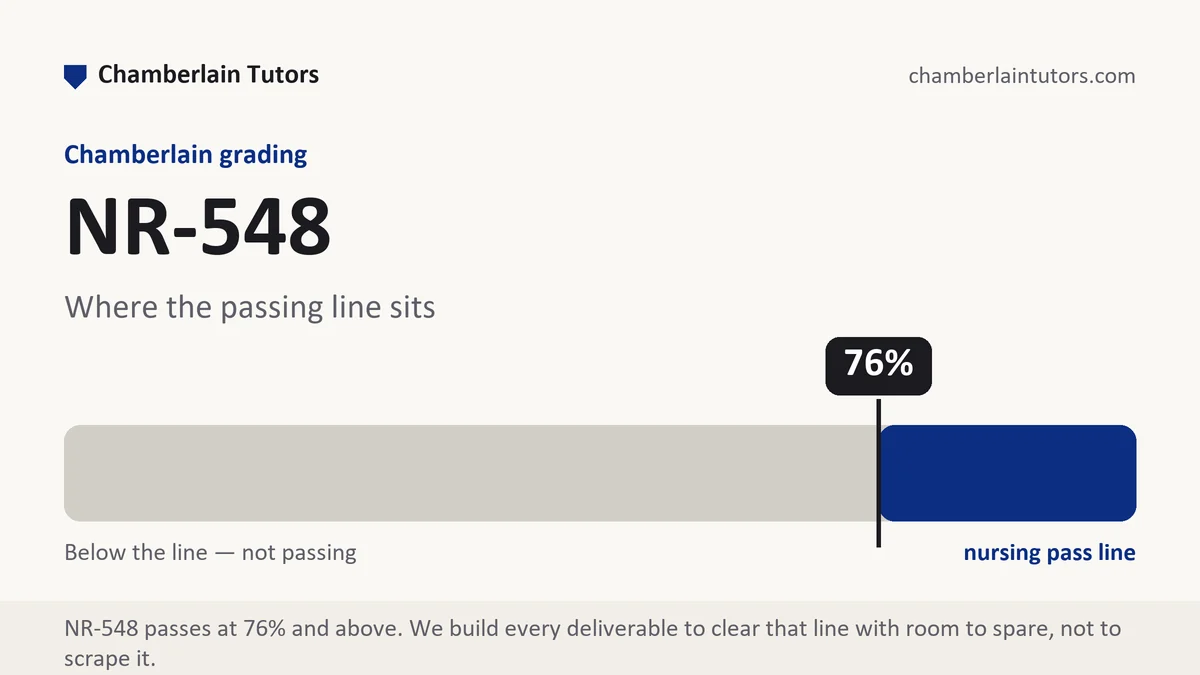
The arithmetic closes where it began: an 84 floor, no C band, two theory credits concentrating the term into a handful of grades, of which this is likely the largest. The evaluation is also the document the specialty will ask you to produce for years, which makes this the rare week where the exam and the job are the same task.
The NR-548 Week 8 method, step by step
Six moves that turn a term of sections into one coherent evaluation.
-
Assemble the skeleton from your rubric, not from memory
List the required sections in the required order and confirm each against the scoring guide. The capstone's cheapest failure is a missing section that every earlier week knew how to write.
-
Write each section in its own register
Report in the history, coverage in the review, observation in the examination, judgment only where judgment belongs. The term taught one register per section; the capstone grades whether they stay unmixed at full length.
-
Make the sections agree with each other
The examination should show the person the history described; the risk section should reflect what the review surfaced. Read the draft once only for contradictions, because internal consistency is the mark of a document written as a whole.
-
Build the formulation on three questions
Why this person, why these symptoms, why now: biological givens and family history, psychological patterns and losses, social context and supports, woven into a short causal story rather than listed. One common frame organizes factors that predispose, precipitate, perpetuate and protect; if your section teaches a frame, use that one.
-
Let the impression follow the formulation
The concluding impression and next steps should read as the formulation's consequence, not a separate announcement. If the impression surprises after the formulation, one of them is wrong.
-
Cut to the word ceiling by register, not by section
When the draft runs long, trim repetition and interpretive drift inside sections rather than deleting whole parts. A complete evaluation slightly lean everywhere outscores a rich history with an amputated formulation.
A structure for the complete evaluation
Planning guides from our desk for a capstone in the 1,200 to 1,500 word range, not Chamberlain requirements. Your rubric's section list and order replace this one wherever they differ.
| Section | What belongs in it | Suggested length |
|---|---|---|
| Identification and chief concern | The de-identified client and the visit's reason in their words. | 60-90 words |
| History of present illness | The episode in intervals, symptoms characterized, the why-now stated. | 200-240 words |
| Psychiatric, medical and social history | Prior episodes and treatment outcomes, relevant medical context, substances, and the life the illness lives in. | 200-240 words |
| Review of systems | The domain sweep's positives characterized and negatives attributed. | 120-150 words |
| Mental status examination | The observed exam, domain by domain, in descriptive vocabulary. | 180-220 words |
| Risk assessment | The gradient, the factors, the stratified judgment with its horizon, and the action. | 140-170 words |
| Formulation | Why this person, why these symptoms, why now, woven from the document above it. | 180-220 words |
| Impression and next steps | Where the evaluation lands and what the following contact is for. | 80-110 words |
Evidence and citation craft for a capstone week
The formulation is where citations earn the most. Causal claims, that early adversity shapes later vulnerability, that a stressor pattern precipitates episodes, are research claims, and the capstone's thinking section is exactly where sourcing them pays.
Carry every section's citation habit forward at full length. Instrument properties, documentation standards and interviewing evidence were each cited in their own weeks; the capstone is graded on whether the habits survive assembly, not on whether they existed once.
Check the reuse rules before harvesting your own weeks. Rebuilding the capstone from your earlier submissions may be intended, tolerated or barred depending on your course's policy on prior work; read it and follow it visibly, because a final-week similarity flag is the term's most expensive surprise.
End with verbs that leave the door open. An evaluation concludes with an impression that is consistent with the data and a plan that will test it; the document's last sentences should sound like the beginning of care, because that is what the genre is for.
Five mistakes that cost points in an evaluation capstone
- Sections stapled, not integrated. A capstone whose history and examination describe two different people announces it was assembled from parts on the deadline night.
- The formulation as summary. Restating the history in shorter sentences is not explaining it. If the section answers what happened instead of why, it is a recap wearing the wrong heading.
- Judgment leaking backward. Diagnostic language appearing in the history or exam, after a term of keeping registers clean, reads as regression under pressure and is graded accordingly.
- Risk compressed to make room. Trimming the safety section to fit a word ceiling saves the wrong words; it is the part of the document with stakes beyond the rubric.
- A de-identification slip in the fullest document. The capstone contains more detail than any earlier write-up, which makes a surviving name, date or facility most likely here and most costly here.
Before you submit the evaluation
- Every section your rubric names is present, in its required order
- Each section holds its own register, with no diagnostic leak upstream
- The sections describe the same person with no internal contradictions
- The formulation answers why this person, why these symptoms, why now
- Risk keeps its full gradient, horizon and documented action
- De-identification is verified line by line before upload
Capstone evaluation deciding your grade?
Send the case, the rubric and any section requirements from Canvas. A complete evaluation with the formulation built comes back in 24 to 48 hours, floor-checked against the 84 line, first premium sample free.