NR-548 Week 6 usually carries the intake's heaviest section: risk assessment, the structured inquiry into thoughts of self-harm or harm to others and the documentation that turns those questions into a defensible clinical record. The anatomy is fixed, what was asked, what was said, what was observed, what was concluded, over what horizon, and what was done, and the write-up is graded on whether all six parts survive onto the page. Your section may print this as NR 548 or NR548; it is the same course.
Chamberlain publishes no syllabi outside Canvas. The placement here is our teaching judgment from the course's catalog arc; your section's rubric decides what your week actually asks.
What NR-548 Week 6 asks for
By this point the arc has built every data channel the risk inquiry uses: interview craft to ask the hard questions, history to find the strongest known predictor in past behavior, systematic review to catch unvolunteered ideation, examination to observe what report conceals, and instruments to structure the screen. The late-middle of the session is where a course assembles those channels into the assessment that matters most, because risk is the section with consequences beyond the grade.
The deliverable usually asks for a risk assessment and its documentation from a case: elicit or interpret ideation data, weigh risk and protective factors, commit to a stratified judgment over a stated horizon, and record the action taken. Discussion versions may present an ambiguous safety picture and ask for your assessment and rationale; write it offline and post once, since boards preserve everything. Your week's rubric names the required framework and elements, and it is the only authority on them.
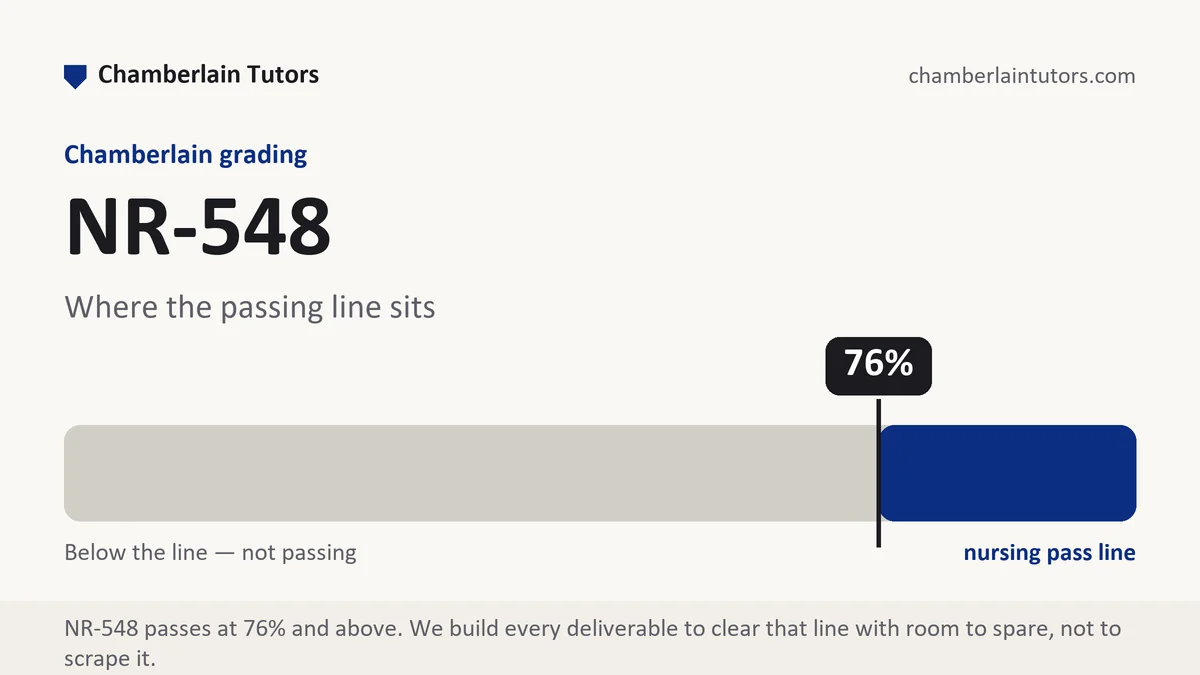
The academic frame does not soften for the subject: the specialty scale's 84 floor and missing C band apply here as everywhere, and in a two-credit course the risk write-up is likely one of the term's heaviest single grades.
The NR-548 Week 6 method, step by step
Six moves that produce a risk section a clinician could defend and a grader can pay.
-
Ask directly and record the asking
Ideation questions are asked in plain words, and the documentation must show they were. The evidence is settled that asking about suicide does not plant it, and the write-up that hedges its questions signals the discomfort this week trains out.
-
Walk the gradient to its end
Ideation, intent, plan, means, access, preparatory behavior: each step asked and each answer recorded, including denials. Stopping at the first no leaves the gradient unwalked, and graders check its full length.
-
Weigh history as the heavyweight it is
Past attempts and past self-harm outweigh most present-moment factors, and recent discharge or recent loss modify the picture further. The historical paragraph belongs beside the current one, not in another section.
-
Count protective factors without leaning on them
Reasons for living, connections, dependents and engagement with care get documented, and then the write-up must not let them cancel arithmetic they do not cancel. Protection modifies judgment; it never erases stated risk.
-
Commit to a stratified judgment with a horizon
Low, moderate or elevated, for a stated interval, on the record with its reasoning. Risk without a timeframe is an opinion; risk for the coming week, revisited at next contact, is a clinical statement.
-
Document the action the judgment demanded
Safety planning done collaboratively, means counseling, escalation, or continued outpatient monitoring with the revisit set: the concluding entry is what you did, because an assessment that changes nothing is not finished.
A structure for the risk write-up
Planning guides from our desk for a risk section in the 600 to 800 word range, not Chamberlain requirements. Your rubric's framework, where it names one, replaces this outline.
| Section | What belongs in it | Suggested length |
|---|---|---|
| Inquiry record | The questions asked across the gradient and the client's answers, denials included, attributed. | 130-160 words |
| Observed indicators | Examination findings bearing on risk: affect, agitation, hopelessness statements, engagement. | 70-100 words |
| Historical factors | Past attempts and self-harm, prior crises, recent losses or discharges, with intervals. | 100-130 words |
| Protective factors | Connections, reasons for living, dependents and care engagement, stated without inflation. | 70-100 words |
| Stratified judgment | The level, the horizon it covers, and the reasoning that weighed the factors into it. | 110-140 words |
| Action and follow-up | What was done in response, the safety plan's substance, and the revisit point. | 90-120 words |
Evidence and citation craft for a risk week
The asking-does-no-harm evidence deserves its citation. The finding that inquiring about suicidal thoughts does not increase them is one of the field's best-replicated reassurances, and citing it grounds your direct-questioning approach in research rather than bravado.
Predictor claims need their effect sizes' honesty. Past behavior is the strongest known factor and still predicts poorly at the individual level; the literature says both, and a write-up that says both reads as genuinely informed.
Safety planning has an evidence base; contracts do not. If your action section builds a safety plan, the intervention research behind collaborative planning is citable, and the contrast with discredited no-harm contracting is worth one referenced sentence.
Keep prediction out of your verbs. Risk is assessed and stratified for an interval; it is never predicted. Writing that a client will not act converts assessment into prophecy, and this is the one section where that verb error carries weight beyond the rubric.
Five mistakes that cost points in a risk documentation week
- Denies SI as the whole section. Two words where a gradient belongs shows the inquiry stopped at its first step, and every reader, faculty or clinical, reads it exactly that way.
- An instrument score standing in for judgment. A screening number can inform stratification but cannot perform it; the reasoning paragraph is not optional, and its absence is the week's costliest omission.
- Risk stated without a horizon. Unbounded risk statements are unfalsifiable and clinically unusable. The interval is what makes the judgment reviewable at next contact.
- Protective factors doing arithmetic they cannot do. Writing that support systems offset stated intent misuses protection to discount danger, and graders in this specialty treat it as the substantive error it is.
- No documented action. A stratified judgment with nothing after it leaves the assessment unfinished at its most consequential step; even continue current plan with revisit date is an action worth recording.
Before you submit the risk write-up
- The full gradient is asked and every answer, including denials, is recorded
- Historical factors appear with intervals, past behavior weighted honestly
- Protective factors are documented without offsetting stated risk
- The judgment is stratified, reasoned and bounded by a horizon
- The action taken and the revisit point close the section
- No sentence predicts; every sentence assesses
Risk write-up carrying real weight this week?
Send the case and rubric from Canvas. A gradient-complete, horizon-bounded risk assessment comes back in 24 to 48 hours, floor-checked, first premium sample free.