NR-548 Week 7 usually delivers on the catalog's across-the-lifespan promise: adapting the interview and history techniques the term has built to clients they were not designed around, children who show more than they say, adolescents negotiating privacy, and older adults whose intake runs through sensory limits and informant accounts. The core method survives every adaptation; what changes is the machinery around it, and the write-up must show which is which. Your section may print this as NR 548 or NR548; it is the same course.
Chamberlain publishes no syllabi outside Canvas. The placement here is our teaching judgment from the course's catalog arc; your section's rubric decides what your week actually asks.
What NR-548 Week 7 asks for
An assessment sequence that has taught its skills on the default adult client has one obligation left before synthesis: the ages where the default breaks. Interviewing a seven-year-old through play and caregiver report, an adolescent whose honesty depends on the confidentiality conversation, or an eighty-year-old whose history arrives partly through a daughter, each requires deliberate adaptation of technique, history-taking and the review's questions, and the late arc is where courses place that flexibility training.
The deliverable usually takes one of these shapes: an adaptation plan for an assigned age group, a comparison of how one assessment element changes across two ages, or a documented practice encounter with an age-specific client. Discussions like to assign different ages across the class and compare; draft yours offline and post it once, because the board keeps every word. The age groups covered, the format and the length are your rubric's to define, and its word wins everywhere this manual differs.
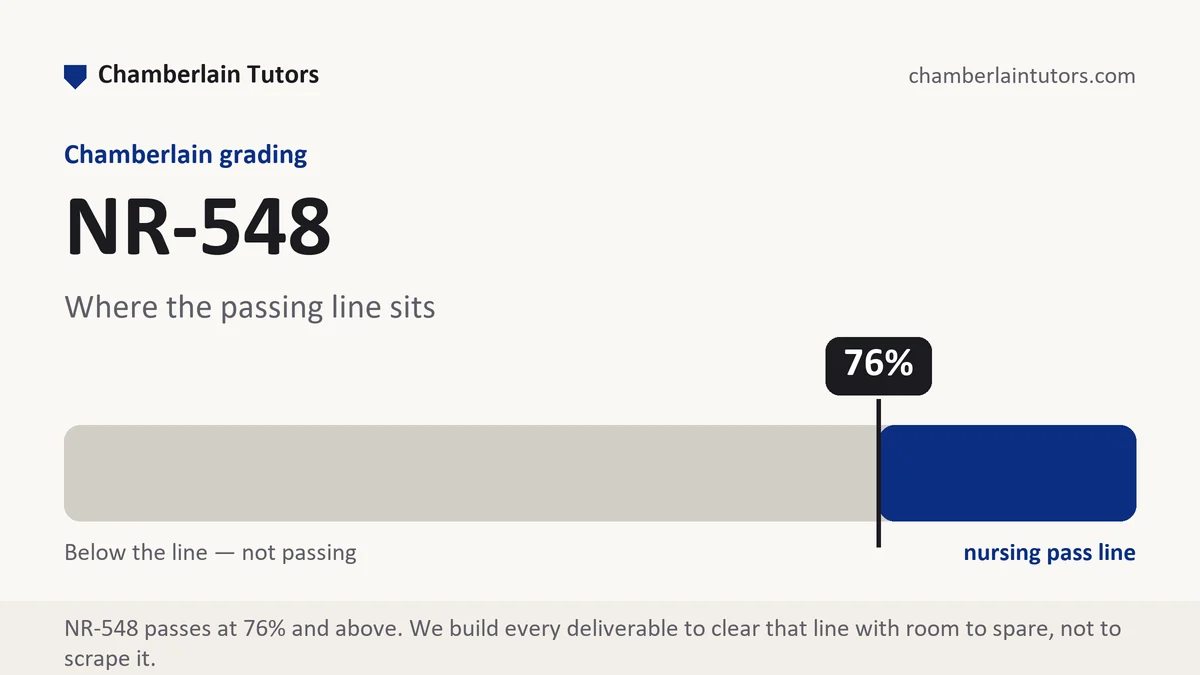
The grading backdrop holds steady: a two-credit course on the NP specialty scale, 84 to pass with no C band, late enough in the session that each remaining deliverable defends the whole term's margin.
The NR-548 Week 7 method, step by step
Five moves that adapt the interview without abandoning its spine.
-
State what does not change
Alliance, the open-to-closed funnel, attribution of every finding: the spine holds at every age. Open the write-up by saying so, because graders reward students who adapt from principle rather than swapping to a new script per age.
-
Match the medium to the development
Young children disclose through play, drawing and behavior more than questioning; adolescents need directness without condescension; older adults need pace, hearing accommodations and questions that respect a long story. Name your medium and why it fits this client's stage.
-
Run the confidentiality conversation for the age
The adolescent version, what stays private, what safety forces you to share, delivered before trust is tested, is the week's signature move. For children and supported elders, clarify to everyone in the room who will hear what.
-
Structure the multi-informant encounter deliberately
Decide and document who is interviewed together and apart, and in what order. Time alone with the client, at any age that can use it, is a designed step, not an accident of scheduling.
-
Adapt the questions, keep the coverage
The history and systematic review still cover their ground; the phrasing shifts to school and play for children, peers, screens, substances and mood for adolescents, function, losses and medications for elders. Show one rewritten question per domain to prove coverage survived translation.
A structure for the adaptation write-up
Planning guides from our desk for a write-up in the 700 to 900 word range, not Chamberlain requirements. If your rubric assigns one age group only, expand its blocks and drop the rest.
| Section | What belongs in it | Suggested length |
|---|---|---|
| The unchanged spine | The techniques that hold at every age, stated as the baseline being adapted. | 80-110 words |
| Developmental frame | The assigned client's stage and what it changes about disclosure, language and attention. | 100-130 words |
| Setting and medium | Room setup, play or drawing materials, pacing, sensory accommodations, and the reason for each. | 100-130 words |
| Confidentiality and consent choreography | Who is told what, the age-appropriate privacy conversation, and assent alongside consent where it applies. | 110-140 words |
| Informant structure | Who is seen together and apart, in what order, and how disagreements between accounts will be recorded. | 100-130 words |
| Adapted question set | One translated question per core domain, showing coverage preserved through the rewording. | 120-150 words |
Evidence and citation craft for a lifespan week
Developmental interviewing has its own literature; use it by age. Claims about how children disclose, or how adolescent honesty responds to confidentiality assurances, come from studies in those exact populations, and citing across ages weakens the match this week is grading.
Assent and consent claims deserve a source. The frameworks for involving minors in agreement to care are published professional guidance; naming the guidance turns your choreography section from custom into standard.
Sensory and cognitive accommodation is evidence-based practice. The adjustments that preserve assessment validity in older adults, pacing, hearing support, single questions at a time, are documented; one citation makes the accommodation paragraph clinical rather than courteous.
Keep age generalizations bounded. Adolescents as a group under-report to adults in general and disclose more with privacy assured; individual adolescents vary. Write the group claim with its source and the individual caveat in the same breath, because flattening development into stereotype is this week's characteristic overreach.
Five mistakes that cost points in an adaptation week
- A new method per age. Write-ups that abandon the term's spine for each group read as improvisation. The assignment is adaptation, and adaptation requires the constant to be visible.
- Interviewing the caregiver about the child, only. A pediatric encounter with no direct engagement of the child, at whatever level their development allows, misses the client in the room.
- Skipping the adolescent privacy conversation. Without the confidentiality frame delivered early, every sensitive answer that follows is compromised, and graders treat its absence as the structural failure it is.
- Talking past the older adult. Directing questions to the accompanying family member while the client sits present is both a clinical error and a documented one, since your write-up will show who you addressed.
- Adapting tone but not content. Softening language while silently dropping the substance, screens and safety questions for an adolescent, or mood questions for an elder, trades coverage for comfort and loses the coverage row.
Before you submit the adaptation write-up
- The unchanged spine is stated before any adaptation appears
- Every adjustment is tied to a named developmental reason
- The confidentiality choreography fits the age and appears early
- The informant structure says who is seen apart and why
- Each core domain shows a translated question, coverage intact
- Group-level age claims carry sources and individual caveats
Age-adapted assessment due this week?
Send the assigned age group and rubric from Canvas. An adaptation write-up with the spine held and every change justified comes back in 24 to 48 hours, first premium sample free.