NR-548 Week 2 usually moves from how you ask to what you keep: the psychiatric history of present illness and the psychiatric history behind it. This is the narrative core of the intake document, the story of this episode told in intervals and treatments rather than adjectives, and it is where assessment writing is won or lost. After a technique-focused opening, the arc's natural second step is turning an interview into an episode history that another clinician could act on. Your section may print this as NR 548 or NR548; it is the same course.
Chamberlain publishes no syllabi outside Canvas. The placement here is our teaching judgment from the course's catalog arc; your section's rubric decides what your week actually asks.
What NR-548 Week 2 asks for
The catalog anchors this course in the mental health history, and the history of present illness is that history's engine room: onset, course, duration, severity, what has been tried, what changed, and why the client is here now rather than last month. Expect the week's territory to be episode documentation, usually paired with the longitudinal psychiatric history, prior episodes, prior treatment and its results, because the two sections only make sense written together.
The deliverable often looks like an HPI and psychiatric history written from a case, a transcript or a practice interview, graded on chronology, completeness and the discipline of keeping interpretation out of the narrative. A discussion version might dissect what makes a strong psychiatric HPI different from a medical one. Boards keep whatever you post, so draft offline and submit once. Requirements belong to your week's rubric; treat every convention here as secondary to it.
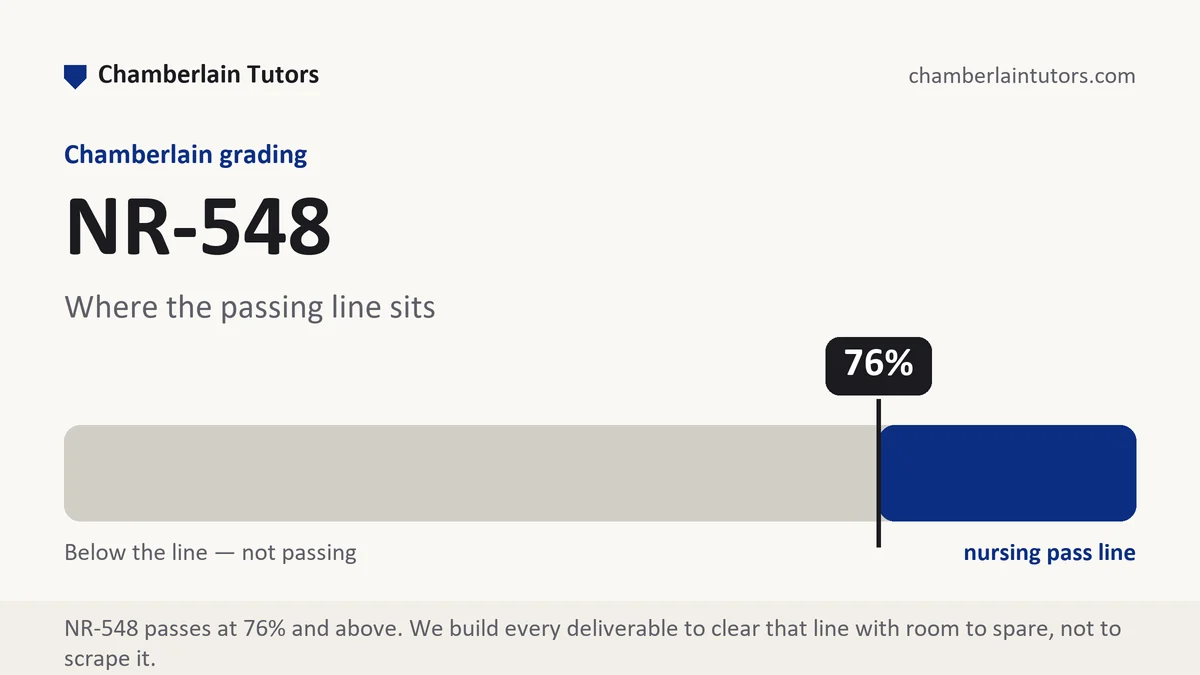
The standing frame: a two-credit course on the NP specialty scale, 84 to pass, no C band, where the small number of deliverables makes each one structurally heavy. A clean history write-up in week two banks margin the later weeks will want.
The NR-548 Week 2 method, step by step
Six moves that turn an hour of story into an episode history that scores.
-
Establish the why-now
Every present illness has a reason the visit happened this week. Find it, date it, and let the HPI's first sentences carry it, because the why-now is what turns a symptom list into a clinical narrative.
-
Build the episode's timeline in intervals
Onset, escalation points and any remissions get dates or durations: three weeks ago, since the job loss, worsening over five days. Every adjective of time in your draft should be replaceable by a number or an anchor event.
-
Characterize each symptom, not just its presence
Sleep is not disturbed; it is delayed onset with early waking, four hours nightly, for two weeks. Frequency, severity and functional impact are the dimensions the row is counting.
-
Capture the pertinent negatives of this episode
What you asked about and the client denied, elevated mood, psychotic features, ideation, belongs in the narrative, attributed as denial rather than absence. Those negatives are the HPI's connection to next week's systematic review.
-
Write the treatment history as trials with outcomes
Each prior medication or therapy gets agent or type, approximate dose or intensity where known, duration, effect and why it ended. A list of drug names without outcomes tells the next prescriber nothing and the grader knows it.
-
Separate this episode from the pattern
Close the psychiatric history by relating the present episode to the longitudinal course: first episode or recurrence, similar or different presentation, faster or slower build. That one comparative paragraph is where assessment writing shows judgment without slipping into diagnosis.
A structure for the HPI and psychiatric history
Planning guides from our desk for a section pair in the 700 to 900 word range, not Chamberlain requirements. Rebalance to your rubric's weights.
| Section | What belongs in it | Suggested length |
|---|---|---|
| Opening and why-now | The client, the concern in their words, and the dated reason the visit is happening now. | 70-100 words |
| Episode narrative | Onset, course and current state in intervals, each symptom characterized by frequency, severity and impact. | 200-240 words |
| Pertinent negatives | The denied symptoms that narrow the picture, written as denials with the asking implied. | 60-90 words |
| Prior episodes | Number, timing, duration and shape of past episodes, with the source of the account noted. | 100-130 words |
| Treatment trials | Each medication and therapy as a trial: what, roughly how much, how long, what happened, why it stopped. | 140-170 words |
| Episode-in-pattern summary | How the present episode compares to the longitudinal course, stated without diagnosing. | 70-100 words |
Evidence and citation craft for a history week
Cite the documentation standard you are following. The elements of a psychiatric history are set out in the specialty's assessment literature; anchoring your structure to a named source turns format choices into defended ones.
Recall limits are citable facts. Clients date past episodes imperfectly, and the literature on retrospective recall lets you say so professionally when your history flags an uncertain timeline, rather than presenting shaky dates as firm.
Attribute records against report. Where prior treatment details come from documentation rather than memory, say which, because the two sources disagree often enough that the distinction is clinically real and rubrics in assessment courses reward the precision.
Keep interpretation out of the verbs. The HPI reports: the client describes, dates, denies. The moment a sentence explains rather than records, it has left this section's register, and history rows mark the drift down reliably.
Five mistakes that cost points in an HPI week
- Adjectives where intervals belong. Recently, for a while and longstanding are not data. Every one of them in a draft is a question you failed to ask or an answer you failed to record.
- The undated visit. An HPI that never explains why the client came now is a symptom essay. The why-now is the section's organizing fact and its absence is the first thing experienced readers notice.
- Medication names without verdicts. Listing three antidepressants tried tells nobody whether any worked, at what dose, or for how long, and it forfeits the treatment-history row almost entirely.
- Diagnosis leaking into the narrative. Writing the client's depression worsened, in a course that has not yet reached diagnostic territory, imports a conclusion into a data section and graders mark the register break.
- Prior episodes compressed to a phrase. A history of similar episodes, unnumbered and undated, throws away the longitudinal pattern that gives the present episode its meaning.
Before you submit the history write-up
- The why-now is stated and dated in the opening lines
- No time adjective survives where an interval or anchor event could stand
- Each present symptom carries frequency, severity and functional impact
- Pertinent negatives are written as attributed denials
- Every treatment trial has an outcome and an ending reason
- The closing paragraph places this episode inside the longitudinal pattern
History write-up due this week?
Send the case or transcript and the rubric from Canvas. An HPI with the timeline built and the treatment trials documented comes back in 24 to 48 hours, floor-checked, first premium sample free.