NR-548 Week 1 usually opens where the psychiatric encounter itself opens: interview technique, the deliberate craft of building enough trust in fifty minutes that a stranger tells you the truth about their mind. The catalog frames this course around psychiatric interview technique and the mental health history, so the first week of an 8-week session almost certainly belongs to the conversation before any finding exists to record. This manual covers the write-up that documents and defends your questioning. Your section may print this as NR 548 or NR548; it is the same course.
Chamberlain publishes no syllabi outside Canvas. The placement here is our teaching judgment from the course's catalog arc; your section's rubric decides what your week actually asks.
What NR-548 Week 1 asks for
Assessment courses teach the instrument before the data, and in psychiatry the instrument is the interviewer. Expect the opening territory to be technique: how an encounter is opened, how rapport is built deliberately rather than by accident, how question forms are chosen, and how a clinician follows distress without chasing it. The specialty's interview differs from the general medical one in exactly these places, which is why a dedicated course begins here.
The deliverable usually takes one of a few shapes: a discussion on engagement strategy, an analysis of a recorded or transcribed interview identifying techniques and missed openings, or a plan for approaching a described client. If your section opens with a discussion, write it in a document first and paste it once, because Canvas boards cannot be edited after posting. Whatever shape arrives, your week's rubric defines it, and this manual bows to that rubric everywhere they differ.
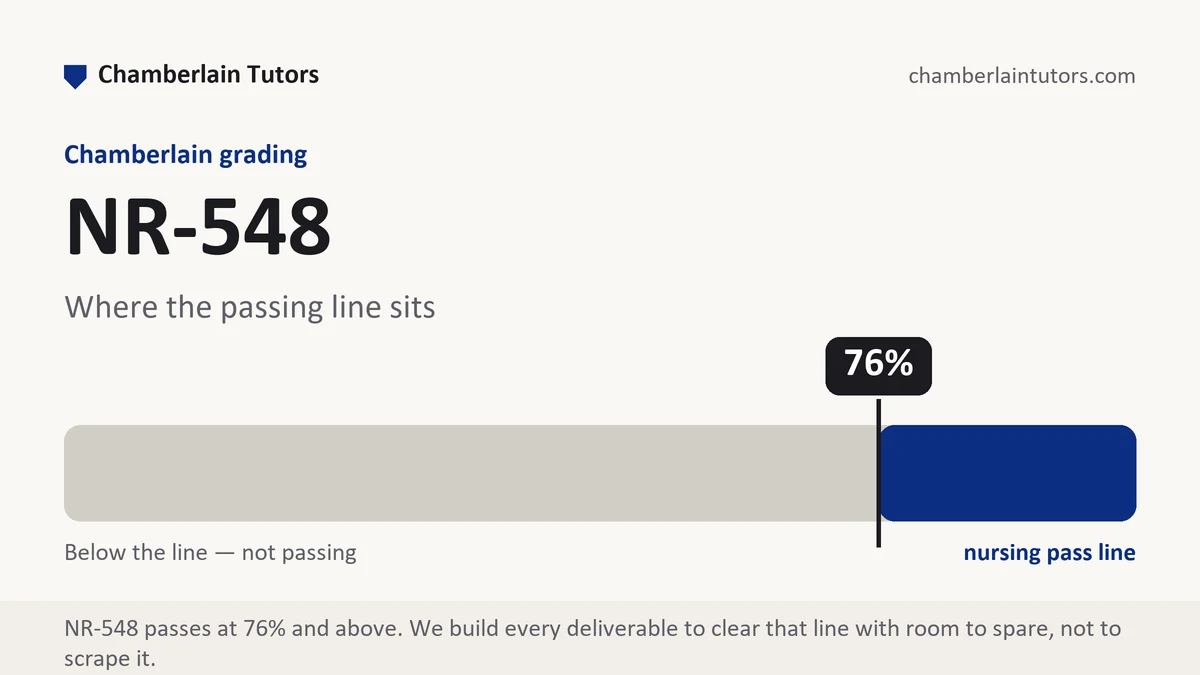
The grading context arrives with week one: NR-548 sits on the NP specialty scale, where nothing below 84 passes and no C band exists, and it carries two theory credits, which tends to mean fewer, shorter deliverables where every submission moves the average visibly.
The NR-548 Week 1 method, step by step
Five moves that turn interviewing craft into a document a grader can score.
-
Find where the rubric hides the relationship
Technique weeks scatter their marks across rows named engagement, communication or therapeutic use of self. Map them first, because the row names tell you which techniques must appear by name in your write-up.
-
Name your opening strategy
How the first two minutes go, introduction, purpose, confidentiality and its limits, an open invitation to talk, is a designed choice. Write it as one, with a sentence on why this opening suits this client.
-
Show the question funnel
Open questions first, focused follow-ups second, closed confirmations last. When your write-up quotes example questions, order them in that funnel and say what each form is for; the sequence is the technique.
-
Handle the difficult moment on paper
Tears, silence, hostility or reluctance: pick the moment your assignment presents and describe the specific response, normalizing, waiting, reflecting, that keeps data flowing without steamrolling the person.
-
Defend every choice with a mechanism
For each technique you claim, add why it works: what reflection does to disclosure, what a premature closed question forecloses. Mechanism sentences are what separate analysis from vocabulary listing.
A structure for the interview technique write-up
Planning guides from our desk for a write-up in the 700 to 900 word range, not Chamberlain requirements. Two-credit courses run short, so proportion matters more, not less.
| Section | What belongs in it | Suggested length |
|---|---|---|
| Encounter frame | The client, setting and purpose, plus the confidentiality ground rules you would state. | 80-110 words |
| Opening strategy | The designed first minutes and the reason they fit this client. | 100-130 words |
| Question strategy | The funnel from open to closed, with example questions and each form's purpose. | 170-200 words |
| Rapport and repair | The techniques keeping the alliance alive, and the response to the encounter's difficult moment. | 150-180 words |
| Technique rationale | The mechanisms: why each named choice increases the honesty or completeness of what is disclosed. | 120-150 words |
| Limits and next encounter | What one interview cannot establish and what the following session would pursue. | 80-110 words |
Evidence and citation craft for a technique week
Interviewing techniques have names and origins; use both. Reflection, normalization and transition statements come from a communication literature. Citing where a technique was described and tested moves your write-up from opinion to method.
Disclosure claims are research claims. The sentence saying open-ended openings yield fuller symptom reports is supported by actual studies of clinical interviews; source it rather than asserting it, because this is the week's central empirical claim.
Prefer sources from psychiatric settings. Communication research from general practice transfers imperfectly to encounters involving paranoia, mania or acute distress. When your source studied psychiatric interviews specifically, say so; that precision is graded.
Verbs stay observational. Techniques are associated with better disclosure and support engagement; they do not guarantee either. In a course that will spend seven more weeks on careful attribution, verb discipline in week one sets the register faculty are watching for.
Five mistakes that cost points in a technique week
- Listing techniques without deploying them. Naming reflection and empathy in the abstract, with no example question or moment attached, reads as a glossary and scores as one.
- Opening with the checklist. A write-up whose interview begins with demographic questions and symptom inventories has already told the grader the alliance was an afterthought.
- Confusing interrogation with thoroughness. Ten closed questions in a row is data collection at the cost of the relationship that makes data true; graders in this specialty flag the pattern instantly.
- Skipping confidentiality and its limits. The psychiatric interview's ground rules are part of technique, and their absence from an opening strategy is a visible hole in a specialty where the limits matter.
- Writing the client as an obstacle. Describing reluctance or anger as interference, rather than as clinical information shaping your approach, misses the week's actual lesson and faculty read the framing closely.
Before you submit the technique write-up
- Every claimed technique has an example question or moment attached
- The question funnel runs open to closed and says why
- Confidentiality and its limits appear in the opening strategy
- The difficult moment gets a specific, mechanism-backed response
- At least one source studied interviews in psychiatric settings
- No verb promises what a technique can only make more likely
First NR-548 deliverable due?
Send the Week 1 prompt and rubric from Canvas. A technique write-up with the funnel built and every choice defended comes back in 24 to 48 hours, floor-checked, first premium sample free.