NR-581NP Week 8 closes the first core course, and closing weeks in an 8-week session usually ask for synthesis: a reflective deliverable that looks back across the history, standards, theory, and ethics work and names what changed in your thinking, plus whatever final discussion your section runs. Reflection is the most misgraded genre in graduate school because students mistake it for a diary, and this manual is the correction. Your section may print this as NR 581NP or NR581NP; it is the same course. Chamberlain publishes no syllabi outside Canvas. The placement here is our teaching judgment from the course's catalog arc; your section's rubric decides what your week actually asks.
What NR-581NP Week 8 asks for
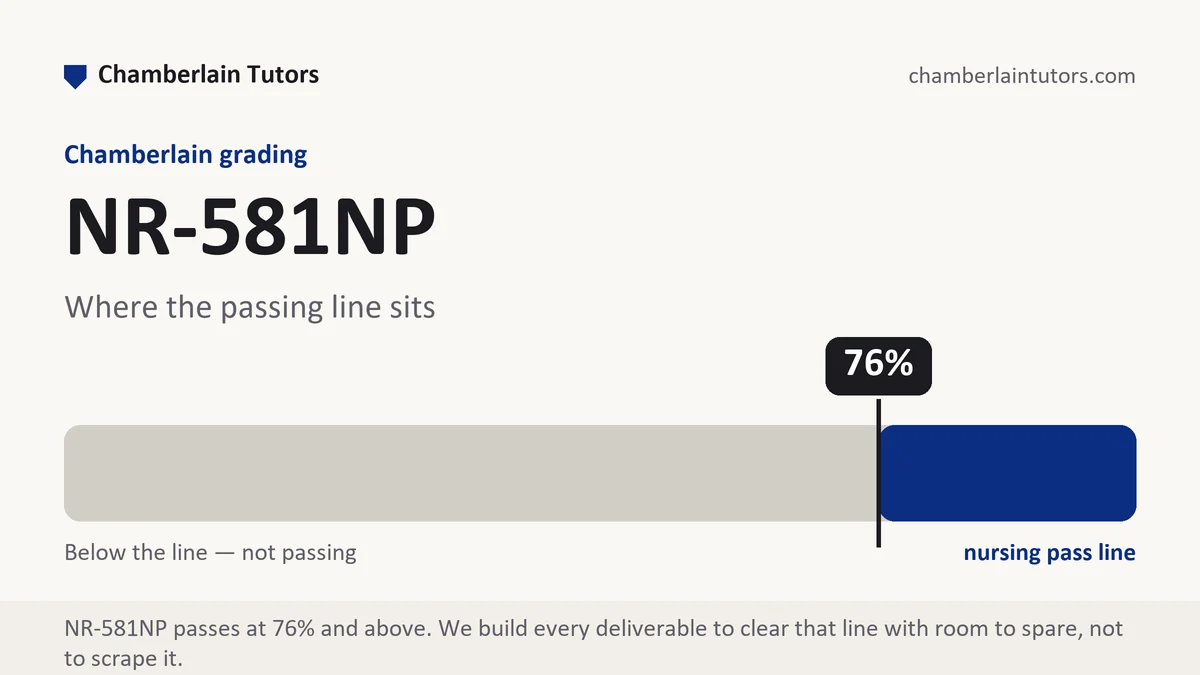
Final weeks carry two jobs at once. The first is intellectual: a synthesis piece, usually a reflective post or short paper, that demonstrates the course's strands actually met in you, that the theory week changed how you read the standards, that the ethics work complicated what the history had made simple. The second is administrative and entirely yours: the gradebook math that decides whether the course's number is safe, which in this course carries extra weight because bridge students need a B to progress and the specialty scale fails everything below 84.
If your section runs a discussion this week, expect a looking-back, looking-forward prompt, and hold it to the same standard as every board before it: drafted outside Canvas, sourced where it makes claims, pasted once, because the final week's boards are as permanent as the first's.
What the rows in reflective territory pay for is evidence of change, not testimony of effort. A grader cannot score how hard the eight weeks felt. They can score a specific before, a specific after, and the specific course material that moved you between them, which is what the method below is built to produce.
The NR-581NP Week 8 method, step by step
-
Read the rubric, then reread your own week 1
After the rows are laid out, open your first post of the course and read it as a stranger. The distance between that writing and your current writing is the reflection's raw material, and it is evidence you can quote, which almost no one does.
-
Collect artifacts before drafting sentences
Pull two or three concrete traces of the course: a feedback comment that stung and helped, a paragraph you would now rewrite, the theory concept that resurfaced in the ethics paper. Reflection built on artifacts grades like analysis; reflection built on memory grades like mood.
-
Name one before-and-after per course strand
For at least two of the course's strands, write a paired claim: what you assumed in week 1, what you hold now, and which reading or assignment moved you. The pairing is the genre's engine, and each pair is one paragraph.
-
Connect two strands to each other
The synthesis move that separates top-band reflection: show where two threads met, where the scope work made an ethical principle concrete, where a theory's vocabulary organized the history. One genuine connection outscores four parallel summaries.
-
Keep sources in the frame
Reflective register does not suspend scholarship. Cite the theorist whose concept you now use, the standard you now check, the ethics literature that reframed a case. Two or three citations anchor a reflection without embalming it.
-
Run the final arithmetic before you write the last word
Compute what the closing deliverables need to hold your target, remembering the working minimum is 86 for bridge students and that nothing curves. If the math is tight, the reflection is not the place to coast, and neither is the final board.
A structure for the synthesis reflection
Targets fit a reflection of roughly 700 words; your section's rubric, where it specifies parts or lengths, overrides them.
| Part | What it has to do | Target |
|---|---|---|
| Opening claim of change | One sentence naming the single biggest shift in your thinking, specific enough to be checked against what follows. | ~60 words |
| Artifact evidence | The concrete traces, quoted or described, that prove the shift happened: your own early writing, feedback received, a graded moment. | ~140 words |
| Strand one, before and after | What you assumed, what you now hold, and the material that moved you, for the first course thread. | ~130 words |
| Strand two, before and after | The same pairing for a second thread, in different terms, not a template refill. | ~130 words |
| The connection | Where two strands met each other in your thinking, the paragraph that makes this synthesis rather than summary. | ~140 words |
| Forward commitment | One specific habit or checkpoint you carry into the next course, stated so it could be verified later. | ~100 words |
Evidence in reflective register
Reflection changes what counts as data. Your own earlier work becomes citable: quoting a sentence from your week 1 post and showing what is wrong with it is the single most persuasive move in the genre, because it is verifiable and vain-proof at once. Faculty feedback is evidence too, paraphrased fairly. What does not become evidence is feeling: exhausted, proud, and stretched are states, not findings, and a paragraph of them answers no row.
External sources keep their usual jobs at lower density. Cite the specific concept, standard, or principle you claim changed you, once each, so the reflection's claims about the course are anchored to the course. A reflection with zero citations reads as detached from the material; one with twelve reads as a literature review hiding from the prompt. Two to four, placed exactly, is the working band.
And keep verbs honest even about yourself. You did not transform in eight weeks; you started checking jurisdiction before making scope claims. The smaller verb is the credible one, and credibility is this genre's currency.
Five mistakes that cost points in week 8
- Diary register. A chronological tour of how the weeks felt answers no row. The genre wants change demonstrated, not experience recounted.
- Growth claims with no artifact. I have grown as a scholarly writer is unscoreable. A quoted before-sentence and its rewrite is a grade.
- Summary wearing synthesis clothes. Restating each week's topic in order proves attendance. The connection paragraph, where strands meet, is what the top band buys.
- Skipping the final math. Students at 85 have coasted the last week into a repeat. Compute first, then decide how much the closing deliverables matter.
- Cutoff submissions. The last night of a session is the worst night for an upload problem, and the Mountain Time deadline does not move for technical difficulties you discovered at 11:57.
Six checks before the course closes
- The opening claim names one specific shift, and every later paragraph is evidence for it.
- At least one artifact, your own early writing or received feedback, is quoted or concretely described.
- Two strands carry before-and-after pairs, and one paragraph connects strands to each other.
- Citations number two to four and land exactly on the material you claim moved you.
- The forward commitment is checkable: a habit, a checkpoint, a number.
- The gradebook arithmetic is done, the target confirmed, and everything uploads with hours of margin.
Final week, and the number is close?
Send the gradebook and the closing rubric. We run the math, then draft the reflection that holds your band, floor-checked, in 24 to 48 hours.