NR-581NP Week 6 tends to be where the ethics strand goes to full depth: a complete dilemma worked through a structured decision process, stakeholders and options and justification included, usually as the heaviest paper of the course's back half. Last week graded whether you know the principles; this territory grades whether you can run them under load. Your section may print this as NR 581NP or NR581NP; it is the same course. Chamberlain publishes no syllabi outside Canvas. The placement here is our teaching judgment from the course's catalog arc; your section's rubric decides what your week actually asks.
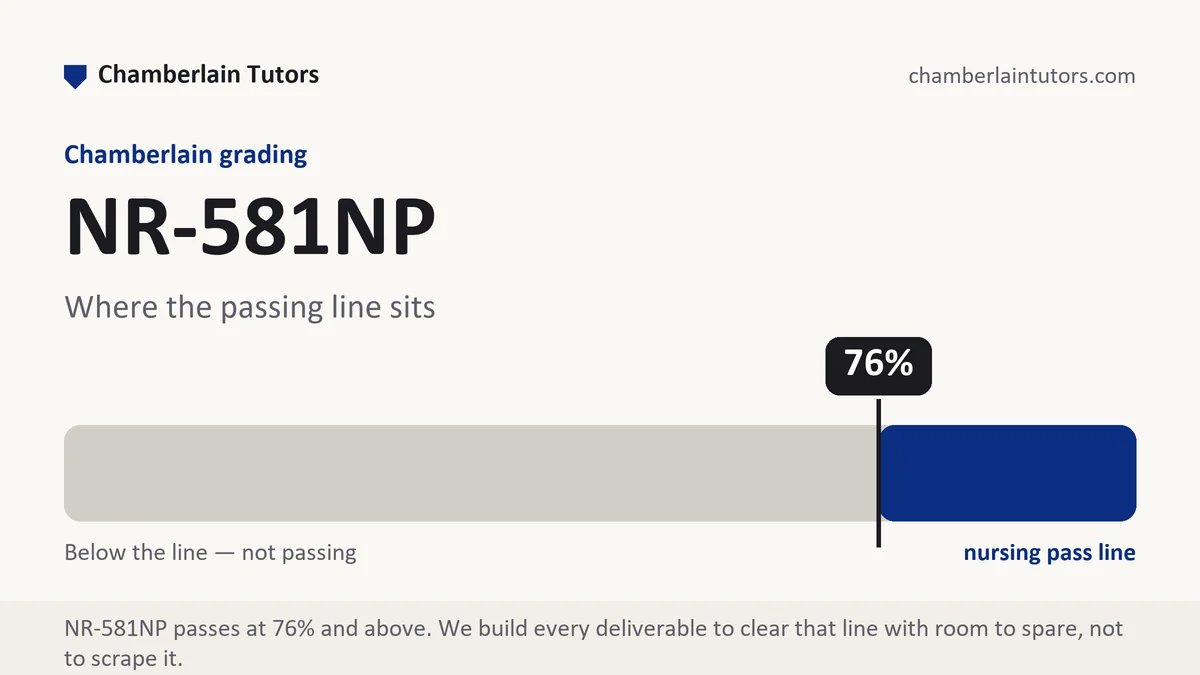
What NR-581NP Week 6 asks for
Disciplines that teach principles one week teach process the next, because knowing the values is not the same as deciding under them. The territory here is the worked dilemma: a situation with two defensible courses of action, taken through a recognized decision framework step by visible step, from fact-gathering through stakeholders, options, decision, and a plan to evaluate the outcome. The distinction between a true dilemma and ordinary moral distress, where the right act is known but blocked, is often part of the week's vocabulary.
The dominant shape is a paper, the longest ethics writing of the course, sometimes fed by a smaller discussion. If your section runs a discussion this week, treat it as a rehearsal space for the paper's case and keep the two consistent, because faculty read both.
The rows in this territory are process rows. They pay for a dilemma that genuinely forks, for stakeholders beyond the obvious two, for options compared rather than asserted, and for a decision whose justification could persuade the losing side that it was heard. A brilliant verdict delivered without visible machinery scores like a coin flip with confidence.
The NR-581NP Week 6 method, step by step
-
Confirm the fork before you outline
Test your case against the definition: are there at least two courses of action a reasonable clinician could defend? If one option is obviously right and merely difficult, you have moral distress, not a dilemma, and the paper will fight you the whole way. Choose a case that forks, then set the rubric rows as your headings.
-
Write the dilemma as one answerable question
Should the team honor this refusal, or pursue the intervention? A question forces the paper toward an answer and gives every later section a job: facts that inform it, stakeholders who feel it, options that answer it. Papers without the question wander.
-
Inventory stakeholders past the bedside
Patient and provider are the start. Family, the wider care team, the organization, sometimes a payer or the public interest each hold a stake, and the rows usually pay for at least four perspectives rendered fairly, each with what they stand to gain or lose.
-
Run the framework in the open
Whichever decision model your section teaches, show each step happening on your case, named in the text as you go. The most common failure in this territory is a framework introduced in one paragraph and never seen again; the fix is mechanical, one step, one visible section.
-
Weigh the options with principles attached
For each live option, state which principles support it and which it strains. Then decide, and justify with the deciding weight named. A decision that acknowledges what the rejected option protected reads as judgment; one that pretends the rejected option had nothing going for it reads as haste.
-
Close with evaluation, then audit the draft
Say how the decision's outcome would be reviewed, what would count as the choice having been right, and when it should be revisited. Then reverse-check the draft against the rows and submit ahead of the deadline, not at it.
The dilemma paper, section by section
Planning targets below fit a paper of roughly 1,100 words of body. Your rubric's architecture, where it names sections, replaces this one.
| Section | What it has to do | Target |
|---|---|---|
| Case presentation | The situation in brief, facts only, identities protected, no analysis yet. | ~130 words |
| The dilemma, stated | The single question the paper answers, plus why both branches are defensible, which is what makes it a dilemma. | ~110 words |
| Stakeholders and interests | Four or more parties, each with their stake stated in a register they would recognize as fair. | ~180 words |
| Options through the framework | The live courses of action taken through the decision model's steps, principles attached to each. | ~300 words |
| Decision and justification | The answer to the question, the weight that decided it, and what the rejected option protected. | ~230 words |
| Evaluation plan | How and when the outcome would be reviewed, and what would trigger reconsideration. | ~130 words |
Evidence for a worked dilemma
Three source families carry this paper. The decision framework needs its originating literature cited, not just its steps listed, because the framework is itself a claim about how deciding should work. The dilemma's subject, refusal of care, disclosure, end-of-life intervention, capacity, has its own bioethics literature, and one or two precedent discussions of similar cases lift the analysis from private reasoning to scholarship. And any empirical claim inside the argument, about outcomes of honored refusals or the effects of disclosure, needs research behind it with the design visible.
If the case is drawn from experience, composite it and say so: a sentence noting that identifying details are altered protects everyone and costs nothing. The alternative, recognizable specifics, is not a style problem but a confidentiality one, and it is the kind of error that outlives a grade.
Keep the code of ethics in its lane here too: it obligates, it does not adjudicate. When both branches of your fork can quote the code, and in a true dilemma they usually can, saying so is itself analysis worth a sentence.
Five mistakes that cost points in week 6
- A dilemma that does not fork. If no reasonable clinician would take the second option, the paper is a lecture, and the comparison rows have nothing to score.
- Two-party analysis. Patient versus provider is the opening move, not the stakeholder section. The unlisted parties are where the missing points sit.
- Verdict-first writing. A decision announced in the introduction turns every later section into decoration. Let the question stay open until the framework has run.
- The framework as furniture. Naming a decision model and never walking its steps is the single most common deduction in this territory.
- New facts in the conclusion. A detail that first appears in the final paragraph was never analyzed, and graders treat it as the paper admitting it argued the wrong case.
Six checks before this paper uploads
- The dilemma is written as one question, and both branches are defended as reasonable before the analysis picks one.
- At least four stakeholders appear, each with a stake stated fairly.
- Every step of the named framework is visible in the text, in order.
- The decision names its deciding weight and what the rejected option protected.
- Identifying details are composited, with the alteration acknowledged in a sentence.
- The reverse outline shows each rubric row served, and the upload beats the Mountain Time cutoff with margin.
The big ethics paper on your desk this week?
Send the case and the rubric. A floor-checked dilemma analysis with the framework run in the open comes back in 24 to 48 hours, first sample free.