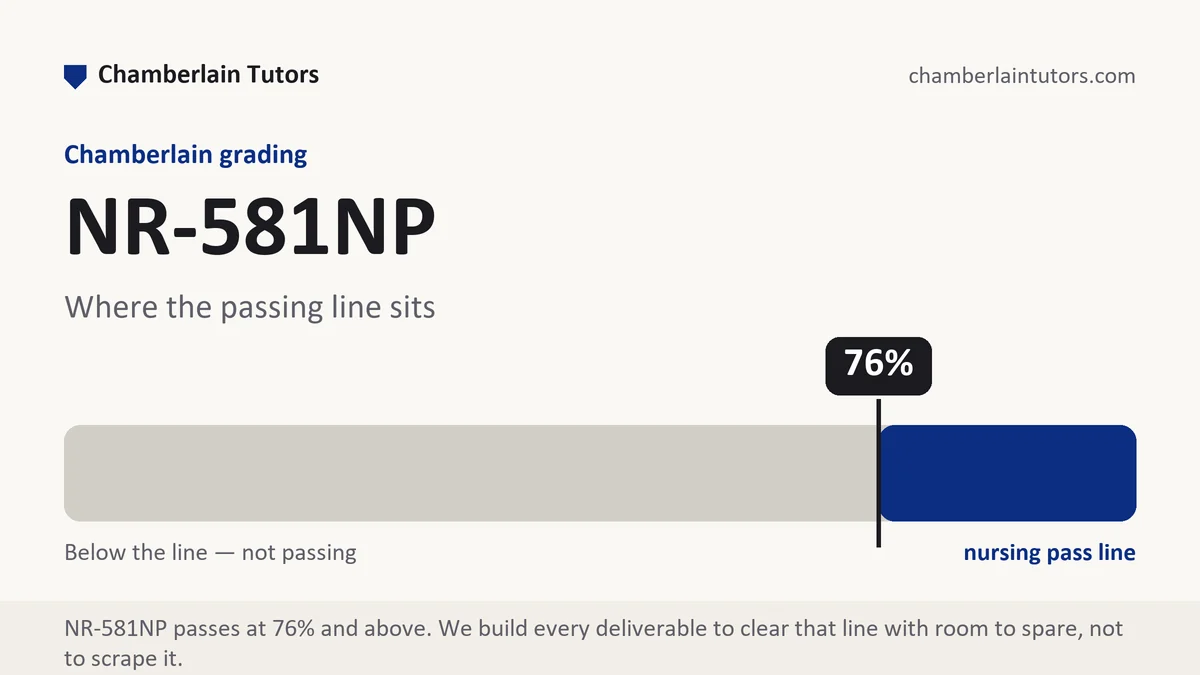
NR-581NP Week 1 is where the first NP core course usually starts its story: the history of advanced practice nursing, and why the role you are entering looks the way it does. This manual covers the writing that opening week tends to ask for, the method our tutors run on it, a structure with word targets, and the habits that cost points on a scale where below 84 already fails. Your section may print this as NR 581NP or NR581NP; it is the same course. Chamberlain publishes no syllabi outside Canvas. The placement here is our teaching judgment from the course's catalog arc; your section's rubric decides what your week actually asks.
What NR-581NP Week 1 asks for
The catalog describes this course as the professional standards and the historical, theoretical and ethical underpinnings of advanced nursing practice, and disciplines teach that list in order. History comes first because every later argument leans on it: you cannot claim what the NP role should be until you can say how it came to exist. So the opening week's territory is usually the record itself, which forces built the role, which decisions mattered, and what that record means for the provider you are training to become.
The deliverable shapes at this point in an 8-week session are modest: an introduction thread, and, if your section runs a graded discussion this week, an initial post that takes a position on the role's development plus replies to classmates. Our tutors usually see opening posts land between 300 and 700 words, but that is an observation, not a rule; your week's rubric owns the number.
Modest does not mean safe. These are the first graded words of your program, the specialty scale applies from day one with no C anywhere on it, and a Chamberlain board cannot be edited after it posts. For bridge students the course also carries a progression requirement of a B, so the arithmetic starts now.
The NR-581NP Week 1 method, step by step
-
Open the rubric before the prompt
Pull your week's rubric out of Canvas and turn each criterion row into a heading in a blank document. The prompt tells you the subject is history; only the rows tell you what the grade is made of. Write nothing that does not sit under a row.
-
Cut the history down to one thread
A single post cannot hold the whole profession. Choose one line and follow it: the nurse anesthesia tradition, the 1965 Colorado program that produced the first nurse practitioners, or the federal primary care funding that scaled the role. One thread traced with dates outscores a century summarized.
-
Give every claim a year and a place
History writing is graded on specificity. "The role grew rapidly" is filler; "NP programs multiplied through the 1970s as federal primary care money followed the physician shortage" is analysis. If a sentence carries no date and no location, it is probably restating the textbook.
-
Draw the line to the present role
End the historical account with one paragraph that lands in the present: what the record you traced explains about the role today, and what it suggests about where the role is still contested. This is usually the move that separates a summary from an argument.
-
Draft in a document, never in the reply box
Whatever posts is what gets graded, and the board does not reopen. Write the post in a file, hold it against your rubric rows, fix what is thin, then paste once.
-
Post early and treat replies as graded work
An early initial post earns readers and better replies. Your own replies should extend the thread with a source, not compliment it, because a reply is scored under the same rows and the same permanence.
A structure for a history-anchored post
The targets below are our planning numbers for a post of about 600 words. Your section's rubric decides the real length and sections; divide whatever it gives you in roughly these proportions.
| Part | What it has to do | Target |
|---|---|---|
| Opening claim | State in one or two sentences what your chosen development changed about advanced practice. A position, not an agenda. | ~60 words |
| The arrangement before | What care and the nursing role looked like ahead of the development, concrete enough to compare against. | ~110 words |
| The turning point | The development itself: who acted, when, where, and what they actually did. | ~130 words |
| What changed, for whom | The consequence traced to real actors: patients, nurses, physicians, payers. One consequence followed far beats four listed. | ~130 words |
| The line to now | What this history explains about the present NP role, including one way the old argument is still running. | ~110 words |
| Close and handoff | A sentence of closure and a question classmates can answer from their own reading or practice. | ~60 words |
Evidence and citation craft for a history week
History weeks bend the usual currency rules, and graders know exactly how far they bend. A recent scholarly account of the role's development satisfies a currency window; the primary record it describes does not have to. If you cite a decades-old landmark, cite it as the event's own document, paired with a current source that interprets it. What never survives is the tertiary shortcut: a timeline page or an encyclopedia entry standing in for literature.
Put the date inside the sentence, not just inside the citation. A reader should be able to reconstruct your chronology without opening a reference list. And keep that reference list honest: every in-text citation matched by an entry, every entry cited somewhere, because a mismatch is the cheapest deduction on the board.
Finally, watch the direction of your verbs. Historical claims are observational by nature: a funding change was followed by program growth, associated with expansion, coincided with shortage. Only where the record itself documents intent does a stronger verb belong.
Five mistakes that cost points in week 1
- Surveying the whole profession. A post that runs from Nightingale to now has no room left for analysis, and analysis is where the rows pay.
- Celebration register. Writing the history as a tribute reads as opinion. The grade sits in causes and consequences, not admiration.
- Undated claims. Every "eventually" and "over time" is a row half-answered. Years and places are the evidence of a history week.
- Tertiary sources. A timeline website is not literature. Two scholarly sources beat six links.
- No line to the present. A post that never leaves the past answers the prompt but not the course, which is about the role you are entering now.
Six checks before the post goes up
- Every rubric row has a passage that answers it, found by reading the rows one at a time against the draft.
- The post follows one historical thread, and every claim in it carries a year or a place.
- Any older landmark source is paired with a current scholarly account.
- The final paragraph lands in the present role, not the past.
- The draft was written outside Canvas and is being pasted once, replies included.
- Submission beats the 11:59 p.m. Mountain Time cutoff by hours, not minutes.
Want week 1 banked at the A band?
Send your rubric from Canvas and the first premium sample is free: a floor-checked opening post back in 24 to 48 hours.