NR-528 is the three theory hour course on leading and managing change in healthcare delivery settings, using evidence to drive innovation. The graded object is a change, and a change has parts a good idea does not: a current state, a named model, the people who have to move, the thing that will resist, and a way of telling six months later whether anything actually happened.
What NR-528 actually grades
The first scored ability is diagnosing the current state honestly. Most change proposals fail on paper because they describe the desired future in detail and the present in one sentence, which leaves the reader unable to judge whether the proposed change addresses anything real. Where a rubric row asks for a problem statement, it is asking for the present described with enough precision that the gap is visible.
The second is using a change model as a working tool. Naming a framework earns nothing. Using it to decide sequence, to identify who must be engaged before what, and to explain why an early step exists is what the justification rows pay for.
The third is treating resistance as information rather than as an obstacle. Strong papers say who loses something under the proposed change, what they lose, and how the plan accounts for it. Papers describing resistance as a matter of attitude, to be solved with education and communication, sit in the middle of every scoring guide this course uses.
How we help in this course
NR-528 has no clinical hours, so nothing on our side touches placement, preceptors, site paperwork or logs.
Send the prompt and the scoring guide from Canvas and a premium original draft comes back in 24 to 48 hours, structured against the criterion rows, with the model driving the sequence and the evidence described before it is used. The draft clears both quality reviews and the floor check before delivery, and revising is free until it lands.
Writing this course's deliverables from the rubric
Rubric, current state, model, plan, measure. Writing the plan before the current state is why so many change proposals read as solutions in search of a problem.
In NR-528 right now?
Send the week and the rubric from Canvas. First premium sample free, floor-checked, back in 24 to 48 hours.
The floor under a project course
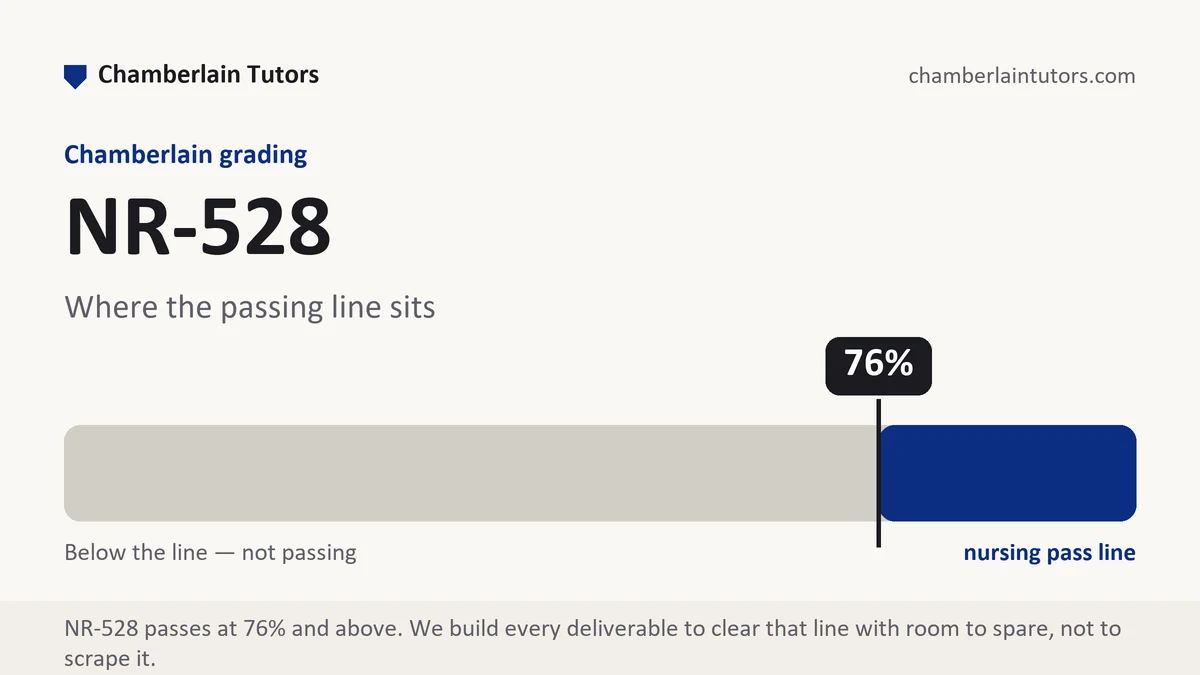
Core nursing courses pass at 76 percent, and where a track uses the nurse practitioner specialty scale, which has no C band, the last passing number is 84. Project courses concentrate risk in a different way from content courses: if the change you chose in week one is too vague to plan, every later deliverable inherits the vagueness.
Two eight week sessions sit inside each sixteen week semester, there are up to six starts a year, deliverables land weekly, and no supplementary work can repair a weighted average. Spend the first week choosing a change narrow enough to have a measurable outcome, even if that feels like a small ambition, because a small change fully planned outscores a large one sketched.
Turn the criterion rows into a section plan
Copy the rows into a blank file in printed order and reduce each to its verb: assess, select, plan, engage, evaluate. Those verbs become your headings in the guide's own sequence, which keeps the document from drifting into the shape of a persuasive essay.
Now price them. Suppose the assignment caps you at 1,700 words with four rows weighted 45, 25, 20 and 10 percent, giving roughly 765 words, 425, 340 and 170. A single row worth 765 words is a strong instruction: that row is usually the change plan itself, and it needs steps, owners, sequence and timing rather than three paragraphs of intention. The 170 word row, often a reflection or a conclusion, is one paragraph. Writing it at four times its budget is the most common way students overrun a change assignment and then thin the plan to compensate.
Keep each target beside its heading while drafting. Title page and references sit outside the count unless your guide says otherwise, and an implementation timeline table usually does as well, which is where the step detail belongs.
The shape of a change proposal
Most graded writing here is a proposal to change something, presented with a model and a measurement plan. Each part below is one a reviewer of a real proposal would look for first.
| Part | What it has to establish | How the thin version reads |
|---|---|---|
| Current state, in detail | What happens now, how often, and what it costs in time, risk or outcome, with data where you have it. | One sentence asserting that the current process is inefficient. |
| The evidence for the alternative | What has been tried elsewhere, in what setting, with what design and what result. | A claim that best practice supports the change. |
| The model, applied | A named change framework whose stages determine your sequence, not just your headings. | A model summarized in a paragraph and then ignored. |
| Stakeholders and losses | Who must act, who must approve, and who gives up time, autonomy or convenience. | A stakeholder list with no mention of what anyone loses. |
| The plan with sequence | Steps in order, each with an owner and a timeframe, including what happens first and why. | A set of activities with no order and no owners. |
| Evaluation and sustainment | The outcome measure, the process measure, the baseline, and what holds the change in place afterwards. | A promise to monitor progress and adjust as needed. |
Evidence and citation craft in change work
Change literature is unusually easy to cite badly, because improvement reports read like trials and are not.
- Currency, with the reason visible. Change models are old on purpose and remain usable, and the sentence should say why. Implementation results, adoption figures and cost estimates older than five years need a stated justification or a newer source.
- Cite the primary report, not the summary of it. Where an article states that an intervention worked elsewhere, follow it to the report that describes the setting, because the setting is what determines whether it transfers to yours.
- Design and setting before the result. Write that a single site before and after evaluation on a 32 bed unit measured an outcome for six months either side of a change, then the finding. Improvement reports without their setting attached are not evidence for anything.
- Verbs the design can pay for. Before and after work cannot separate the change from everything else happening that year. The rate fell after implementation is honest. The change reduced the rate is a counterfactual claim that design cannot supply, and this course grades that distinction directly.
- Denominator and window on every rate. Write that 34 events occurred across 5,200 patient days in the six months before the change, rather than quoting a rate alone, and make sure the after period uses a comparable base. Comparing two rates built on different denominators is the most common analytic error in change proposals.
The gap between a passing proposal and a strong one
A passing NR-528 proposal identifies a genuine problem, cites evidence for a better way, names a change model and plans some activities. Nothing is wrong with it. What is missing is friction: no one in it objects, nothing costs anything, and the plan would work in a building with no other pressures.
Strong proposals are specific about who pays. They name the group whose work increases, say by how much, and build that into the plan rather than around it. They put the sequence under the model's control, so the reader can see why engagement precedes training and why a pilot precedes a policy. And they answer the sustainment question honestly, because most changes survive for eight weeks and then decay, and naming what would hold this one in place is the paragraph that separates a graduate proposal from an enthusiastic one.
Six mistakes that cost points here
- A change too big to plan. Transform the culture is not a project. Change one process, on one unit, with one measure.
- Model as decoration. If the framework does not determine your sequence, the justification row scores in the middle.
- Resistance framed as ignorance. People resist because something is being taken from them. Name it, or the stakeholder row is unfed.
- No baseline. Without a current measurement, no later measurement can show anything, and the evaluation row collapses.
- Education as the whole intervention. Training alone rarely changes behaviour and graders in this course know it. Change the process, the default or the accountability as well.
- Posting to the board from the text box. Chamberlain posts do not reopen once submitted. Draft elsewhere, check the citation, then paste.
Questions NR-528 students ask
How small can my change be before it looks unambitious?
What do I do if my organization has no data on the problem?
Which change model should I use?
The weeks, one by one
Week 1
NR-528 Week 1 is where the whole session is quietly decided, because a change course starts by making you choose the thing you will change, and every later deliverable inherits that choice. Read the full Week 1 manual.
Week 2
NR-528 Week 2 turns from the problem to the literature that might fix it: finding what has been tried elsewhere, weighing how good each report actually is, and building the case that one approach deserves your setting's next eight weeks. Read the full Week 2 manual.
Week 3
NR-528 Week 3 hands you the theory shelf: the change models that explain why some improvements take and most decay, and the assignment of choosing one and making it drive your project. Read the full Week 3 manual.
Week 4
NR-528 Week 4 maps the people: who must act for your change to happen, who must approve it, who absorbs its costs, and who can quietly kill it. Read the full Week 4 manual.
Week 5
NR-528 Week 5 converts everything so far into a plan someone could actually run: steps in order, each with an owner, a timeframe and a resource cost, arranged so the dependencies are visible. Read the full Week 5 manual.
Week 6
NR-528 Week 6 shrinks the change to a size where failure is affordable: the pilot, one unit or one shift or one month, run to learn rather than to prove. Read the full Week 6 manual.
Week 7
NR-528 Week 7 asks the question the whole project has been building toward: how will anyone know the change worked? Read the full Week 7 manual.
Week 8
NR-528 Week 8 asks the question most change projects never answer: what holds the improvement in place after the attention moves on? Read the full Week 8 manual.
Where NR-528 sits in Chamberlain's programs
Open the exact program map for sequence, credit, and option context. The current student schedule and syllabus remain authoritative after transfer evaluation, electives, state rules, and approved plan changes.