NR-528 Week 8 asks the question most change projects never answer: what holds the improvement in place after the attention moves on? The closing territory is sustainment, the structures that keep the practice running, spread, the disciplined extension to new units, and dissemination, telling the result honestly to audiences who can use it. Your section may print this as NR 528 or NR528; it is the same course. Chamberlain publishes no syllabi outside Canvas. The placement here is our teaching judgment from the course's catalog arc; your section's rubric decides what your week actually asks.
What NR-528 Week 8 asks for
Improvements decay. The pattern is reliable enough to plan around: performance climbs while the project team watches, plateaus when the watching stops, and slides back toward baseline as staff turn over, competing priorities arrive and the old workflow reasserts itself, because the old workflow is usually still the easier one. Sustainment territory asks you to treat that decay as an engineering problem. The graded question is what, structurally, will hold the practice in place when no one is championing it: the policy that makes it the documented standard, the orientation content that teaches it to every new hire, the recurring audit with an owner and a feedback path, the supply or system default that makes the new way the path of least resistance, and the named role, not the named person, that owns the measure after the project closes.
Spread is a different discipline from sustainment, and closing weeks reward students who keep them apart. Spreading a practice to new units is not copying the pilot everywhere at once; it is sequencing, adapting and re-measuring. Each receiving unit differs in load, staffing and culture, so the spread plan states what about the practice is fixed, the core that made it work, and what is adaptable, the local fitting, then sequences units deliberately and carries the measurement apparatus along, because a practice that spreads without its measures spreads on reputation.
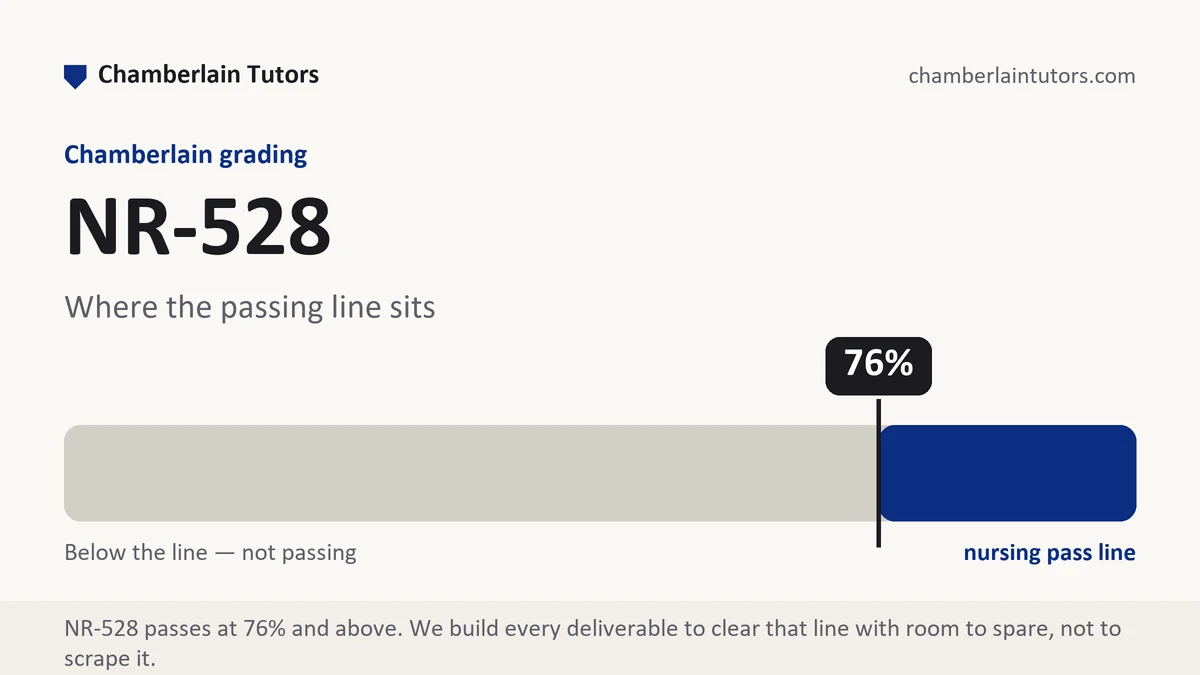
Dissemination closes the loop with the wider profession, and its craft is honesty at the right altitude: an internal audience needs the operational detail, a poster or manuscript audience needs the design, the numbers with their boundaries, and the limits stated plainly. Expect your week's guide to ask which audiences, which channels and what message, and expect the writing rows to be at full strictness in a final deliverable. The 76 percent floor on core courses settles its account this week, and on nurse practitioner specialty tracks the no-C scale makes anything below 84 a failing result, so the closing paper carries real arithmetic weight. If your section runs a discussion this week, Canvas posts remain uneditable once submitted, and a final-week post is the last impression your grader gets before the gradebook closes.
The NR-528 Week 8 method, step by step
Six moves that turn a finished project into a held gain.
-
Read your week's rubric for the three territories' weights
Closing guides split among sustainment, spread and dissemination unevenly. Find where the points sit before allocating words, because a beautiful poster plan cannot repay an empty sustainment section.
-
Name the decay forces your specific gain faces
Turnover, float staff, the workaround's convenience, seasonal load, the next initiative's arrival. One paragraph, specific to your unit. Sustainment structures chosen without named decay forces are ornaments; chosen against them, they are answers.
-
Match one holding structure to each decay force
Turnover gets orientation content; drift gets the recurring audit with a feedback path; the workaround gets a default changed so the new way is easier; the attention shift gets a named owning role with the measure in its routine. The matching is the analysis.
-
Split the practice into fixed core and adaptable fitting
State what must transfer unchanged for the mechanism to work, and what each receiving unit may localize. This one distinction prevents both failure modes of spread: rigid copying and dilution to nothing.
-
Sequence the spread and carry the measures
Order the receiving units by readiness and resemblance, give each a start, a local owner and the same three measures your evaluation used, and state the rule for pausing spread if a unit's numbers do not hold.
-
Build the dissemination messages by audience
Internal leadership gets the result, the cost and the ask; the unit gets credit and the sustained expectation; an external audience gets design, numbers, limits. Three messages, each honest, none identical, each with its channel named.
A layout and word budget for a sustainment and dissemination plan
This is the frame our tutors keep beside closing project work, sized for roughly 1,200 to 1,500 words. It is a tutor's scaffold rather than anything the university issues, and your week's rubric outranks it wherever the two disagree. Scale the targets proportionally if your assigned length differs.
| Section | What belongs in it | Word target |
|---|---|---|
| The gain and its decay forces | What improved, by how much against baseline, and the specific forces in your setting that will erode it. | 160 to 200 |
| Holding structures, matched | Each decay force paired with the structure that answers it: policy, orientation, audit, default, owning role. | 260 to 310 |
| Ownership after the project | The role that owns the measure, where it appears in that role's routine, and the path a slipping number travels. | 140 to 170 |
| Spread: core and fitting | What transfers unchanged and why, what localizes, and the readiness-ordered sequence of receiving units. | 220 to 260 |
| Spread measurement and pause rule | The measures each unit carries, who reads them, and what pauses further spread. | 130 to 160 |
| Dissemination by audience | The three messages, their channels, and the limits each audience is owed, stated without inflation. | 180 to 220 |
Evidence craft for sustainment and dissemination writing
Decay has a literature, and citing it turns worry into analysis. Studies following improvements past their project periods report how often and how fast gains erode, in named settings. Anchoring your decay paragraph there, with the settings attached, makes the sustainment section evidence-based rather than anxious.
Sustainability claims about structures deserve the same verb discipline as everything else. Evidence that audit-and-feedback or orientation content preserves practice comes mostly from observational and improvement work, so write supports and is associated with rather than guarantees. The course's verb standard does not retire in the final week.
Dissemination reporting has conventions, and following them is the honesty. Improvement reporting frameworks exist precisely so audiences can judge what a project's numbers mean; presenting your before-and-after with its design named, its denominators visible and its limits stated is the convention, and every simplification toward a cleaner story is a step toward a claim you did not earn.
Internal data leaves the building only as your organization permits. A poster or manuscript built on unit data needs whatever review your organization requires before anything external, and your dissemination plan should include that step by name. A plan that ships internal numbers outward without the clearance step has a compliance gap where its final milestone should be.
Five mistakes that cost points in this week's territory
- Sustainment as a promise to monitor. Ongoing monitoring with no owner, cadence or feedback path is the intention this territory exists to replace. Name the role, the routine and what happens when the number slips.
- Spread as simultaneous rollout. Everywhere at once abandons sequencing, adaptation and measurement in one move, and it is the single fastest way to fail three rubric rows in one sentence.
- The person instead of the role. A plan sustained by a named enthusiast dissolves with one resignation. Structures outlive people; assign the role.
- Results inflated for the poster. The dissemination version with the caveats sanded off will be read against your own evaluation section, and the gap between them costs credibility in both.
- The closing paper started in the closing week. Final deliverables land in the same days as every other course's finals, and a sustainment plan drafted at midnight reads like one. Start it in week seven and let week eight be revision.
Before you submit
- Every decay force named is matched by a holding structure
- The owning role, its routine and the feedback path are explicit
- Fixed core and adaptable fitting are kept separate for spread
- Each receiving unit carries the measures and a pause rule exists
- All three audience messages are honest against your own evaluation
- The external step includes your organization's clearance by name
Closing NR-528 this week?
Send the instructions and the rubric out of Canvas. A premium original draft comes back in 24 to 48 hours with the gain engineered to hold, and revisions run until the grade lands.