NR-528 Week 5 converts everything so far into a plan someone could actually run: steps in order, each with an owner, a timeframe and a resource cost, arranged so the dependencies are visible. The graded skill is specificity under sequence, and the difference between a plan and a list of intentions is that a plan says who does what by when, and what must finish first. Your section may print this as NR 528 or NR528; it is the same course. Chamberlain publishes no syllabi outside Canvas. The placement here is our teaching judgment from the course's catalog arc; your section's rubric decides what your week actually asks.
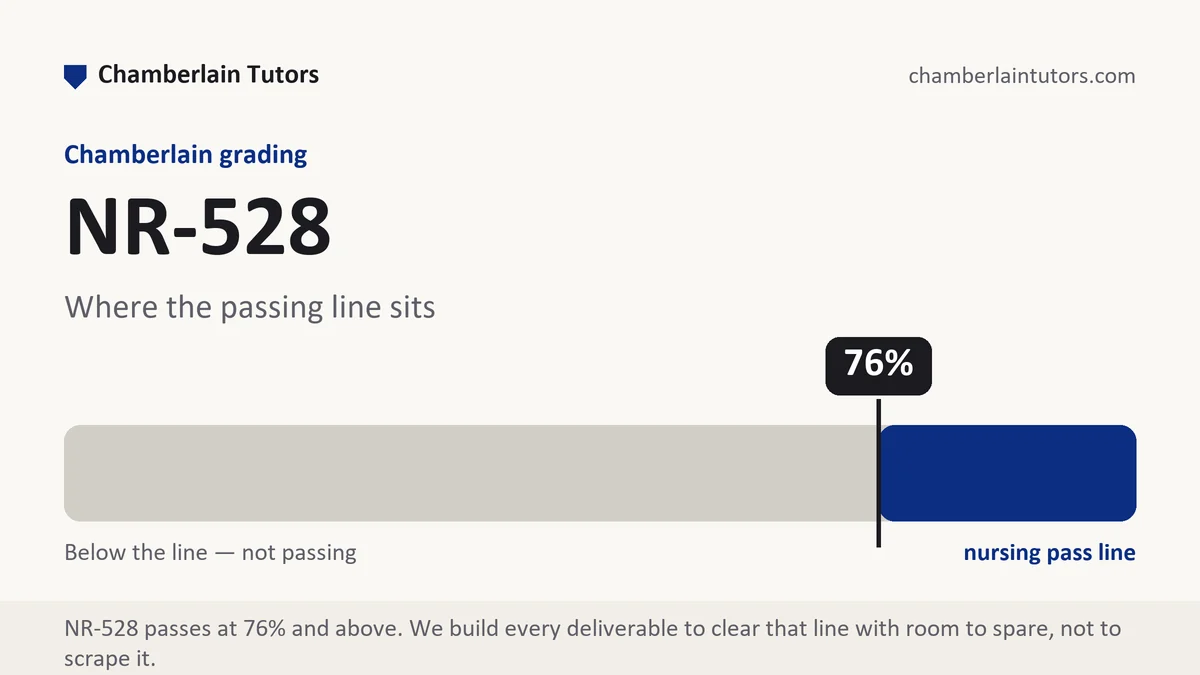
What NR-528 Week 5 asks for
Planning territory is where a change course stops rewarding vision and starts rewarding logistics. The deliverable is usually an implementation plan with a timeline artifact, and its quality is measured by whether a stranger with your unit's resources could execute it. That standard decides everything. Every step needs a verb someone can perform, an owner named as a role, a duration or date range, and a position in the order that respects what depends on what. Approval before purchase, materials before education, education before launch, and the engagement moves from your stakeholder work threaded through at the points your change model dictates.
Dependencies are the intellectual content of a timeline. A list of activities all starting at once is a wish; a sequence where step four cannot begin until step two produces its output is a plan, and drawing that chain forces the thinking this week grades. So does resourcing. Every step consumes something, hours from named roles, replacement coverage while people learn, materials, printing, a license, and a plan that costs nothing is a plan that has not been priced. Expect a row about resources or budget, and expect honesty to score better than optimism: education hours multiplied by staff count at replacement rates is a real number your instructor can check the shape of.
The timeline artifact itself, a table or simple chart, is usually required and always worth doing properly, because it externalizes the reasoning: a reader should see the whole project's shape in it, the dependencies, the parallel tracks, the milestone where the change goes live, and the measurement points your evaluation will need. If your section runs a discussion this week, posting a defensible fragment of your timeline for critique is the natural shape, and Canvas posts cannot be edited once submitted.
The NR-528 Week 5 method, step by step
Six moves that turn a proposal into an executable sequence.
-
Extract the plan's skeleton from your change model
The stages you applied earlier already order the project's phases. Write those phases as headers first, then plan inside them, so the sequence argument you made in the model week is visibly kept rather than quietly dropped.
-
Decompose each phase into performable steps
A step is one verb, one owner, one output: draft the audit form, brief the night shift, obtain manager sign-off. If a step needs a paragraph to explain, it is a phase wearing a step's name; split it until each line is executable.
-
Assign every step an owner by role
Roles, not names, and never you for everything. A plan where the project lead personally performs education, data collection and follow-up is a plan that dies when its author has a hard week, and graders read ownership spread as feasibility.
-
Chain the dependencies before setting any dates
For each step, name what must exist before it can start. The chain exposes the real critical path, and dates assigned before dependencies are chained are decoration that will not survive contact with the first delay.
-
Price the plan in hours and materials
For each step with a cost, estimate it: role hours, coverage, supplies. State your assumptions beside each estimate, ten nurses, thirty minutes each, at replacement coverage, so the arithmetic is checkable even where the inputs are estimates.
-
Build the timeline artifact and walk it as a stranger
Lay the steps against weeks, mark milestones and measurement points, then read it cold: can each step start when the chart says, given what finishes before it? The walk finds the impossible weeks before your grader does.
A layout and word budget for an implementation plan
This is the frame our tutors keep beside planning work, sized for roughly 1,100 to 1,400 words plus the timeline artifact. It is a tutor's scaffold rather than anything the university issues, and your week's rubric outranks it wherever the two disagree. Scale the targets proportionally if your assigned length differs.
| Section | What belongs in it | Word target |
|---|---|---|
| The change and its phases | What is being implemented and the phase structure your model produced, in one orienting pass. | 110 to 140 |
| The steps, phase by phase | Each phase decomposed into owned, dated, performable steps with outputs named. | 320 to 380 |
| The dependency argument | The chains that order the steps, and the critical path the chains reveal, argued rather than implied. | 170 to 210 |
| Resources and cost | Hours, coverage and materials per costed step, with assumptions stated beside each estimate. | 180 to 220 |
| Risks and slack | The two or three most likely delays, what each would push, and where the plan absorbs them. | 150 to 190 |
| The timeline, presented | The artifact introduced and read aloud in prose: shape, milestones, measurement points, go-live. | 120 to 150 |
Evidence craft for planning and feasibility writing
Duration claims borrow best from reported projects. How long education, piloting and adoption actually took in published implementations is citable planning evidence, with the setting attached. Estimates anchored to a reported project read as researched; bare confident durations read as hope.
Cost figures age and localize, so date and place them. Any dollar figure borrowed from the literature carries its year and setting in the sentence, because prices move and settings differ. Where you localize a figure, show the adjustment as arithmetic a reader can follow.
Your own estimates are legitimate evidence when the assumptions are visible. Staff counts, minutes per task and coverage rates from your setting are the right inputs for your plan. State each assumption where it is used, and the estimate becomes checkable; bury them, and the same number becomes assertion.
Feasibility claims from vendors and program materials are advocacy. Implementation guides published by the makers of tools and programs systematically underestimate burden. Use them for step lists, not for durations or costs, and say what kind of source they are when they appear.
Five mistakes that cost points in this week's territory
- Activities without owners. Education will be provided and data will be collected are sentences hiding an empty column. Every passive verb in a plan is a step nobody has agreed to do.
- Everything starting at once. A timeline with no dependencies is a list wearing a chart's clothes, and it announces that the sequencing thought has not happened.
- The heroic week. Somewhere in most drafts is a week where approval, education and go-live all occur. Find yours and split it, because your grader will find it if you do not.
- A costless plan. Zero hours, zero coverage, zero materials reads not as efficiency but as unfamiliarity with implementation, and the feasibility rows price it accordingly.
- The project lead does everything. Ownership concentrated in the author is the most common feasibility flaw in student plans, and it contradicts the stakeholder work the course just made you do.
Before you submit
- Every step has a verb, an owner-role, a timeframe and an output
- Dependencies are chained and the critical path is named
- Each costed step shows its assumptions beside its estimate
- Engagement moves from your stakeholder analysis appear at their sequenced points
- The timeline artifact shows milestones and measurement points
- No week in the chart requires two things that cannot coexist
In NR-528 Week 5 right now?
Send the instructions and the rubric out of Canvas. A premium original draft comes back in 24 to 48 hours with owners, chains and honest costs, and revisions run until the grade lands.