NR-528 Week 6 shrinks the change to a size where failure is affordable: the pilot, one unit or one shift or one month, run to learn rather than to prove. The graded skills are pilot design, deciding what small still means real, and barrier response, what you do in the live weeks when the plan meets the building. Your section may print this as NR 528 or NR528; it is the same course. Chamberlain publishes no syllabi outside Canvas. The placement here is our teaching judgment from the course's catalog arc; your section's rubric decides what your week actually asks.
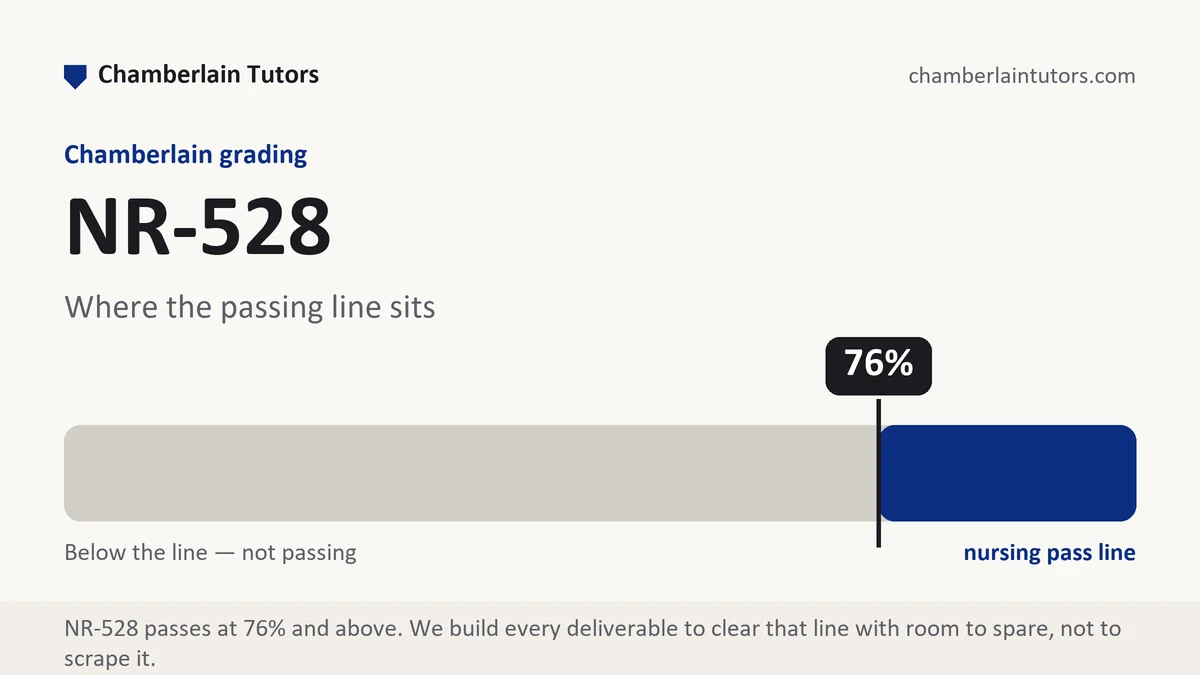
What NR-528 Week 6 asks for
A pilot is an experiment wearing work clothes, and pilot territory grades whether you understand both halves of that sentence. The experiment half demands design decisions made before launch: the scope, small enough to supervise and cheap to stop, big enough that the result means something; the duration, long enough to see the practice under normal load, short enough to hold attention; the learning questions, written down in advance, because a pilot that does not know what it is asking cannot answer anything. The work half demands operational honesty: who actually performs the new practice during the pilot, who watches, who collects, and what the covering arrangements are when the champion is off shift.
Stop and adapt criteria are the design decisions that separate graduate work from enthusiasm. Before launch, the plan should say what result or event would pause the pilot, what signal would trigger an adjustment, and what an adjustment is allowed to touch, because changing several elements at once mid-pilot destroys the ability to say what worked. A pilot plan with explicit criteria reads as someone prepared to learn; one without them reads as a small launch that will be declared a success regardless, and graders in this territory have seen many of those.
Barriers are the week's other subject, and the expectation is response, not just anticipation. Early implementation reliably produces a familiar set: the workaround that reappears under pressure, the education that did not reach the weekend staff, the data collection that quietly stops by day ten. Written work here usually wants each likely barrier paired with a concrete response and an owner, and it wants the responses proportionate, an adjustment to the process where the process is the problem, a conversation where engagement is the problem, rather than one answer applied to everything. If your section runs a discussion this week, one barrier analyzed to its mechanism beats five listed, and Canvas posts cannot be edited once submitted.
The NR-528 Week 6 method, step by step
Six moves that turn a launch into a designed pilot.
-
Size the pilot from your week's rubric and your project's risk
The guide's feasibility language tells you what scale it expects. Within that, choose the smallest scope that still exercises the practice under real conditions: one unit, one shift band, a few weeks is the classic shape for unit-level change.
-
Write the learning questions before anything else
Three or four, in plain words: does the practice fit the workflow, do the intended people actually perform it, does the early signal move in the right direction, what does it really cost per shift. Every later design choice must serve these questions.
-
Choose the pilot population and say why it generalizes
The pilot site should resemble the eventual rollout sites in the ways that matter, load, staffing pattern, patient mix, and your paper should argue that resemblance. A pilot on the easiest unit answers a question nobody asked.
-
Set the watch: who observes, what gets counted, how often
Assign observation and collection to named roles with a cadence, daily tallies, a mid-pilot check, an end review. Data that depends on everyone remembering is data that stops by the second week, so build the counting into an existing routine.
-
Fix the stop and adapt criteria in writing
What pauses the pilot, what triggers an adjustment, and the rule that only one element changes at a time, with each adjustment dated and noted. This paragraph is the difference between a pilot and a hopeful launch, and it is the one graders quote.
-
Pair each likely barrier with a proportionate, owned response
Take the three barriers your setting is most likely to produce, name each one's mechanism, and assign a response that matches it, plus the person who executes the response. Generic vigilance is not a response; a second briefing for the weekend staff is.
A layout and word budget for a pilot and barrier plan
This is the frame our tutors keep beside pilot work, sized for roughly 1,100 to 1,400 words. It is a tutor's scaffold rather than anything the university issues, and your week's rubric outranks it wherever the two disagree. Scale the targets proportionally if your assigned length differs.
| Section | What belongs in it | Word target |
|---|---|---|
| The pilot's purpose | The learning questions, written as questions, and what answering them buys the wider project. | 120 to 150 |
| Scope and site | Where, how long, who participates, and the argument that this site resembles the rollout targets. | 180 to 220 |
| Operations during the pilot | Who performs, who observes, who collects, at what cadence, with coverage for off-shifts named. | 200 to 240 |
| Stop and adapt criteria | What pauses the pilot, what triggers change, the one-element rule, and how adjustments get recorded. | 160 to 200 |
| Barriers and responses | The three most likely barriers, each with its mechanism, its proportionate response and its owner. | 240 to 280 |
| The decision at the end | How pilot results convert into a go, adjust or stop recommendation, and who receives it. | 110 to 140 |
Evidence craft for pilot and early-result writing
Small numbers forbid big verbs. A pilot produces counts in the dozens, and dozens support observed and suggested, not demonstrated and proved. Writing pilot arithmetic with trial vocabulary is the fastest way to show a grader the measurement lesson has not landed.
Report the denominator's story, not just its size. Fifteen of twenty observed handoffs means one thing if the twenty were consecutive and another if they were the twenty someone happened to see. Say how the observations were sampled, because in small data the sampling is most of the meaning.
Early trends are fragile, and the sentence should carry the fragility. Two good weeks can be the practice working or the attention working, and a pilot cannot tell them apart. State the alternative explanation alongside the hopeful reading; the pairing is what graduate interpretation looks like at this scale.
Published pilot studies are precedents for design, not for results. Cite reported pilots for their scope choices, durations and collection methods, which transfer, rather than for their outcomes, which belong to their settings. A design justified by precedent reads as researched; a result promised by precedent reads as borrowed.
Five mistakes that cost points in this week's territory
- A pilot that is just the rollout, smaller. If nothing is being asked, watched or allowed to fail, it is not a pilot, and the missing learning questions are visible from the first paragraph.
- No stop criteria. A pilot that cannot be paused was never an experiment, and its success was decided before launch, which graders in this territory read instantly.
- Changing three things at once mid-pilot. Each adjustment beyond the first destroys attribution, and the one-element rule exists precisely because live projects tempt everyone to tinker.
- Data collection with no owner. Everyone will track it means the tally stops by day ten. Collection built into one role's existing routine survives; collection added to everyone's goodwill does not.
- Barrier lists without mechanisms. Staff resistance and time constraints, listed and left, are categories. The scored material is the mechanism in your setting and the response sized to it.
Before you submit
- The learning questions are written as questions, before the design
- The pilot site's resemblance to rollout sites is argued
- Observation and collection have owners, cadence and off-shift coverage
- Stop and adapt criteria exist, with the one-element rule stated
- Each barrier has a mechanism, a proportionate response and an owner
- The end-of-pilot decision path names who decides and on what
In NR-528 Week 6 right now?
Send the instructions and the rubric out of Canvas. A premium original draft comes back in 24 to 48 hours with the pilot designed to learn, and revisions run until the grade lands.