NR-509 Week 3 typically brings the head, eyes, ears, nose, throat and neck: the most instrument-dense stop on the exam, where the otoscope and ophthalmoscope enter the record and dozens of small structures each expect a line. The write-up is graded on whether every structure you claim to have examined leaves a specific trace, in standard terms, in standard order. Your section may print this as NR 509 or NR509; it is the same course.
Chamberlain publishes no syllabi outside Canvas. The placement here is our teaching judgment from the course's catalog arc; your section's rubric decides what your week actually asks.
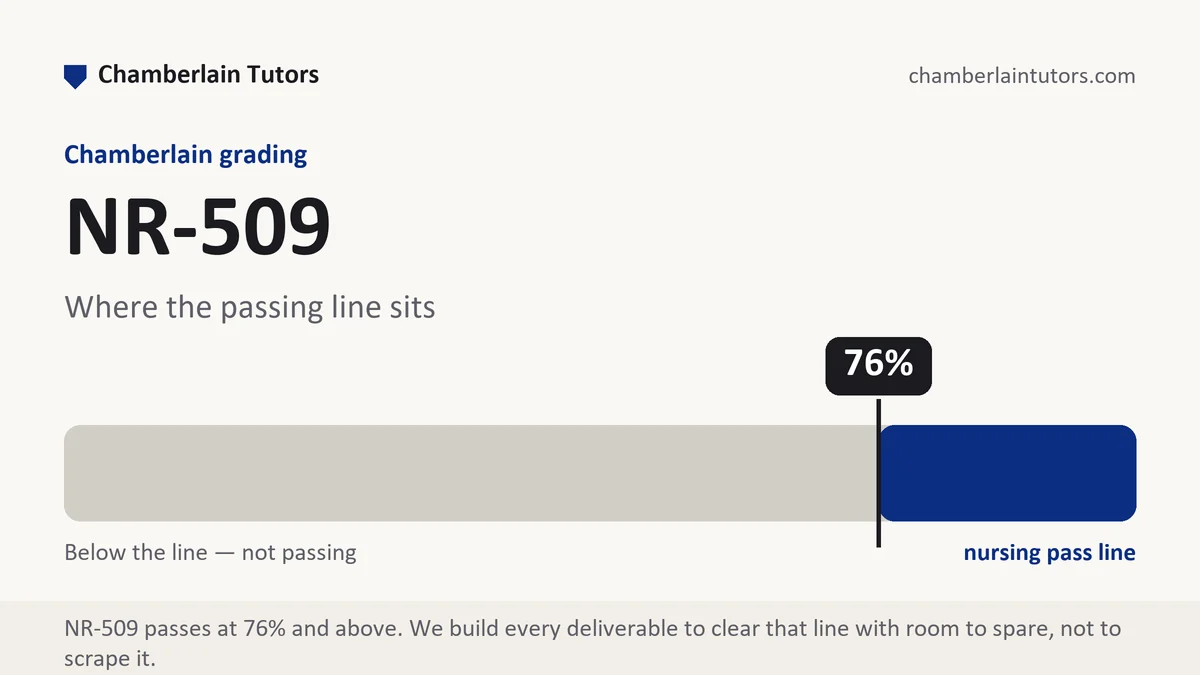
What NR-509 Week 3 asks for
After the surface systems establish descriptive habits, the arc climbs to the regional exams, and the head and neck region comes first in nearly every telling of this discipline: it follows the top-down convention the comprehensive exam will later use, and it introduces instruments while the course still has weeks left to drill them across its roughly 25 lab hours. That is why our judgment places it here, in the front half of an 8-week session.
Expect the deliverable as a regional write-up or a focused episodic note built around a head-and-neck concern, with the encounter real, recorded or virtual depending on how your section runs its lab time. Your week's rubric decides whether history rows ride along; a focused note usually wants a short, targeted subjective block before the regional exam, so read the rows before assuming this week is objective-only.
The regional exams are also where documentation volume jumps. Six subregions, each with inspection and instrument findings, means the write-up can double in length while the deadline stays the same, a scheduling fact worth respecting on a scale where 84 is the line and late-session recovery room is thin.
The NR-509 Week 3 method, step by step
Six moves for a region with many small rooms.
-
Assign every rubric row a subregion
Head and face, eyes, ears, nose and sinuses, mouth and throat, neck with thyroid and lymph nodes. Rows that name none of these are usually grading terminology or organization, and they are answered by how you write, not what you find.
-
Target the history to the region
If a subjective block is asked for, take it narrow: vision change, hearing change, pain, discharge, congestion, voice change, swallowing, lumps. Regional notes reward a history that already points at one subregion.
-
Document the eye in its testing order
Acuity with correction status, visual fields, external structures, pupils with the light responses actually tested, extraocular movements, then the ophthalmoscopic view with the red reflex and what of the fundus you visualized. Claim only the depth you reached.
-
Take the ear from outside in
External ear and tenderness, canal condition, then the tympanic membrane with its color, position and landmarks, then hearing as actually screened. The membrane deserves a full sentence; "intact" alone is a missed row.
-
Cover nose, sinuses, mouth and throat without shortcuts
Patency, mucosa and septum; sinus tenderness if pressed; then lips, teeth, gums, tongue, palate, tonsils with a grade if enlarged, and the pharynx. Small structures, one clause each, none skipped silently.
-
Close at the neck with chains and lobes
Range of motion, tracheal position, thyroid by lobe and isthmus, and lymph nodes by named chain with size, consistency and mobility for anything palpable. Nodes without chains is the classic lost point of this region.
A structure for the regional write-up
Desk planning lengths for an 800 to 1,000 word regional note, not Chamberlain numbers; let your rubric's weights redistribute them.
| Subregion | What the record needs | Suggested length |
|---|---|---|
| Focused history | Regional symptoms interrogated, with the negatives that narrow toward one subregion. | 120-160 words |
| Head and face | Skull and scalp, facial symmetry, temporal arteries, temporomandibular joint if assessed. | 60-90 words |
| Eyes | Acuity, fields, external structures, pupillary responses, movements, and the ophthalmoscopic findings to the depth visualized. | 140-180 words |
| Ears | External ear, canal, tympanic membrane with landmarks, hearing screen result. | 100-140 words |
| Nose, sinuses, mouth, throat | Patency, mucosa, septum, sinus tenderness, dentition, tongue, palate, tonsils, pharynx. | 120-160 words |
| Neck, thyroid, lymphatics | Motion, trachea, thyroid by lobe, nodes by chain with the empty chains named. | 120-160 words |
Evidence and citation craft for instrument findings
Quote test characteristics with their comparator. Bedside screens of hearing and vision have measured accuracy, and citing one means naming what it was compared against and in whom. A whispered-voice screen validated in older adults is evidence about older adults, and saying so is the graded move.
Anchor instrument norms to a source. The colors, angles and landmarks of a healthy tympanic membrane are published, not folklore. When your write-up calls a view normal, a citation to the standard you compared against turns opinion into measurement.
Let screening claims come from screening bodies. Statements about when vision or hearing should be checked belong to named organizations with dates, and recommendations differ by age band. Attributing a screening interval to the body that issued it, current within five years, is worth more than three textbook citations.
Size your verbs to a bedside exam. An otoscopic view suggests; it rarely establishes. Reserve firm verbs for findings a bedside instrument can actually settle, and let the write-up say when confirmation would need referral or testing.
Five mistakes that cost points in HEENT territory
- Acronym findings with no exam behind them. Writing the pupil acronym while documenting no light response, near response or accommodation testing tells the grader the phrase came from habit, not examination.
- The ophthalmoscopic exam that vanishes. If the fundus was not visualized, write that, with why. Silence reads as skipped; an honest limited view reads as clinical integrity and usually keeps the row.
- A tympanic membrane called intact and nothing else. Color, position and the visible landmarks are the finding. One adjective spends a whole subregion.
- Lymph nodes without chains. "No lymphadenopathy" is unbounded. Name the chains palpated and call them free of palpable nodes, so the negative has edges a grader can credit.
- Acuity recorded without correction status. The same fraction means different things with and without lenses, and omitting which was tested makes the number unusable and ungradeable.
Submission check for the regional note
- Each of the six subregions leaves at least one specific, examined trace
- Acuity includes correction status; pupils include which responses were tested
- The tympanic membrane has color, position and landmarks or an honest limited view
- Tonsils carry a size grade if enlarged, and the pharynx has its own clause
- Thyroid findings are by lobe; nodes are by named chain, including the clear ones
- Every claim of normal names the structure examined, not the region in bulk
Buried in small structures?
Send your rubric and the encounter. A HEENT and neck write-up with every subregion documented to depth comes back in 24 to 48 hours, floor-checked. The first sample costs nothing.