NR-509 Week 8 closes the arc with synthesis: the complete note, subjective through plan, where the history you learned in week one and the exams you built since finally argue for a ranked differential and a defensible plan. Whatever label your section gives the closing deliverable, its grading center is traceability, every diagnosis pointing back at findings, every plan element pointing back at a diagnosis. Your section may print this as NR 509 or NR509; it is the same course.
Chamberlain publishes no syllabi outside Canvas. The placement here is our teaching judgment from the course's catalog arc; your section's rubric decides what your week actually asks.
What NR-509 Week 8 asks for
Final weeks in an assessment course convert skills into judgment. Having examined by region and integrated by sequence, the course's last written act is usually a full clinical note on a complete encounter: subjective database, objective record, an assessment that ranks competing explanations, and a plan that follows from the ranking. Our judgment says week eight carries it because that is where the catalog's across-the-lifespan promise cashes out: the note must adapt to whoever the patient is, whatever their age.
Your week's rubric may deliver this as one large write-up, a capstone-style encounter with documentation, or a shorter note plus reflection; the shapes vary by section and the rubric is the only source that settles it. What rarely varies is where the points sit: the assessment and plan sections, the ones this course has been building toward, tend to carry the weight, and the write-up that treats them as an afterthought has misread the week.
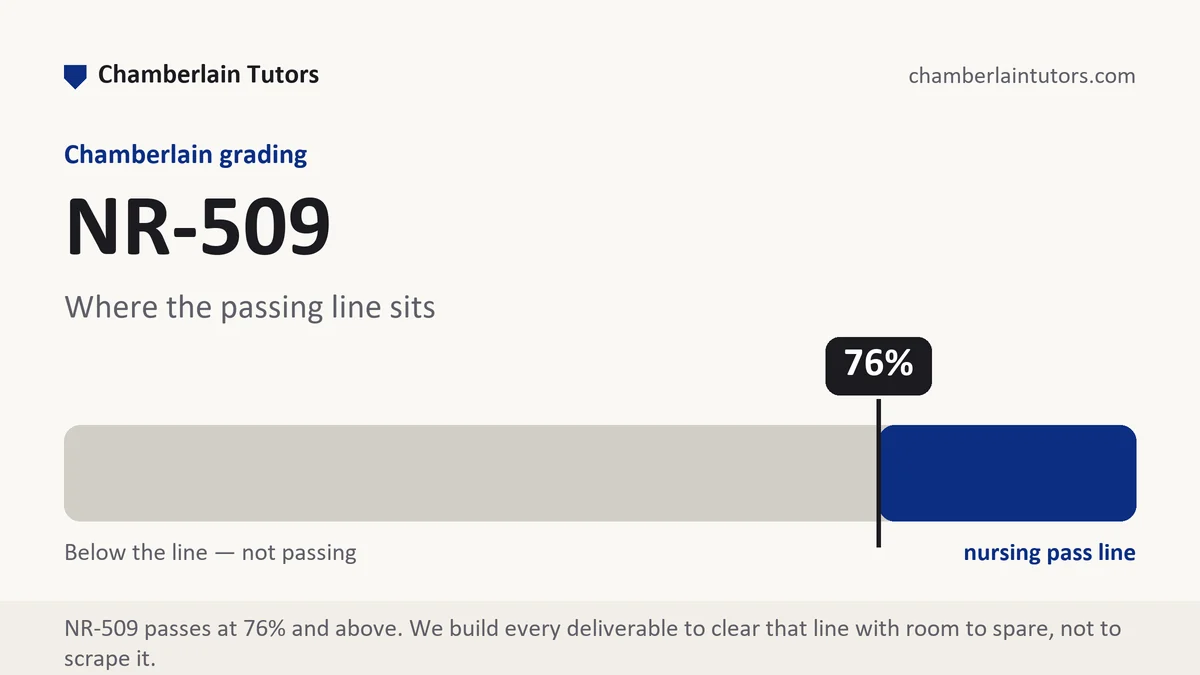
The session math closes here too. On the specialty scale, 84 is the last passing number, and by the final week the gradebook leaves no room for averaging your way out. If the recorded check-off or immersion still sits ahead of you on your section's calendar, rehearsal continues alongside the writing; pass/fail events do not respect deadlines for written work.
The NR-509 Week 8 method, step by step
Six moves from encounter to argument.
-
Give each rubric row a home in the note
Before drafting, assign every row to subjective, objective, assessment or plan. Rows about safety, education or follow-up almost always live in the plan, and they are the ones orphaned when students draft by momentum.
-
Compress the subjective without losing its spine
The full history discipline from early in the course, delivered lean: quoted concern, an interrogated illness narrative, and only the fixed histories that bear on this encounter, each earning its sentence.
-
Write the objective in record order at survey depth
The relevant regional exams, in the order performed, with the located findings and bounded negatives your differential will need. Every finding your assessment cites must exist here first; write the objective knowing what the assessment will ask of it.
-
Rank at least three explanations and pay for the ranking
Each differential entry gets the finding that raises it and the finding that lowers it, from your own note. The order of the list is a claim; defend it in the text, not in your head.
-
Build the plan as consequences of the ranking
Diagnostics that would separate your top entries, treatment or referral matched to the leader, education in the patient's own reading level, and a follow-up threshold naming what should bring them back and when.
-
Read the finished note backwards
Plan to assessment, assessment to objective, objective to subjective. If each layer is predictable from the one above it, the note traces; wherever you have to guess, a link is missing and a row is leaking.
A structure for the complete note
Desk proportions for a 1,100 to 1,400 word complete note. Planning figures only, not Chamberlain requirements; your rubric's weighting overrides them wherever they disagree.
| Section | What it must accomplish | Suggested length |
|---|---|---|
| Subjective | Quoted concern, interrogated narrative, relevant histories and review of systems, nothing observed. | 240-300 words |
| Objective | Vitals with technique, then the relevant exams in performed order with located findings and bounded negatives. | 300-360 words |
| Assessment | Three or more ranked differentials, each tethered to raising and lowering findings from this note. | 260-320 words |
| Plan | Discriminating diagnostics, management for the leading diagnosis, education at patient level, follow-up threshold with a time frame. | 240-300 words |
| References | Current sources woven into the sentences above, listed per your section's format. | As required |
Evidence and citation craft for the synthesis note
Rank with epidemiology, not instinct. When two diagnoses both fit, the one more common in this age, sex and setting usually deserves the higher seat, and that claim needs a source with a denominator and a population, stated in the sentence.
Let the plan cite forward. Each diagnostic you order should carry a clause about what result would move your ranking, and management for the leading diagnosis should trace to a named guideline current within five years, with its issuing body and year in the text.
Keep finding-verbs and evidence-verbs apart. Findings support and argue against; studies report and demonstrate; guidelines recommend. A synthesis note is where these lanes blur under deadline pressure, and graders in a final week are reading precisely for that blur.
Cite the lifespan adjustment. If your patient's age changed a normal range, a screening choice or a communication approach, the source for that adjustment belongs beside it. The across-the-lifespan claim of this course is graded here, in whether your citations know how old your patient is.
Five mistakes that cost points in the synthesis week
- A differential imported from a textbook rather than built from the note. If an entry cites no finding you documented, it confesses that the list came from the diagnosis, not the patient.
- A plan that ignores its own ranking. Ordering tests unrelated to the top differentials, or treating an entry the assessment ranked low, breaks the note's spine where graders look first.
- Subjective bloat starving the assessment. Momentum drafting spends the word budget before the graded sections arrive. Budget backwards from assessment and plan, then trim the story to fit.
- Education written over the patient's head. If the teaching paragraph would not survive being spoken to the actual patient, the row asking for education remains unanswered.
- No follow-up threshold. A time frame and a named warning finding close every real clinical note; their absence in a final write-up reads as a course lesson unlearned.
The final-note audit
- Every rubric row has a traceable home in one of the four sections
- Each differential entry cites a raising and a lowering finding from this note
- Every plan element maps to a specific assessment entry
- The lifespan adjustment for this patient's age is explicit and sourced
- Follow-up names a time frame and the finding that should trigger return
- The note read backwards traces cleanly, plan to findings, with no guessed links
Final note standing between you and the finish?
Send the encounter and rubric from Canvas. A complete synthesis note, ranked, traced and floor-checked against the 84 line, returns within 24 to 48 hours. The first premium draft is free.